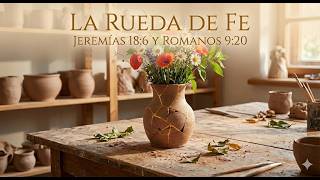
The Potter and the Clay: an Exhaustive Exegetical and Theological Analysis of the Intertextual Dynamics Between Jeremiah 18:6 and Romans 9:20
Jeremiah 18:6 • Romans 9:20
Summary: The enduring metaphor of the potter and the clay, central to Judeo-Christian scripture, serves as a primary theological framework for understanding the intricate relationship between divine sovereignty and human agency. This profound imagery is anchored by two pivotal texts: the prophetic oracle of Jeremiah 18:1–12 and the apostolic argumentation in Romans 9:19–24. Traditionally, these passages have been interpreted in distinct ways, with Jeremiah emphasizing conditional sovereignty and Paul often understood as asserting unconditional election. However, a deeper analysis reveals a complex intertextual dynamic where Paul reinterprets and expands upon Jeremiah’s message.
Jeremiah 18 presents God's sovereignty through the observation of a potter reworking a marred vessel. This sign-act illustrates God's dynamic responsiveness to the House of Israel. The passage explicitly states that God's plans for nations, whether for judgment or blessing, are contingent upon their repentance or rebellion. The clay, representing Israel, is not passive but has the capacity to "turn," thereby influencing the potter's ultimate design. This text firmly establishes a theology of conditional sovereignty, where the marring of the vessel is directly tied to the nation's sin, and God's "reworking" is His response to that moral state.
In Romans 9, the context shifts to Israel’s widespread unbelief concerning the Messiah and the inclusion of Gentiles. Paul leverages the potter metaphor to assert God’s sovereign right (*exousia*) over His creation. He asks if the potter lacks the authority to fashion "out of the same lump" (*phurama*) vessels for both honorable and dishonorable use. Unlike Jeremiah's single marred vessel being reworked, Paul depicts the simultaneous production of distinct vessels. While "vessels of mercy" are explicitly prepared by God for glory, the "vessels of wrath" are described as "prepared for destruction" with a grammatical ambiguity that allows for their self-culpability while highlighting God’s "much patience" (*makrothumia*) toward them.
The interplay between these texts reveals that Paul does not overturn Jeremiah’s logic but rather recontextualizes it to address a new stage in salvation history. The "marring" of the vessel in Jeremiah—representing Israel's sin—provides the foundation for God's right to "rework" the "lump" of historical Israel in Romans. This reshaping culminates in a new configuration of God’s people: unbelieving Israel becoming vessels of wrath, endured with patience to facilitate the ingathering of Gentiles, and the multi-ethnic Church emerging as vessels of mercy. Ultimately, this comprehensive analysis suggests that God's purpose is not a rigid determinism but a patient and sovereign pursuit of a people fit for His glory, dynamically transforming and redefining His covenant community.
1. Introduction
The metaphor of the potter and the clay constitutes one of the most enduring and evocative images within the Judeo-Christian scriptural tradition. It serves as a primary theological locus for investigating the complex interplay between divine sovereignty and human agency, the Creator’s prerogative and the creature’s responsibility. Within the biblical canon, this metaphor is anchored by two pivotal texts: the prophetic oracle of Jeremiah 18:1–12 and the apostolic argumentation in Romans 9:19–24. In the former, the prophet Jeremiah visits a potter’s house to receive a revelation concerning the fate of the House of Israel, a message deeply rooted in the historical exigencies of the impending Babylonian exile. In the latter, the Apostle Paul appropriates this imagery within his magnum opus, the Epistle to the Romans, to address the agonizing theological problem of Israel’s unbelief and the inclusion of the Gentiles in the covenant community.
The relationship between these two texts is not merely one of simple citation or allusive echo; it represents a complex hermeneutical event wherein the apostolic author reinterprets, expands, and potentially radicalizes the prophetic source to serve a distinct soteriological and historical argument. Where Jeremiah 18 explicitly delineates a theology of conditional sovereignty—where the potter’s reshaping of the vessel is contingent upon the clay’s response (repentance or rebellion)—Romans 9 has frequently been interpreted, particularly in the Western Augustinian and Reformed traditions, as establishing a theology of unconditional election and reprobation, where the clay is passive and the potter’s will is determinative and inscrutable.
However, contemporary scholarship has increasingly scrutinized this dichotomy, suggesting that Paul’s use of the metaphor is more nuanced and deeply indebted to the broader matrix of Second Temple Jewish literature (e.g., Isaiah 29, 45, 64; Wisdom of Solomon 15; Sirach 33) and the specific covenantal logic of Jeremiah itself. The interplay raises profound questions: Does Paul invert Jeremiah’s message from flexibility to fatalism? Is the "lump" (phurama) in Romans 9 the same as the "clay" (chomer) in Jeremiah 18? How does the introduction of the "vessels of wrath" and "vessels of mercy" alter the structural logic of the metaphor?
This report provides an exhaustive analysis of the interplay between these two pivotal texts. It proceeds through a rigorous exegesis of the Hebrew text of Jeremiah 18 and the Greek text of Romans 9, examining the philological, historical, and rhetorical dimensions of each. It then synthesizes the intertextual dynamics, engaging with the extensive scholarly debate regarding corporate versus individual election, the nature of divine hardening, and the rhetorical function of the diatribe. Ultimately, the analysis suggests that Paul’s appropriation of the potter-clay motif is not a negation of human agency but a radical assertion of God’s right to define the terms of the covenant and to reshape the "marred" vessel of Israel into a new configuration that includes the nations, thereby fulfilling the ultimate redemptive purpose inherent in the potter’s design.
2. Exegesis of Jeremiah 18:1–12: The Sovereign Potter and the Conditional Decree
To understand the trajectory of the potter metaphor into the New Testament, one must first anchor it in its original prophetic context. Jeremiah 18 is not an abstract treatise on metaphysics but a prophetic oracle delivered into a specific socio-political crisis.
2.1. Historical and Literary Context
The oracle is generally dated to the reign of Jehoiakim (approx. 609–598 BC), a period characterizing the twilight of the Kingdom of Judah. Following the death of the reformer King Josiah, Judah had slid back into idolatry and political vacillation between Egypt and Babylon. The "word that came to Jeremiah" (Jer 18:1) functions as a judicial warning. The metaphor of the potter is deployed to counter a prevailing theological presumption: the inviolability of Jerusalem and the Davidic covenant. The people believed that the Temple served as a talisman against destruction, effectively rendering God’s protection unconditional regardless of their ethical or cultic fidelity. Jeremiah’s visit to the potter’s house shatters this illusion of security.
The setting itself is significant. Jeremiah is commanded to "go down" (yared) to the potter's house. This physical descent into the Hinnom Valley, where the workshops were likely located due to water and clay accessibility, grounds the metaphor in the gritty reality of artisan production. It is not a vision seen in the heavens but a lesson learned in the dust.
2.2. The Sign-Act and the Metaphor (Jer 18:1–4)
The text describes a visual parable. Jeremiah observes the potter (yotser) working at the wheel (avnayim). The duality of the wheels—upper for shaping, lower for momentum—provides the mechanical context for the metaphor: constant motion and active engagement. As the potter works, the vessel being shaped "was spoiled (shachat) in the potter's hand" (Jer 18:4). The Hebrew verb shachat implies corruption, ruin, or marring. This term is critical; it is the same word used in Genesis 6 to describe the earth as "corrupt" before the Flood.
Crucially, the text notes the potter’s response: he does not discard the clay. Instead, "he reworked it into another vessel, as it seemed good to the potter to do" (Jer 18:4, ESV). This establishes the fundamental dynamics of the metaphor:
-
The Agent: The Potter (God) possesses the requisite skill and intent.
-
The Subject: The Clay (House of Israel) is the material being shaped.
-
The Conflict: The resistance or flaw within the material leads to a "marred" state.
-
The Resolution: The Potter exercises sovereignty not by abandonment but by reconfiguration.
The marring occurs in the hand of the potter. The clay has not fallen off the wheel; it is still within the sphere of the potter's control, yet it exhibits a defect that frustrates the potter's original design for that specific lump. The "reworking" (shuv + asah, literally "turned and made") signifies a change in the product, not a change in the potter's ultimate intention to produce something.
2.3. The Divine Oracle: Sovereignty and Conditionality (Jer 18:5–10)
The interpretation of the sign-act in verses 5–10 is critical for establishing the "Jeremianic" theology of the potter. God asserts His right: "O house of Israel, can I not do with you as this potter has done?" (Jer 18:6). This rhetorical question affirms absolute power. The phrase "like clay in the potter's hand" asserts that Israel has no ontological autonomy that can thwart God’s ultimate capacity to act.
However, verses 7–10 introduce a vital theological pivot that defines the nature of this sovereignty. The text presents a double conditional prophecy:
-
Case A (Judgment to Mercy): If God declares destruction ("pluck up, break down, destroy"), but the nation "turns from its evil" (shuv), God will "relent" (nacham) of the disaster (Jer 18:7-8).
-
Case B (Blessing to Judgment): If God declares building and planting, but the nation does evil, God will "relent" (nacham) of the good (Jer 18:9-10).
Scholars emphasize that this passage serves as a locus classicus for the doctrine of divine responsiveness or conditional sovereignty. The Hebrew word nacham (often translated "repent" or "relent") indicates a change in God's administrative action based on a change in the human object. It conveys a deep emotional shift—a sigh of relief or of sorrow—leading to a change in policy. Far from depicting a static determinism where the clay’s fate is fixed from eternity, Jeremiah 18 portrays a dynamic interaction. The "marring" of the vessel in verse 4 is interpreted as the nation's sin; the "reworking" of the vessel is God's response to that moral state.
The agency of the clay is explicitly affirmed. The clay can "turn" (shuv), and this turning determines the shape the potter will ultimately form. As one analysis notes, "Jeremiah 18:6 challenges the concept of autonomous, self-determinative free will... Yet, within that sovereignty, the broader pericope affirms meaningful human response". The tension is resolved in the concept of covenantal dialogue: God retains the right to judge or bless, but He binds His decision to the moral trajectory of the nation.
2.4. The Stubbornness of the Clay (Jer 18:11–12)
The tragedy of Jeremiah 18 lies in the conclusion. When presented with the option to repent and be reshaped into a vessel of honor, the people reply, "That is in vain! We will follow our own plans, and will every one act according to the stubbornness of his evil heart" (Jer 18:12). Here, the clay essentially declares itself "unworkable" in its current mode.
The Hebrew word for "stubbornness" (sherirut) implies a twisting or hardness of heart. The clay has calcified. It is no longer plastic. This necessitates the judgment described in Jeremiah 19, where the potter’s jar is smashed—a state of destruction from which it cannot be mended, distinguishing the plastic stage of clay (Jer 18) from the fired stage of the pot (Jer 19). The interplay between chapter 18 and 19 is crucial: Chapter 18 offers the possibility of reshaping (soft clay); Chapter 19 declares the inevitability of breaking (hardened clay).
Summary of Jeremiah 18: The potter metaphor illustrates God’s sovereign right to judge or bless nations based on their response to His word. It is a defense of God's justice in changing His announced plans (relenting from blessing to judgment) in the face of persistent rebellion. It is a theology of dynamic responsiveness.
3. Exegesis of Romans 9:19–24: The Potter, The Lump, and The Vessels
When we turn to Romans 9, the context shifts from the impending Babylonian exile to the first-century crisis of Jewish rejection of the Messiah. Paul is grappling with the theodicy of Israel’s unbelief. If the Gospel is the power of God for salvation, why has the "clay" of Israel largely rejected it? This section demands a careful philological and rhetorical analysis to determine if Paul is overturning the Jeremianic logic or deepening it.
3.1. The Context of the Objection (Rom 9:14–19)
Paul’s argument in Romans 9 builds a case for God’s freedom in election. He cites the choices of Isaac over Ishmael and Jacob over Esau (Rom 9:6–13) to demonstrate that being "children of the flesh" does not guarantee being "children of the promise." He then cites the hardening of Pharaoh (Rom 9:14–18) to show that God has mercy on whom He wills and hardens whom He wills.
This provokes the diatribe’s objection in verse 19: "You will say to me then, 'Why does he still find fault? For who can resist his will?'". The objector infers determinism from Paul’s teaching on hardening. If God’s will (boulema) is irresistible, human responsibility (blameworthiness) seems logically negated. The objector represents a specific Jewish interlocutor who feels the sting of Paul's argument: if Israel is hardened like Pharaoh, how can God blame them for not accepting the Messiah?.
3.2. The Apostolic Rebuke: "Who are you, O Man?" (Rom 9:20)
Paul’s initial response is not a philosophical resolution of the tension between determinism and free will, but a rhetorical rebuke of the creature’s posture toward the Creator. "But who are you, O man, to answer back to God?" (Rom 9:20a).
The Greek term antapokrinomenos (answering back/disputing) implies a litigious or contentious contradiction. It denotes a counter-answer, a refusal to accept the verdict. By addressing the objector as O anthrope ("O human"), Paul emphasizes the ontological chasm between the finite and the infinite. This rhetorical move is deeply rooted in the Cynic-Stoic diatribe tradition, where a teacher exposes the folly of a student's question before answering the substance of it.
Paul immediately grounds this rebuke in the Old Testament scripture, fusing Isaiah 29:16 and 45:9: "Will what is molded say to its molder, 'Why have you made me like this?'". This allusion is critical. In Isaiah 29, the context is the people "turning things upside down" by hiding their counsel from God. In Isaiah 45, the context is Israel questioning God's use of Cyrus (a Gentile) to save them. By invoking these specific texts, Paul is not just citing a truism about sovereignty; he is evoking a history of Israel questioning God’s unconventional methods of redemption—specifically methods that involve judgment or the use of "outsiders" (Gentiles).
3.3. The Potter and the Lump (Rom 9:21)
Verse 21 introduces the direct parallel to Jeremiah 18, yet with significant modifications. "Has the potter no right (exousia) over the clay, to make out of the same lump (phurama) one vessel for honorable use and another for dishonorable use?".
Here, distinct philological shifts occur that distinguish Paul's usage from Jeremiah's:
-
The Lump (Phurama): Paul uses phurama (mixture/dough/lump) rather than simply "clay" (pelos). This term appears elsewhere in Romans 11:16 ("if the dough is holy, so is the whole lump") and 1 Corinthians 5:6 ("a little leaven leavens the whole lump"). This implies a collective mass from which distinct vessels are drawn. It suggests the historic people of Israel or humanity in its fallen state—a singular entity from which God draws different destinies.
-
Honor and Dishonor: Unlike Jeremiah, where one vessel is marred and then reworked, Paul depicts the simultaneous production of two types of vessels from the same source material. This parallels Wisdom of Solomon 15:7, which describes a potter fashioning "vessels that serve clean uses and those for contrary uses" from "the same clay". The phrasing "out of the same lump" is crucial for Paul's argument against Jewish exceptionalism. Jews and Gentiles, or the elect and the hardened, come from the same phurama. There is no ontological superiority of the Jew.
-
Right/Authority (Exousia): The focus is on the Potter's right. The objection in v.19 challenged God’s justice ("Why find fault?"). Paul answers by asserting God’s exousia to diversify the destiny of the clay for His own purposes.
3.4. Vessels of Wrath and Mercy (Rom 9:22–24)
Paul extends the metaphor to the historical reality of his day, moving from the potential of the potter (v. 21) to the actual administration of history (vv. 22-24).
-
Vessels of Wrath: These are "prepared for destruction" (katertismena eis apoleian). The participle katertismena is perfect passive or middle. This grammatical ambiguity has fueled centuries of debate:
-
Passive: "Fitted by God" (Calvinist/Determinative). God prepares them for destruction to show His wrath.
-
Middle: "Fitted themselves" (Arminian/Reflexive). They prepared themselves for destruction through their own obstinacy (like the stubborn clay in Jeremiah 18:12).
-
Adjectival: "Ripe/Ready for destruction." A description of their state without specifying the agent.
-
-
Divine Patience: Crucially, Paul states that God "endured with much patience" (enengken en polle makrothumia) these vessels. This echoes Jeremiah’s potter working with the marred clay. Why endure? Why not smash them immediately? The presence of makrothumia (longsuffering) strongly suggests a delay of judgment to allow for a window of repentance or to facilitate a larger redemptive plan.
-
Vessels of Mercy: These are "prepared beforehand for glory" (proetoimasen). Here, the active voice is used, explicitly attributing the preparation to God. This creates an asymmetry: God is the direct author of the glory of the vessels of mercy, but the destruction of the vessels of wrath is described more ambiguously, involving their own state and God's endurance.
Summary of Romans 9: Paul uses the potter metaphor to assert God's sovereign freedom to partition the "lump" of Israel (and humanity) into vessels that serve different functions in redemptive history—some to demonstrate wrath and power (like Pharaoh and unbelieving Israel), and others to receive mercy (the Remnant and Gentiles).
4. Comparative Analysis: Intertextual Dynamics
The "interplay" between these texts reveals a sophisticated theological appropriation. Paul does not merely quote Jeremiah; he recontextualizes the metaphor to address a different stage of salvation history. The differences are as instructive as the similarities.
4.1. From Responsiveness to Right (Conditionality vs. Sovereignty)
The most striking difference lies in the treatment of conditionality.
-
Jeremiah 18: The potter’s action is reactive. The clay spoils; therefore, the potter reworks it. The prophecy explicitly states that if the nation turns, God turns. The sovereignty is flexible and interactive. The clay has a "vote" in its shape.
-
Romans 9: The potter’s action appears initiative or determinative. The text asks if the potter has the right to make different vessels from the same lump. It does not explicitly mention the clay’s repentance as the cause for the distinction in verse 21.
Scholarly Synthesis: Critics of the strict determinist reading argue that Paul expects his readers to know the Jeremiah context. If the "clay" in Jeremiah represents a nation that can repent and be reshaped, then Paul’s allusion implies that Israel’s current "hardening" (dishonor) is not a final, fatalistic decree, but a temporary "marring" that God is enduring with patience, waiting for them to "turn" so He can reshape them. This aligns with Romans 11:23, where Paul explicitly hopes that "if they do not continue in their unbelief, will be grafted in".
Conversely, Reformed scholars argue that Paul is escalating the metaphor. While Jeremiah deals with national fortune (planting/plucking), Romans 9 deals with soteriological election. They argue Paul combines Jeremiah 18 with Isaiah 29/45 to silence the claim that God is obligated to save all of ethnic Israel. The "lump" is fallen in Adam (Rom 5), and God has the right to leave some in their hardness (vessels of wrath) while rescuing others (vessels of mercy) purely by grace.
4.2. The Identity of the "Lump" and the "Vessels"
-
In Jeremiah: The vessel is unequivocally the House of Israel (Jer 18:6). It is a corporate entity. The threat is national exile; the promise is national restoration.
-
In Romans: The "lump" arguably starts as ethnic Israel (the context of Rom 9:1–5 and the "same lump" of the patriarchs). However, Paul radically redefines the vessels drawn from this lump. The "vessels of mercy" are "even us whom he has called, not from the Jews only but also from the Gentiles" (Rom 9:24).
-
Third-Order Insight: Paul uses the potter metaphor to justify the redefinition of the People of God. Just as the potter in Jeremiah could take the "spoiled" clay of Israel and make "another vessel" (a different shape than intended), God is now taking the "lump" of historical Israel and fashioning a new vessel—the Church (comprising Jew and Gentile). The "vessel of dishonor" corresponds to unbelieving Israel (temporarily hardened, Rom 11:25), and the "vessel of honor" corresponds to the remnant and believing Gentiles. Paul validates the inclusion of Gentiles by appealing to the Potter's right to reshape the clay of the covenant history.
4.3. The "Marred" State and Divine Patience
In Jeremiah 18:4, the clay is "marred" (shachat) in the potter's hand. In Romans 9:22, God endures with "much patience" the vessels of wrath. These concepts link deeply. The "patience" of God in Romans 9 is arguably the same patience exercised by the potter in Jeremiah, who does not immediately discard the spoiled clay but attempts to rework it.
Jason Staples’ Argument (Divine Pathos): Staples argues that Romans 9:22 represents "divine pathos." God is not arbitrarily creating people for hell; rather, He is enduring the obstinacy of Israel (the vessels fitting themselves for destruction) to allow time for the full number of Gentiles to come in and for the Remnant to be saved. The "patience" implies that the potter is still at the wheel, working with resistant material. The "vessels of wrath" are not trash; they are instruments (skeuos can mean tool/instrument) used by God to spread His name (like Pharaoh) and to facilitate the incoming of the Gentiles.
Table 1: Comparative Philology of the Potter Metaphor
| Feature | Jeremiah 18:1–12 (MT/LXX) | Romans 9:19–24 (Greek) | Theological Implication |
| The Material | Chomer (Heb) / Pelos (LXX) - "Clay" | Phurama - "Lump/Mixture" (also Pelos) | Rom 9 implies a collective mass (humanity/Israel) from which distinct destinies are drawn. |
| The Action | Shuv (Turn) / Nacham (Relent) | Katertismena (Fitted) / Proetoimasen (Prepared) | Jer 18 emphasizes dynamic interaction; Rom 9 emphasizes teleological purpose (destruction/glory). |
| The Potter | Yotser (Former/Potter) | Kerameus (Potter) | Both emphasize Creator rights, but Rom 9 adds the nuance of the "molder" (plasanti). |
| The Vessel | One vessel marred, reworked into another | Two vessels made from the same lump | Rom 9 introduces the duality of outcome from a single source (Monergistic focus). |
| Key Term | Shachat (Spoiled/Marred) | Makrothumia (Patience) / Orge (Wrath) | God's patience in Rom 9 parallels the Potter's reworking in Jer 18. |
5. Theological Implications and Scholarly Debate
The interplay of these texts is the battleground for competing theological systems regarding election. The snippets provided highlight a fierce debate between Corporate and Individual interpretations, and between Calvinist and Arminian readings.
5.1. The Corporate vs. Individual Election Debate
A major strand of modern scholarship (N.T. Wright, B. Abasciano) argues that both Jeremiah 18 and Romans 9 refer to corporate election, not individual salvation.
-
Evidence: Jeremiah 18:7–10 explicitly speaks of "nation" (goy) and "kingdom" (mamlakah). The context is the survival of the state of Judah. In Romans 9, the conclusion of the argument (v. 24ff) quotes Hosea regarding "my people" (corporate) and "not my people."
-
Implication: The "vessels of wrath" are not individuals predestined to hell before birth, but the corporate entity of unbelieving Israel which serves a historical purpose (like Pharaoh) in spreading God's name. The "vessel of mercy" is the multi-ethnic Church.
-
Counter-Argument (Schreiner/Moo): While the context is national, the application is individual. Paul uses singular language ("whomever," "O man"). Furthermore, salvation (glory/destruction) is an individual experience in the New Testament. A corporate group is made of individuals; one cannot be saved corporately without being saved individually. They argue that Paul uses national examples (Jacob/Esau) to illustrate a principle of individual election.
5.2. The Argument from Divine Freedom (The Reformed View)
Scholars like Douglas Moo and Thomas Schreiner emphasize that Paul cites Jeremiah 18 not to import its conditionality, but to extract the principle of Creator Rights.
-
Insight: In this view, Paul is employing a kal vachomer (from lesser to greater) or simply an analogical argument. If a human potter has rights over lifeless clay, how much more does the Divine Creator have rights over human creatures? The objection in Rom 9:19 ("Who resists his will?") proves that Paul is teaching a will that is irresistible in the ultimate sense; otherwise, the objection would be moot. Paul’s refusal to answer with "You have free will" and his retreat to "Who are you, O man?" is seen as the affirmation of compatibilism or hard determinism.
5.3. The Argument from Intertextual Consistency (The Arminian/Remonstrant View)
Scholars advocating this view (e.g., Picirilli, Walls, Dongell) insist that Paul cannot be misusing Jeremiah. Since Jeremiah 18 is emphatically conditional, Paul’s use of it must assume that backdrop.
-
Insight: The "vessels of wrath" are those who have persistently resisted the Potter’s hand (like the clay in Jer 18:12). God’s "making" of them into vessels of dishonor is a judicial hardening in response to their prior stubbornness (Rom 1:24-28). The "right" of the potter is the right to judge the rebellious and have mercy on the humble, contrary to Jewish expectations of ethnic entitlement. God is free to dispense mercy according to His terms (faith), not theirs (lineage).
5.4. The Wisdom of Solomon Connection
The snippets highlight the importance of Wisdom of Solomon 15:7 as a bridge text. In Wisdom 15, the potter makes "vessels that serve clean uses and those for contrary uses" from the same clay. However, in Wisdom, this is a critique of idolatry—the potter makes an idol and a chamber pot from the same mud. Paul adapts this to soteriology. By alluding to this, Paul might be subtly critiquing Israel’s idolatry (of the law or ethnicity) which has rendered them a "vessel for ignoble use."
6. Synthesis: The Potter’s Patience and the New Vessel
The most robust synthesis of Jeremiah 18:6 and Romans 9:20 acknowledges both the sovereignty of the Potter and the historical crisis of the Clay.
Paul appeals to Jeremiah 18 to establish that God is not bound by the "shape" of ethnic Israel. Just because He started forming the vessel of Israel for glory does not mean He cannot "rework" it if it becomes marred by unbelief. The "marring" (rejection of Christ) gives the Potter the right to re-form the lump.
This reworking results in a surprising new configuration:
-
Vessels of Dishonor: The unbelieving majority of Israel, hardened to facilitate the crucifixion and the spread of the Gospel (Rom 11:11). They are "endured with patience" (Rom 9:22) because their hardening is instrumental for the Gentiles.
-
Vessels of Honor: The "called" ones (Rom 9:24), comprising the Jewish remnant and the believing Gentiles.
This reading harmonizes the freedom of the Potter (Romans 9) with the responsiveness to the clay’s condition (Jeremiah 18). God is free to change His method of dealing with Israel because Israel has changed its posture toward Him. The "lump" (the covenant people) is being reshaped into the Church, a vessel that contains the "riches of His glory."
7. Conclusion
The interplay between Jeremiah 18:6 and Romans 9:20 is a masterclass in biblical intertextuality. Paul draws upon the rich prophetic tradition of the Potter to dismantle the entitlement of his kinsmen. He reminds them that being "clay" in God's hand is not a guarantee of static security but a call to malleability and submission.
Jeremiah 18 establishes that the Potter’s work is dynamic and responsive to repentance. Romans 9 amplifies this by asserting that when the clay becomes obstinate, the Potter reserves the right to display His wrath and power through judgment, or to fashion new vessels of mercy from the same lump. Far from depicting a mechanistic determinism, the metaphor, when read through the lens of both testaments, reveals a God who is relentlessly pursuing a vessel fit for His glory—enduring with patience the marred shapes of history until they can be reformed into the image of His Son.
The "O Man" of Romans 9 is thus silenced not merely by raw power, but by the recognition that the Potter’s ultimate design—the inclusion of the Gentiles and the salvation of the Remnant—manifests a wisdom and mercy that far transcends the limited perspective of the clay.
Table 2: Intertextual Echoes in Romans 9:20–21
| OT Passage | Textual Parallel | Function in Romans 9 |
| Isaiah 29:16 | "Shall the potter be regarded as the clay... He did not make me?" | Establishes the ontological absurdity of the created judging the Creator. |
| Isaiah 45:9 | "Does the clay say to the potter, 'What are you making?'" | Direct source for Rom 9:20b. Rebuke of the objector's attitude regarding God's use of foreign agents (Cyrus/Gentiles). |
| Jeremiah 18:6 | "Can I not do with you as this potter has done?" | Establishes God's right to reshape the nation/people based on His sovereign prerogatives. |
| Wisdom 15:7 | "Fashioning out of the same clay both the vessels that serve clean uses and those for contrary uses." | Closest parallel to Rom 9:21 (Honor/Dishonor from the same lump). |
8. Detailed Analysis of Key Terms and Concepts
8.1. Phurama vs. Chomer: The Nature of the Clay
The shift from chomer (raw clay) in Jeremiah to phurama (kneaded dough/lump) in Romans is significant. Phurama in the LXX (e.g., Num 15:20) often refers to the firstfruits offering. By using phurama, Paul might be linking the discussion to Romans 11:16 ("if the firstfruit is holy, the lump is also holy"). This suggests the "lump" is the Patriarchal promise. The "vessels of wrath" are those within the covenant line who have become "marred" (unbelieving Jews), while the "vessels of mercy" are the reformulated covenant people. This moves the metaphor from creation ex nihilo (making man from dust) to covenantal reformation (remaking Israel).
8.2. The "Middle Voice" Debate on Katertismena
As noted in snippet and , the translation of katertismena in Rom 9:22 is pivotal.
-
Passive View: "Prepared [by God] for destruction." This supports double predestination.
-
Middle View: "Prepared themselves for destruction." This aligns with the Jeremianic backdrop where the clay's resistance causes the marring.
-
Resolution: Grammatically, it can be either. However, the asymmetry with verse 23 (where God is explicitly the subject of proetoimasen) suggests Paul is careful not to make God the direct efficient cause of the destruction in the same way He is of the glory. This "passive/middle" nuance preserves the mystery of human culpability within divine sovereignty.
8.3. The Diatribe and the "O Man"
The identity of the "O Man" (O anthrope) is often universalized, but snippet suggests a specific Jewish interlocutor. The objection "Why does he still find fault?" makes sense coming from a Jew who believes his covenant status should exempt him from hardening. Paul’s use of the diatribe form allows him to dismantle the logic of entitlement. The "O Man" is the person who claims God must act according to human standards of fairness (i.e., saving all Jews), rather than according to His own purpose of election.
8.4. The Role of Makrothumia (Patience)
The presence of "much patience" in Rom 9:22 is the strongest link to the character of the potter in Jeremiah. In Jeremiah, the potter doesn't smash the clay the moment it mars; he tries to rework it. In Romans, God endures the "vessels of wrath" with patience. This suggests that the "hardening" is not an instantaneous act of reprobation but a long process of divine endurance of human sin (cf. Rom 2:4). God’s patience serves a redemptive purpose: waiting for the full number of Gentiles (Rom 11:25).
9. Final Synthesis: A Covenantal Hermeneutic
The investigation leads to the conclusion that Paul is operating with a covenantal hermeneutic. He sees the Potter not as a distant fate-spinner, but as the Covenant Lord who has the right to define who belongs to the covenant.
-
In Jeremiah, the threat was: "If you don't repent, I will reshape you into a vessel of disaster (exile)."
-
In Romans, the reality is: "You didn't repent (accepted Christ), so I am reshaping you into a vessel of dishonor (hardening) to let the Gentiles in. But, if you do not persist in unbelief, I can graft you back in (reshape you again)."
Thus, the interplay of Jeremiah 18 and Romans 9 is a coherent theological trajectory. It affirms that God is the Lord of History who creates, deconstructs, and reconstructs His people to ensure that His ultimate purpose—mercy on all (Rom 11:32)—is achieved. The clay cannot complain about the shape it is in, for the Potter has a plan that extends beyond the immediate moment of "marring" to a future of "glory."
What do you think?
What do you think about "The Potter and the Clay: An Exhaustive Exegetical and Theological Analysis of the Intertextual Dynamics Between Jeremiah 18:6 and Romans 9:20"?
Related Content
The Wheel of Grace
Father, Your Will Be Done Because I Am a Mere Servant of Yours
The Lord did not cling to his privileged condition but he stripped himself of it and became like a man, and not just any man but a doulos, a slave of ...
Reshaped for Glory: Embracing the Potter's Will
Jeremiah 18:6 • Romans 9:20
As believers, we find profound insight into God's character and our place in His divine plan through the timeless metaphor of the Potter and the clay....
Read in Context
Click to see verses in their full context.
Song (Other Languages)