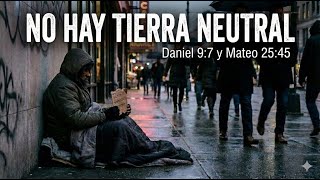
Beyond Playing It Safe: Our Faith Demands Action
To You, O Lord, belongs righteousness, but this day we are covered with shame—the men of Judah, the people of Jerusalem, and all Israel near and far, in all the countries to which You have driven us because of our unfaithfulness to You. — Daniel 9:7
Then the King will answer, ‘Truly I tell you, whatever you did not do for one of the least of these, you did not do for Me.’ — Matthew 25:45

Author
Dr. Ernst Diehl
Summary: We often comfort ourselves by defining righteousness as merely the absence of sin, but scripture reveals God demands more than passive avoidance, for the triumph of evil is assured when good men do nothing. Neutral ground does not exist; our indifference to the vulnerable is an active rejection of Christ himself and a profound collective failure. We must abandon the lie that our faith is private and live out a vibrant, courageous righteousness that produces fruit.
Edmund Burke famously observed that the only thing necessary for the triumph of evil is for good men to do nothing, a truth that stands as a haunting indictment of our modern spiritual condition. We often comfort ourselves with the idea that righteousness is merely the absence of bad behavior—that if we do not steal, kill, or lie, we are safe. But scripture shatters this illusion of safety, revealing a God who demands more than our passive avoidance of sin.
We feel the tension between God’s perfection and our performance, yet we rarely own it. We prefer to externalize the blame, but the prophet Daniel refused such a luxury. In the crushing weight of exile, he did not say "they sinned," but rather declared that righteousness belongs to You, O Lord, but to us open shame. Daniel was a man of immense personal integrity, yet he did not distance himself from his people. He understood that God’s justice is not a theoretical concept but an active force, and when we break faith, we are all profoundly accountable. We must learn, like Daniel, to stop pointing fingers at the culture and start confessing the "we" of our collective failure.
Centuries later, Jesus escalated this standard from national shame to the terrifying reality of eternal judgment. Standing on the Mount of Olives, He unveiled a vision of the end where we can be condemned simply for doing nothing. In Matthew 25, those sent into eternal punishment are not accused of overt malice, nor are they charged with blasphemy or murder. They are condemned for their bewilderment. They ask, Lord, when did we see You hungry or thirsty? Their crime was not what they did, but what they failed to do. They believed, as we often do, that they could occupy a neutral ground where inaction was a safe harbor.
But Jesus declares that neutral ground does not exist. Indifference to the needs of the vulnerable is not a passive state; it is an active rejection of Christ Himself. When we ignore the hungry, the stranger, or the imprisoned, we are not merely neglecting a social duty; we are stepping over the King to maintain our own comfort. The sin of omission is the silent killer of our faith.
We cannot afford to be found among the bewildered who ask when they saw Him. We must see Him now. We must strip away the lie that our faith is a private, internal matter that demands nothing of our hands. If our theology does not move us to help the least of these, our theology is dead. Let us repent of the arrogance of apathy, identify with the brokenness of our world, and live out a vibrant, courageous righteousness. The King is coming, and He is looking for fruit, not excuses.
What do you think?
What do you think about "Beyond Playing It Safe: Our Faith Demands Action"?
Related Content
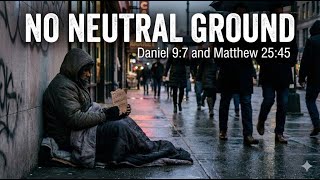
No Neutral Ground
The Enduring Standard: from National Shame to Eternal Judgment and Compassionate Life
Daniel 9:7 • Matthew 25:45
The grand narrative of scripture is driven by the dynamic tension between the unchanging perfection of God and the inconsistent obedience of humanity....
The Divine Standard and the Human Condition: a Comprehensive Analysis of the Interplay Between Daniel 9:7 and Matthew 25:45
Daniel 9:7 • Matthew 25:45
1. Introduction: The Dialectic of Righteousness and Judgment The biblical meta-narrative is frequently propelled by the tension between the immutable...
Read in Context
Click to see verses in their full context.
Song (Other Languages)