The Enduring Standard: from National Shame to Eternal Judgment and Compassionate Life
To You, O Lord, belongs righteousness, but this day we are covered with shame—the men of Judah, the people of Jerusalem, and all Israel near and far, in all the countries to which You have driven us because of our unfaithfulness to You. — Daniel 9:7
Then the King will answer, ‘Truly I tell you, whatever you did not do for one of the least of these, you did not do for Me.’ — Matthew 25:45
Summary: Our journey through scripture reveals the profound tension between God's perfect righteousness and humanity's unfaithfulness, from Daniel's confession of corporate shame to Jesus' final judgment. This powerful narrative calls us to anchor our trust in God's immutable justice and confront the gravity of our omissions and indifference. We are challenged to embrace humility, confess our collective failures, and actively see Christ in the "least of these." There is no neutral ground in God's kingdom; our active love and compassion for the vulnerable are paramount, shaping our path to inherit His eternal presence.
The grand narrative of scripture is driven by the dynamic tension between the unchanging perfection of God and the inconsistent obedience of humanity. This tension is powerfully articulated in the ancient confession of Daniel and the future pronouncements of Jesus, revealing a profound and continuous theological thread concerning divine righteousness and human accountability.
Daniel, immersed in the devastating reality of the Babylonian exile, offered a heartfelt prayer acknowledging God's absolute justice and Israel's undeniable failure. In a time of national catastrophe, he declared that righteousness belonged solely to God, while "open shame" was the rightful portion of his people. This was not merely a lament but a profound theological insight: God's integrity was proven not by averting judgment, but by enacting the covenant curses that Israel’s persistent unfaithfulness demanded. The term for Israel's sin, ma'al, signifies a deep-seated treachery, a breach of sacred trust, suggesting a systemic failure that brought public disgrace and dispersion. Daniel, despite his personal uprightness, identified fully with this corporate guilt, demonstrating the biblical concept of collective responsibility where the actions of a nation's leaders and populace affect everyone.
Centuries later, Jesus, the Son of Man, stood on the Mount of Olives and unveiled a breathtaking vision of the final judgment. Here, God's abstract righteousness, once revealed through historical events like the exile, is personified in the King who sits on His glorious throne. The standard of judgment is no longer merely the Law given to Moses, but the very presence of the King embodied in "the least of these." Those who stand accused in this cosmic courtroom are not condemned for overt acts of evil, but primarily for their sins of omission – for what they failed to do. Their bewildered protests, "When did we see You...?" reveal a blindness to the King's presence in the suffering and marginalized.
The journey from Daniel's confession to Matthew's judgment reveals an escalation and concretization of divine justice. The "open shame" that Israel experienced in exile, a temporal and national disgrace, foreshadows the "everlasting contempt" and "eternal punishment" awaiting those at the end of the age. Just as Israel was judged for neglecting God's prophets, the nations are judged for neglecting the King's representatives – whether these are understood as the universally poor and suffering, Christian missionaries, or the persecuted Jewish remnant. The principle remains: how one treats the messenger or the vulnerable reflects one's true allegiance to the Sender, the King Himself.
An Edifying Message for Believers:For believers, this profound connection between Daniel and Matthew offers crucial insights and calls to action:
- God's Immutable Righteousness is Our Anchor: We are reminded that God is inherently just and faithful. His judgments, whether historical or final, are not arbitrary but flow from His perfect character and His unwavering commitment to His covenant. This should instill both awe and trust.
- The Gravity of Omission and Indifference: The pronouncements against the "goats" in Matthew are a stark warning against passive faith. It is not enough to avoid evil; we are called to actively pursue good. Indifference to the needs of others, particularly the vulnerable, is not a neutral stance but an active rejection of Christ Himself. Our faith must translate into compassionate action.
- Embrace Corporate Humility and Confession: In an age that often prioritizes individualism, Daniel's "we" prayer challenges us to recognize and confess corporate sins – the failures of our communities, nations, and even the Church. True spiritual restoration often begins with a shared acknowledgment of collective shame and a turning toward God's righteousness.
- See Christ in the "Least": Regardless of the specific interpretation of "the least of these," the message is clear: Christ identifies profoundly with the suffering, the marginalized, and His faithful messengers. Every act of kindness, every cup of cold water, extended to one in need is an act of worship and service directed to the King. This transforms our perspective on charity and social engagement, making it central to our discipleship.
- No Neutral Ground in the Kingdom: The world often offers the illusion of neutrality, suggesting we can remain uncommitted. However, the King's judgment reveals that inaction is a choice with eternal consequences. We are called to active alignment with God's character, demonstrating love and justice in every sphere of life.
- Hope in Active Righteousness: For those who, by God's grace, respond with active love and compassion, there is immense hope. The "righteous" are those whose lives reflect the King's character, finding eternal life and full access to His presence. Our daily choices, even seemingly small acts of kindness, are woven into the fabric of our eternal destiny.
The cry of Daniel, "To us belongs shame," serves as a necessary starting point for anyone seeking true righteousness. It is a call to humility, confession, and ultimately, to a life poured out in active love for the "least of these," in whom the King Himself is found. Only through such a life can we confidently anticipate hearing the blessed invitation to inherit the Kingdom.
What do you think?
What do you think about "The Enduring Standard: From National Shame to Eternal Judgment and Compassionate Life"?
Related Content
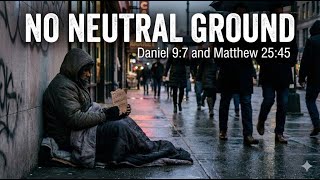
No Neutral Ground
Beyond Playing It Safe: Our Faith Demands Action
Daniel 9:7 • Matthew 25:45
Edmund Burke famously observed that the only thing necessary for the triumph of evil is for good men to do nothing, a truth that stands as a haunting ...
The Divine Standard and the Human Condition: a Comprehensive Analysis of the Interplay Between Daniel 9:7 and Matthew 25:45
Daniel 9:7 • Matthew 25:45
1. Introduction: The Dialectic of Righteousness and Judgment The biblical meta-narrative is frequently propelled by the tension between the immutable...
Read in Context
Click to see verses in their full context.
Song (Other Languages)