From Scarcity to Superabundance
And the LORD answered His people: “Behold, I will send you grain, new wine, and oil, and by them you will be satisfied. I will never again make you a reproach among the nations." — Joel 2:19
And Jesus directed the crowds to sit down on the grass. Taking the five loaves and the two fish and looking up to heaven, He spoke a blessing. Then He broke the loaves and gave them to the disciples, and the disciples gave them to the people. — Matthew 14:19

Author
Dr. Ernst Diehl
Summary: We are entering a new era of "sustainable abundance," where technology may soon lift the burden of work, prompting an existential crisis about our identity. Yet, as Christ's miraculous feeding reveals, our true purpose transcends mere production and biological needs. God's provision fulfills a deeper spiritual hunger with an astonishing overflow, inviting us to move beyond a scarcity mindset. We are called to shift from being producers to partakers of the Divine nature, embracing a higher vocation of communion and distributing Christ's boundless satisfaction, for even when everything is free, He alone truly satisfies.
We stand on the precipice of a strange new era, one that technologists and futurists like Elon Musk describe as a time of "sustainable abundance." We are told we may soon inhabit a world where artificial intelligence and automation drive the cost of goods to near zero, where "name it and claim it" shifts from a spiritual cliché to a technological reality. While this promise of costless living sounds like a utopia, it births a profound, existential anxiety. For millennia, humanity has defined itself by toil; we are what we do, and we are what we produce. If the ancient curse of sweating for our bread is technologically lifted, we are forced to ask: if we no longer need to work to survive, who are we?
To navigate this modern crisis of purpose, we must look backward to an ancient hunger and a miraculous meal. In Matthew 14, the disciples stood in a desolate wilderness surrounded by five thousand hungry families. Operating under the logic of the world, they saw only scarcity. They calculated the lack of resources and urged Jesus to send the crowds away to fend for themselves. But Jesus, stepping into the role of the compassionate Provider, refused to operate in an economy of lack. He was enacting a promise made centuries prior through the prophet Joel, who declared that God would restore His people by sending "grain, new wine, and oil" so that they would be satisfied and never again suffer the reproach of shame.
When Jesus took the meager five loaves and two fish, He did not merely solve a caloric deficit; He redefined the source of our sustenance. By looking up to heaven and blessing the bread, He transformed a barren wilderness into a lush banquet table, fulfilling Joel’s promise of restoration. The result was not merely adequacy, but an astonishing overflow—twelve baskets of leftovers. This superabundance signals that God’s provision always exceeds our biological needs, targeting the deeper spiritual hunger that defines the human condition.
This distinction is the key to finding our footing in a future of technological plenty. A world of sustainable abundance may indeed provide us with "grain"—the physical necessities of life—but no algorithm or machine can provide the "wine" of the Covenant or the "oil" of the Holy Spirit. If the need for labor vanishes, our purpose does not disappear; it simply ascends. We are being invited to shift our identity from being producers of goods to being partakers of the Divine nature. We move from the anxiety of earning a living to the vocation of enjoying the Life Giver.
In this light, the scarcity mindset—that nagging fear that there is never enough time, grace, or resource—is revealed as a lack of trust in the Shepherd. Our worth was never found in our hustle or our job titles, but in the invitation to sit on the green grass and eat from the hand of God. If the world lifts the burden of survival from our shoulders, it merely frees us for the higher calling of communion and distribution.
So, let the machines toil and the algorithms churn out the grain of a new economy; they can only ever sustain the body. Our mandate reaches higher. We are being released from the curse of the grind not to be idle, but to become the stewards of a greater feast—bearers of the wine that gladdens hearts and the oil that heals nations. In a world that may soon solve the problem of hunger, our purpose is to solve the problem of emptiness, taking the overflow of Christ’s compassionate table and distributing it to a generation that will soon discover that even when everything is free, He is the only thing that satisfies.
What do you think?
What do you think about "From Scarcity to Superabundance"?
Related Content
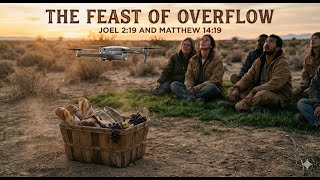
The Feast of Overflow
The Abundant Table: Jesus, Our Compassionate Provider
Joel 2:19 • Matthew 14:19
The profound narratives of Scripture reveal a consistent theme: God’s unwavering faithfulness to His covenant people, especially in times of dire need...
The Eschatological Harvest: a Canonical and Exegetical Analysis of the Interplay Between Joel 2:19 and Matthew 14:19
Joel 2:19 • Matthew 14:19
I. Prolegomena: The Hermeneutics of Covenantal Provision The relationship between the prophetic corpus of the Old Testament and the narrative theolog...
Read in Context
Click to see verses in their full context.
Song (Other Languages)