The Abundant Table: Jesus, Our Compassionate Provider
And the LORD answered His people: “Behold, I will send you grain, new wine, and oil, and by them you will be satisfied. I will never again make you a reproach among the nations." — Joel 2:19
And Jesus directed the crowds to sit down on the grass. Taking the five loaves and the two fish and looking up to heaven, He spoke a blessing. Then He broke the loaves and gave them to the disciples, and the disciples gave them to the people. — Matthew 14:19
Summary: Our God consistently demonstrates unwavering faithfulness and superabundant provision, even in our deepest seasons of despair. This divine fidelity is powerfully revealed by tracing Joel's ancient promise of restoration—encompassing grain, wine, and oil—to its miraculous fulfillment in Jesus’ ministry. What we witness, especially in the feeding of the five thousand, is Jesus stepping in as the Yahweh of Joel, transforming our desolate places into tables of abundance. He not only meets our physical needs but also satisfies our deepest spiritual longings, removing our shame and validating our trust in His superabundant grace. We are invited to abandon a scarcity mindset and embrace the boundless generosity of our Shepherd, finding eternal satisfaction in Him.
The profound narratives of Scripture reveal a consistent theme: God’s unwavering faithfulness to His covenant people, especially in times of dire need. This divine fidelity is strikingly illustrated by tracing the trajectory of an ancient promise of restoration found in the prophet Joel to its miraculous fulfillment in the ministry of Jesus, specifically in the feeding of the five thousand. What we witness is not merely a historical event, but a powerful theological declaration designed to edify and reassure every believer.
In the book of Joel, the people of Israel faced an overwhelming catastrophe. A devastating locust plague, coupled with drought, brought their land to ruin. This was more than an ecological disaster; it was a profound theological crisis. The loss of grain, new wine, and oil—the fundamental blessings of life and joy—signaled divine judgment and severed their ability to offer sacrifices. More painfully, it brought "reproach" upon them, a deep national shame, as surrounding nations questioned the power and presence of their God. The land mourned, the people hungered, and the very connection between God and His heritage seemed broken. In this vacuum of despair, God's compassionate heart responded. He promised to restore the land, sending grain, new wine, and oil in such abundance that His people would be fully satisfied and their shame among the nations would be definitively removed. This promise was a testament to God's character: a vindication of His name and a re-establishment of His covenant bond.
Centuries later, this ancient promise found its vivid enactment in the person of Jesus. Following a period of intense grief and amid a looming threat from political authorities, Jesus withdrew to a deserted place. A massive crowd, like sheep without a shepherd, followed Him into this wilderness—a setting that echoed Israel's Exodus journey and their historical reliance on divine provision. As evening approached, the disciples, operating under the logic of scarcity, urged Jesus to send the hungry multitudes away to buy food. But Jesus, moved by deep compassion, responded with a divine prerogative: "They do not need to go away. You give them something to eat."
Here, Jesus stepped into the role of the Yahweh of Joel. He took the meager five loaves and two fish, looked up to heaven—acknowledging His Father as the ultimate source of all sustenance—and offered a blessing. This was no ordinary prayer; it was a performative act of consecration and multiplication. In that desolate place, the barren wilderness sprouted forth "green grass," a powerful reversal of Joel's ecological curse, signaling the dawn of the Messianic age where desolation gives way to flourishing life. Jesus then broke the bread and gave it to His disciples, who distributed it to the eager crowds.
The outcome was a resounding fulfillment of Joel's prophecy. Everyone ate and was completely filled, even "gorged," mirroring Joel's promise of complete satisfaction. Far from mere adequacy, there was an astonishing overflow: twelve baskets full of leftovers, symbolizing God's superabundant provision for His entire covenant people. This miracle was more than a physical feeding; it was a profound spiritual experience. It inaugurated the Messianic Banquet, the prophetic vision of God’s Kingdom feast where all hunger is abolished and all shame is lifted. The language used by Matthew, of "taking, blessing, breaking, and giving," deeply foreshadowed the Holy Supper, revealing Jesus as the true Bread of Life who offers spiritual nourishment that truly satisfies.
While the feeding focused on "grain" (the loaves), the full triad of Joel’s promise—grain, wine, and oil—finds its complete distribution throughout Jesus’ ministry and the life of the early church. The "wine" of joy and covenant is fulfilled in the Last Supper, where Jesus offers His blood for the new covenant. The "oil" of anointing is revealed in the power and authority by which Jesus performs miracles and ultimately in the outpouring of the Holy Spirit at Pentecost, explicitly linked by Peter to Joel's prophecy. Thus, the satisfaction promised in Joel becomes a progressive reality for believers: nourished by the Word (grain), cleansed by the blood of Christ (wine), and empowered by the Holy Spirit (oil).
For us, as believers, this timeless connection between Joel and Matthew serves as a powerful, edifying message. We are reminded that our God is a compassionate and ever-present Provider, even in our wilderness seasons. When we face scarcity, uncertainty, or the "reproach" of difficult circumstances, Jesus steps in to transform our desolate places into tables of abundance. He not only meets our physical needs but also satisfies our deepest spiritual longings, removing our shame and validating our trust in Him. His provision is always superabundant, a tangible sign of His sovereign reign and His faithful presence among us. We are invited to abandon the world's scarcity mindset and embrace the boundless generosity of our Shepherd, knowing that those who follow Him into the wilderness will always find a feast prepared and their souls eternally satisfied, never again to be put to shame.
What do you think?
What do you think about "The Abundant Table: Jesus, Our Compassionate Provider"?
Related Content
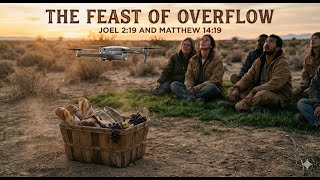
The Feast of Overflow
From Scarcity to Superabundance
Joel 2:19 • Matthew 14:19
We stand on the precipice of a strange new era, one that technologists and futurists like Elon Musk describe as a time of "sustainable abundance." We ...
The Eschatological Harvest: a Canonical and Exegetical Analysis of the Interplay Between Joel 2:19 and Matthew 14:19
Joel 2:19 • Matthew 14:19
I. Prolegomena: The Hermeneutics of Covenantal Provision The relationship between the prophetic corpus of the Old Testament and the narrative theolog...
Read in Context
Click to see verses in their full context.
Song (Other Languages)