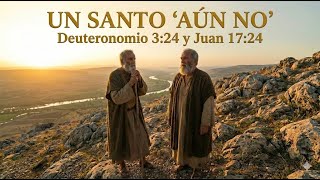
The Unfinished and the Infinite: an Exhaustive Monograph on the Intertextual Dynamics of Deuteronomy 3:24 and John 17:24
Deuteronomy 3:24 • John 17:24
Summary: In the grand tapestry of biblical literature, certain prayers stand as colossal pylons, bridging human finitude with divine infinity. We see this profound intertextual dialogue in the plea of Moses on the plains of Moab (Deuteronomy 3:24) and the High Priestly Prayer of Jesus in the Upper Room (John 17:24). Moses, a servant, stands at the threshold of a promised land he cannot enter, praising a greatness he has only begun to comprehend, a greatness of God's mighty hand. Conversely, Jesus, the Son, stands at the threshold of glory He is about to reclaim, confidently willing that His followers enter a sphere from which they cannot be barred. This is not merely a literary parallel, but a theological progression from the *initium* of God’s historical works to the *telos* of His eternal glory.
My analysis reveals the dramatic contrasts embedded within these divine petitions. Moses' address, "Adonai Yahweh," reflects the judicial relationship of master and servant, a plea for grace rooted in God's demonstrated physical strength and a desire to see the promised land. His lament, "You have begun," expresses the tragedy of an unfinished task. Yet, Jesus addresses God intimately as "Pater," signifying a familial relationship, and His statement, "I will," asserts the sovereign desire of the Son. He seeks not a physical land, but a relational location—presence with the Father—and invites us to behold His pre-existent glory, not merely His mighty hand.
The denial of Moses' petition, therefore, proves a typological necessity. The Law, which Moses represents, can lead us to the border of the promise but cannot bring us into the inheritance due to human failure. This void is filled by Christ, the sinless Son, who perfects the covenant and, as the ultimate Mediator, ushers humanity into the Father’s very presence. The Transfiguration itself serves as a pivotal link, where Moses finally stands "in the land" and beholds the very *doxa* of Jesus—the glory Jesus prays for us to see in John 17:24—confirming that the work Moses "began" is now completed by Christ's "exodus."
This profound progression offers vital comfort and instruction for our faith. God's "No" to a specific, earthly request, like Moses' desire for the land, often prepares us for a greater, heavenly fulfillment, for Moses ultimately gained the eternal presence of Christ. Our Christian life on earth is indeed an *initium*, a "beginning" where we glimpse God's mighty hand, fostering a holy dissatisfaction that fuels our hope for the full "Glory." Ultimately, Jesus' sovereign will in John 17:24 guarantees our beatific vision, transforming death from a tragic cessation into a triumphant entry into His eternal, loving presence, completing Moses' unfinished gaze.
I. Introduction: The Architecture of Divine Petition
In the grand tapestry of biblical literature, certain prayers stand as colossal pylons supporting the bridge between human finitude and divine infinity. These prayers, often uttered at the threshold of death or transition, encapsulate the theological aspirations of an era while simultaneously reaching forward into eschatological fulfillment. Two such prayers, separated by over a millennium of redemptive history, confront the reader with a striking interplay of longing and fulfillment, restriction and liberation, shadow and substance. These are the plea of Moses, the servant of Yahweh, on the plains of Moab (Deuteronomy 3:24), and the High Priestly Prayer of Jesus, the Son of God, in the Upper Room (John 17:24).
The investigation of these two texts reveals a profound intertextual dialogue. Moses stands at the edge of the Jordan, looking physically toward a land he is forbidden to enter, praising a God whose greatness he has only "begun" to comprehend. Conversely, Jesus stands at the edge of the Kidron, looking spiritually toward a glory He is about to reclaim, willing that His followers enter a sphere from which they cannot be barred. The interplay between these verses is not merely one of literary parallel; it is a theological progression from the initium of God’s mighty works in history to the telos of God’s eternal glory in the beatific vision.
This report provides an exhaustive analysis of the linguistic, historical, theological, and typological relationships between Deuteronomy 3:24 and John 17:24. It explores the depths of the Hebrew Masoretic Text and the Greek Septuagint to uncover the nuances of "greatness" and "strength," and examines the Johannine corpus to define the nature of the "glory" requested by the Son. Furthermore, it posits that the rejection of Moses’ petition was a typological necessity, clearing the stage for the Christ who does not merely see the land from afar but ushers humanity into the very presence of the Father. Through this lens, Deuteronomy 3:24 is understood not as a closed chapter of frustration, but as the opening movement of a symphony that finds its resolution in the High Priestly Prayer.
II. The Historical and Literary Locus of Deuteronomy 3:24
To understand the weight of Moses' petition, one must first anchor it firmly within its historical geography and literary context. Deuteronomy 3:24 does not exist in a vacuum; it is the emotional and theological climax of the first farewell address of Moses.
2.1 The Plains of Moab and the Defeat of the Guardians
The setting is the plains of Moab, specifically the region of the Transjordan recently wrested from the control of two formidable Amorite kings: Sihon of Heshbon and Og of Bashan. These were not minor tribal skirmishes; in the theological geography of the Pentateuch, Sihon and Og represented the gatekeepers of the Promised Land, the chaotic forces that stood between the wilderness wanderers and their inheritance.
The defeat of Og, in particular, serves as a critical backdrop to Moses' prayer. Og was the king of Bashan, a region known for its fertile heights and, significantly, its association with ancient Rephaim or giants. The text notes the dimensions of Og's sarcophagus (or bedstead) as nine cubits long and four cubits wide—approximately 13.5 feet by 6 feet. This detail is not trivial; it underscores the magnitude of the "Mighty Hand" required to dislodge him. By defeating Og, Yahweh demonstrated supremacy not just over human armies, but over the mythological "giants" of the earth, asserting His dominance over the chaotic powers that Og represented.
It is in the immediate aftermath of this monumental victory that Moses dares to speak. The conquest of the Transjordan serves as the empirical evidence for his theological claim: "You have begun to show Your servant Your greatness". Moses argues from the lesser to the greater. If Yahweh has dismantled the invincible Og and the fortified cities of Argob—sixty cities with high walls, gates, and bars —then surely the crossing of the Jordan and the conquest of the Cisjordanian highlands are within His power. More poignantly, Moses argues that since he was the instrument for the beginning of this conquest, he should logically participate in its completion.
2.2 The Covenantal Structure: Suzerain and Vassal
The book of Deuteronomy is structured as a Suzerain-Vassal treaty, a common diplomatic format in the Ancient Near East. In this framework, Yahweh is the Great King (Suzerain) and Israel, mediated by Moses, is the vassal.
-
The Address: Moses addresses God as Adonai Yahweh (Lord GOD). This double designation is vital. Adonai (Master) acknowledges Moses' submission and lack of inherent rights; he is the eved (servant/slave). Yahweh invokes the personal, covenantal name revealed at Horeb, the name associated with redemption and presence.
-
The Servant's Plea: As a faithful vassal who has executed the King's will in destroying the Amorites, Moses presents his petition. However, the treaty dynamics also explain the denial. Moses, as the covenant mediator, bears the weight of the people's rebellion at Meribah. In the economy of the treaty, the leader is inextricably bound to the corporate identity of the people. His exclusion is a covenantal sanction, highlighting the severity of holiness required by the Suzerain.
2.3 The Tragedy of the Unfinished
The pathos of Deuteronomy 3:24 lies in the word hachillota—"You have begun." Moses recognizes that he is standing at a point of inauguration, not consummation. He has seen the plagues of Egypt, the splitting of the Sea, the thundering of Sinai, and now the fall of the giants. Yet, he categorizes all of this as merely the "beginning" of God's self-disclosure. This reveals Moses' theological acuity: he understands that the God of Israel is inexhaustible. The tragedy is personal; the "beginner" is not permitted to be the "finisher." This tension creates a narrative void—a longing for a leader who can both begin and complete the work of redemption, a void that remains unfilled until the New Testament.
III. Exegetical Analysis of Deuteronomy 3:24
A granular analysis of the Hebrew text reveals the depth of Moses' theology and the specific attributes of God he invokes.
Masoretic Text:
Adonai Yahweh attah hachillota l’harot et-avdecha et-godlecha v’et-yadecha hachazakah asher mi-el bashamayim uva’aretz asher ya’aseh kh’ma’asecha v’khigvurotecha.
3.1 Hachillota: The Theology of Inauguration
The verb hachillota comes from the root chalal, which can mean "to bore," "to open," or "to begin". In the Hiphil stem, it denotes the act of initiating a process.
-
Implication: Moses asserts that the miraculous history of the Exodus and the wilderness wanderings was not the climax of God’s power but merely the prologue. The defeat of Sihon and Og was the opening act of the conquest.
-
Theological Tension: By claiming God has only "begun," Moses implies that stopping now (with Moses' death) would be structurally incoherent from a human perspective. "You started this with me; let me see it through." It reflects a desire for closure that is denied, enforcing the lesson that in God's economy, workers change, but the work continues.
3.2 Godlecha: Greatness and the Attribute of Mercy
The word godlecha (Your greatness) is a comprehensive term for the magnitude of God.
-
Rabbinic Insight: Rashi, the great medieval commentator, notes a surprising nuance here. He connects godlecha to the divine attribute of Chesed (goodness/mercy). This is counter-intuitive, as "greatness" often implies raw power. However, Rashi argues that for God to restrain His anger and forgive Israel (as He did after the Golden Calf) demonstrates a "greatness" of character superior to mere destructive force. Moses appeals to this "Greatness of Mercy" hoping that the same attribute that spared Israel will now spare him from the decree of exclusion.
-
Contextual Power: In the immediate context of the conquest, godlecha also refers to the sheer scale of Yahweh’s dominion—He is greater than the giants, greater than the fortified cities, and greater than the Amorite gods.
3.3 Yad Chazakah: The Mighty Hand
The phrase yad chazakah ("strong hand" or "mighty hand") is the signature motif of the Exodus narrative.
-
Polemical Function: Scholars suggest this phrase serves as a polemic against the Egyptian propaganda of the Pharaoh’s "strong arm". Pharaoh claimed to rule by a mighty arm; Moses asserts that Yahweh’s hand broke Pharaoh’s arm.
-
Martial Imagery: The "hand" is the instrument of action. It strikes, it divides the sea, it crushes the enemy. Moses is praising God’s active intervention in history. He is not praising a static deity of philosophical contemplation, but a Warrior God who fights for His people.
3.4 The Rhetorical Challenge and the Divine Council
Moses asks: "For what god is there in heaven or on earth who can do such works and mighty acts as Yours?".
-
Monotheism and Incomparability: This question presupposes the context of the Divine Council. In the worldview of the Ancient Near East, nations had patron deities (Deut 32:8). Moses challenges the entire cosmic assembly. He scans the heavens (the abode of the elohim) and the earth (the locus of pagan idols) and finds Yahweh without rival.
-
Ontological Exclusivity: This is not merely claiming Yahweh is the strongest god; it is a move toward claiming He is the only God capable of effective action. The other "gods" are mute and impotent; only Yahweh has a "Mighty Hand" that acts in space-time history.
3.5 The Septuagintal Transformation: Ischyn vs. Doxa
The Greek translation (LXX) of this verse introduces a shift in terminology that impacts the intertextual reading with the New Testament.
-
LXX Text: ...tēn ischyn sou kai tēn dynamin sou....
-
The Shift: The Hebrew godlecha (greatness) is translated as ischyn (strength/might) rather than megaleiotes (majesty) or doxa (glory). The LXX translators focused on the force of God.
-
Ischyn refers to inherent physical strength or capacity.
-
Dynamin refers to power or ability to perform.
-
-
Significance: Moses is depicted in the Greek text as fascinated by the capability of God—His raw capacity to disrupt the natural order. This contrasts with John 17, where the focus shifts to doxa (glory), implying a deeper revelation of essence rather than just capability.
IV. The Historical and Literary Locus of John 17:24
Crossing the canon to the New Testament, we encounter a parallel yet distinct scenario. John 17 records the "High Priestly Prayer" of Jesus, offered at the conclusion of the Farewell Discourse.
4.1 The Hour of Glorification
If Deuteronomy 3 occurs after a military victory, John 17 occurs before the ultimate spiritual victory—the Cross. Jesus declares, "The hour has come" (John 17:1). This "hour" is the pivot of history, comparable to the Exodus but cosmic in scope.
-
The Context of "Finishing": Unlike Moses, who laments an unfinished task ("You have begun..."), Jesus speaks with the confidence of completion: "I have finished the work which You have given Me to do" (John 17:4). The prayer in verse 24 rests on the foundation of a completed mission. The petitioner is not a servant asking for a boon he has not earned, but a Son claiming the reward of His accomplished obedience.
4.2 Jesus as the Anti-Type of Moses
The Gospel of John presents Jesus as the Prophet-like-Moses (Deut 18:15) who succeeds where Moses failed.
-
The New Exodus: Jesus is leading His people not out of Egypt, but out of the "world" (John 17:6).
-
The New Mana: He has fed them with the Bread of Life (John 6).
-
The New Sinai: He has given them the Father’s word (John 17:14).
-
The New Conquest: In John 17:24, He prepares to lead them across the ultimate Jordan—death—into the Father’s presence.
4.3 The Will of the Son
The tone of John 17:24 is distinct from the rest of the prayer. Throughout the chapter, Jesus makes requests ("Sanctify them," "Keep them"). In verse 24, the language shifts to a testamentary declaration: "Father, I will..." (Thelō). This is the expression of the Son's sovereign desire, aligned perfectly with the Father's will. It is the legal claim of the Heir bringing His co-heirs into their inheritance.
V. Exegetical Analysis of John 17:24
The Greek text of John 17:24 contains profound theological density regarding the nature of salvation and the future of the believer.
Greek Text:
Pater, hō dedōkas moi, thelō hina hopou eimi egō kakeinoi ōsin met' emou, hina theōrōsin tēn doxan tēn emēn hēn dedōkas moi hoti ēgapēsas me pro katabolēs kosmou.
5.1 Pater vs. Adonai Yahweh: The Shift in Intimacy
Jesus addresses God simply as Pater (Father). This stands in stark contrast to Moses’ formal and reverent Adonai Yahweh.
-
Implication: The relationship has shifted from the judicial (Master/Servant) to the familial (Father/Son). Moses stood in the royal court as a subject; Jesus stands in the family circle as the Son. This shift in address signals the shift in the nature of the covenant—believers are not merely subjects of a King (as in Deut 3) but children of a Father (John 1:12).
5.2 Thelō: The Authority of Desire
The verb thelō ("I desire" or "I will") indicates a strong, authoritative volition.
-
Comparison: Moses pleaded (va'et-chanan - "I implored grace," Deut 3:23). He had to beg for a favor. Jesus "wills." The difference highlights the Christological superiority of Jesus. He does not need to beg for entry; He holds the keys. His desire for His disciples' presence is as effectual as His command to Lazarus to come forth.
5.3 Hopou Eimi Egō: The Theology of Location
Jesus prays that they may be "with Me where I am".
-
Johannine Spatiality: "Where I am" is a technical term in John for the sphere of divine life and the Father’s presence (cf. John 14:3).
-
Comparison: Moses wanted to go to a geographic location (Canaan, Lebanon). Jesus wants His disciples to be in a relational location (in the Father’s presence). The "Good Land" of Deuteronomy is revealed to be a type; the antitype is the immediate presence of Christ in glory. The geography of salvation has been transposed from earth to heaven.
5.4 Theōrōsin: The Beatific Vision
The purpose of this union is hina theōrōsin—"that they may behold."
-
Lexical Nuance: The verb theōreō implies more than a passing glance. It suggests a sustained, contemplative gaze, a "spiritual perception". It is to look with understanding and intent.
-
The Beatific Vision: This request is the foundation of the doctrine of the Visio Beatifica—the blessed vision of God which constitutes the primary happiness of heaven. Moses asked to "see" (ra'ah) the land; Jesus grants the disciples the right to "behold" the Glory.
-
Insatiable Desire: Just as Moses’ desire to see God’s glory was insatiable (Exodus 33), the "beholding" in John 17 implies an eternal activity. Since the object (God’s glory) is infinite, the act of beholding is an eternal progression of discovery, never exhausting the subject.
5.5 Doxan: Glory vs. Strength
Jesus asks that they behold "My glory" (doxan).
-
Contrast with Deut 3: Moses saw God’s ischyn (strength) and godlecha (greatness). These are attributes of action/power. Doxa (Glory) in John refers to the pre-existent weight of divine love and character ("for You loved Me before the foundation of the world").
-
The Nature of Glory: The glory Jesus reveals is not just the flashing light of Sinai; it is the glory of self-giving love. It is the glory of the relationship between Father and Son. Moses saw the Hand of God (Deut 3); Jesus invites us to see the Heart of God (John 17).
VI. Comparative Theological Synthesis
The juxtaposition of these two texts yields rich theological insights regarding the progression of redemptive history.
6.1 The Typology of the Denied and Answered Prayer
Why was Moses denied while Jesus was heard?
-
Typological Necessity: If Moses enters the land, the typology breaks. Moses represents the Law. The Law can bring the people to the border, it can define the conditions of the covenant, but it cannot bring them into the inheritance. The Law is barred from the Promise because of human failure (represented by Moses' sin at Meribah).
-
Christological Fulfillment: Jesus represents Grace and Truth. He enters the "Better Land" (Hebrews 11:16) because He is the sinless Son. His prayer is answered because He has kept the covenant perfectly. The denial of Moses serves to highlight the necessity of a Better Mediator. Moses is the "servant in the house" who is disciplined; Jesus is the "Son over the house" who rules.
6.2 From "Mighty Hand" to "Loving Heart"
The trajectory from Deuteronomy to John is a movement from external power to internal relation.
-
Deuteronomy 3:24: Focuses on the "Mighty Hand". This is appropriate for a context of war and liberation from tyrants (Pharaoh, Og). The primary need of the people was protection and deliverance.
-
John 17:24: Focuses on "Love before the foundation of the world". This is appropriate for the context of eternal family. The primary need of the believer is not just safety, but union.
-
Synthesis: The "Mighty Hand" of God (Providence) is exercised to secure the people so that they may eventually enjoy the "Loving Heart" of God (Glory). The power serves the purpose of love.
6.3 Time and Eternity: "Begun" vs. "Pre-mundane"
-
Time: Moses operates in linear time: "You have begun to show..." He looks back at history and sees a trajectory.
-
Eternity: Jesus operates in eternity: "You loved Me before the foundation of the world." He looks back before time began.
-
Implication: Moses' vision is historical and developmental; Jesus' vision is eternal and foundational. The works of God in history (Deut 3) are the temporal outworking of the eternal love of God (John 17). The "beginning" that Moses saw was the in-breaking of the "pre-mundane" reality Jesus describes.
6.4 Table 1: Comparative Analysis of the Two Prayers
| Feature | Moses (Deut 3:24) | Jesus (John 17:24) |
| Petitioner Status | Servant (Eved) | Son (Huios) |
| Mode of Request | Plea (Va'et-chanan - I implored) | Will (Thelō - I desire/will) |
| Primary Attribute | Greatness (Godlecha) / Might (Ischyn) | Glory (Doxa) / Love (Agapē) |
| Object of Vision | The Land (Canaan/Lebanon) | The Person (Christ/Glory) |
| Temporal Scope | "You have begun..." (Historical) | "Before foundation of world" (Eternal) |
| Outcome | Denied (View from Pisgah) | Granted (Beatific Vision) |
| Theological Basis | Comparison ("Who is like You?") | Union ("That they may be one") |
VII. The Transfiguration: The Pivotal Link
The narrative arc between Deuteronomy 3 and John 17 finds its tangible intersection on the Mount of Transfiguration (Matthew 17:1-8).
-
The Meeting: Here, Moses finally stands "in the land" (on the mountain) and "sees" the glory of the Lord. The prayer of Deuteronomy 3:24, denied in his mortal life, is answered in the eschaton.
-
The Vision: Moses beholds the doxa of Jesus—the very thing Jesus prays for His disciples to see in John 17:24.
-
The Conversation: They speak of Jesus' "departure" (Greek: exodos). This confirms that the work Moses "began" (the first Exodus) is "finished" by Jesus (the second Exodus).
-
The Witnesses: The disciples (Peter, James, John) are present. They get a foretaste of the answer to John 17:24—they "behold His glory" (John 1:14, 2 Peter 1:16-18) alongside Moses. The Transfiguration is the bridge where the "Mighty Hand" of the Old Testament lawgiver meets the "Glory" of the New Testament Savior.
VIII. The Divine Council and the Unity of Believers
Moses’ rhetorical question, "What god is there in heaven or on earth...?" (Deut 3:24), engages the "Divine Council" worldview. It asserts Yahweh’s supremacy over all spiritual entities (elohim).
-
Deuteronomy: The context is polemic and exclusive. Yahweh stands alone above the council.
-
John 17: The context is unitive and inclusive. Jesus prays "that they all may be one; as You, Father, are in Me, and I in You" (John 17:21).
-
Synthesis: The exclusive monotheism of Deuteronomy (God is One and Unique) becomes the inclusive Trinitarianism of John (God is One, and invites believers into that Oneness). The "gods" of the nations are displaced not just by Yahweh’s power, but by the Church—the Body of Christ—which is invited to sit with Christ in heavenly places (Eph 2:6), effectively taking the place of the Divine Council as the family of God.
IX. Pastoral and Practical Implications
The interplay of these texts offers profound comfort and instruction for the life of faith.
9.1 Dealing with the "No" of God
Moses’ experience in Deuteronomy 3 teaches that a "No" to a specific request is not a "No" to the relationship. God denied Moses the land, but He did not deny him His presence. He took him to Pisgah and showed him the vision. Often, God denies the "lesser" petition (the earthly relief/land) to prepare the soul for the "greater" fulfillment (the heavenly glory/Jesus). Moses wanted Canaan; he got the Transfiguration and the eternal presence of Christ.
9.2 The "Begun" Work in the Believer's Life
Believers often feel their experience of God is incomplete. Moses’ phrase "You have begun to show" validates this. The Christian life on earth is always an initium. We see the "Mighty Hand" in glimpses, but we await the full "Glory." This instills a "holy dissatisfaction"—an insatiable desire to see more, which drives sanctification and hope.
9.3 The Assurance of the Beatific Vision
Jesus’ prayer in John 17:24 is the rock of Christian assurance. It is not merely a wish; it is the will of the Son. Because He wills it, it must happen. The believer can face death with the confidence that they are not entering a void, but are moving "to where He is" to "behold His glory." This transforms the view of death from a tragic cessation (as it might have felt to Moses on Nebo) to a triumphant entry (as Jesus describes it).
X. Conclusion
The intertextual journey from Deuteronomy 3:24 to John 17:24 is a movement from the shadows to the light. Moses, the faithful servant, stands as the great witness to the Beginning—the inauguration of God’s mighty works in history. He sees the Hand that crushes giants and divides seas. He longs for the Land, but must rest in the hope of a better promise.
Jesus, the faithful Son, stands as the Finisher. He completes the work Moses undertook. He transforms the "Mighty Hand" of judgment into the "Glory" of saving love. He takes the petition of the servant—"Let me go over"—and transforms it into the decree of the Sovereign: "I will that they be with Me."
In the end, Deuteronomy 3:24 asks the question that echoes through the ages: "Who is this God?" John 17:24 provides the answer: He is the Father who loved the Son before the world began, and who now welcomes His children to behold that love forever. The "unfinished" gaze of Moses on Mount Pisgah finds its eternal completion in the face of Jesus Christ.
XI. Appendix: Comparative Lexical Data
Table 2: Key Hebrew and Greek Terms
| Hebrew (Deut 3:24) | Meaning | Greek Equivalent (LXX/NT) | Meaning / NT Context |
| Hachillota | You have begun | Ērxō (LXX) / Teteleka (John 17:4) | Begun vs. Finished |
| Godlecha | Your Greatness | Ischyn (LXX) / Megaleiotes | Strength vs. Majesty |
| Yad Chazakah | Strong Hand | Cheira Krataian (LXX) | Mighty Hand (Action) |
| Va'et-chanan | I implored | Edeēthēn (LXX) / Thelō (John 17:24) | Begged vs. Willed |
| Ra'ah | To See | Deixai (LXX) / Theōrōsin (John 17:24) | To show/see vs. To Behold |
Table 3: The Three Mountains of Revelation
| Mountain | Scripture | Event | Revelation |
| Sinai/Horeb | Ex 33 / Deut 4 | Law Giving | God's Holiness & Sound (No Form) |
| Pisgah/Nebo | Deut 3:27 | Moses' Death | God's Faithfulness & The Land (Visual) |
| Transfiguration | Matt 17 / Luke 9 | Glory Revealed | God's Son & The Glory (Personal) |
What do you think?
What do you think about "The Unfinished and the Infinite: An Exhaustive Monograph on the Intertextual Dynamics of Deuteronomy 3:24 and John 17:24"?
Related Content
A Holy Not Yet
When God Says "Not Yet": Finding Purpose in the Waiting
Deuteronomy 3:24 • John 17:24
Have you ever felt caught in a "holding pattern," yearning for purpose or a specific dream, yet finding it consistently out of reach? For months, even...
From Pisgah's Glimpse to Eternal Glory: Christ Our Complete Access
Deuteronomy 3:24 • John 17:24
The sacred narrative presents two pivotal prayers, separated by millennia, that brilliantly illuminate the journey of faith and the progression of God...
Read in Context
Click to see verses in their full context.
Song (Other Languages)