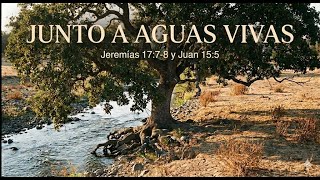
Rooted in Christ: the Path to Unfading Life and Abundant Fruit
But blessed is the man who trusts in the LORD, whose confidence is in Him. He is like a tree planted by the waters that sends out its roots toward the stream. It does not fear when the heat comes, and its leaves are always green. It does not worry in a year of drought, nor does it cease to produce fruit. — Jeremiah 17:7-8
I am the vine and you are the branches. The one who remains in Me, and I in him, will bear much fruit. For apart from Me you can do nothing. — John 15:5
Summary: Our spiritual vitality and ability to produce lasting good depend entirely on our deep connection to the divine source of life, a profound truth shown to us by the ancient prophets and our Lord Jesus Christ. While trusting in worldly strength leads to barrenness, relying on God grounds us, much like a tree by unfailing waters. Jesus elevates this truth further, calling us to an intimate, organic union by "abiding" in Him as the True Vine, where His life flows through us. We are called to cultivate this conscious connection, for it is in Christ alone that we find unfading life and bear authentic, abundant fruit that glorifies our Heavenly Father.
The ancient prophets and our Lord Jesus Christ, though separated by centuries, both speak to the fundamental truth of our spiritual vitality through powerful botanical imagery. They reveal that our very existence, our resilience in trials, and our ability to produce lasting good are entirely dependent on our connection to the divine source of life. This profound continuity in God's message guides us from an understanding of seeking His wisdom to experiencing an intimate, organic union with Him.
Consider first the stark warning given through the prophet Jeremiah. He contrasts two paths, two "ways" of living, much like two distinct plants in a harsh land. There is the man who puts his trust in human strength, in worldly alliances, or in his own abilities. This man is likened to an arar bush in the desert – outwardly, it might appear green and thriving, even tall and impressive. Yet, this is a deceptive mirage. Its fruit is hollow, offering no true nourishment, and its roots are shallow, incapable of drawing sustenance from a barren, saline environment. When the inevitable "heat" or "good" (as in refreshing rain) comes, this bush cannot perceive or benefit from it; it remains withered and desolate. This imagery speaks powerfully to the illusion of self-sufficiency or reliance on fleeting earthly resources, which ultimately leaves the soul empty and vulnerable to judgment. Our own hearts, as Jeremiah profoundly states, are complex and deeply inscrutable, prone to such deceptions, capable of trusting in false promises and unable to find true life apart from God.
In sharp contrast, Jeremiah describes the man who places his full confidence in God. He is like a tree intentionally planted by a perennial stream. This tree actively sends its roots deep, seeking out the unfailing water source. Because its life supply is independent of fluctuating weather, it does not fear the scorching heat, nor does it worry in a year of prolonged drought. Its leaves remain green, a sign of unwavering vitality, and it consistently bears fruit. This is a profound picture of resilience, sustained by a deep, unseen connection to God. It highlights the blessings of actively pursuing God, grounding ourselves in His presence through prayer and devotion, and leaning our entire weight on His unchanging character. This proactive trust leads to a life that flourishes despite external pressures, continuously producing good.
Centuries later, Jesus takes this foundational truth and elevates it to a new, more intimate reality in the New Covenant. He declares Himself the "True Vine," a revolutionary statement that redefines the very identity of God's people. The Golden Vine adorning the Temple in Jerusalem symbolized Israel's covenant with God, but Israel had often failed to bear the fruit of righteousness. Jesus announces that He is the genuine fulfillment of that divine vineyard. To be connected to God's people is no longer about ethnicity or religious rituals, but about a living, organic connection to Him alone.
In this metaphor, the Father is the diligent Vinedresser. His care is personal and purposeful. He "lifts up" or "takes away" branches that are truly unfruitful, reminding us that a lack of fruit signifies a severed connection, leading to spiritual desolation. But for those branches that do bear fruit, the Father actively "prunes" them. This pruning, though sometimes painful or challenging, is an act of divine love, a purification intended to remove anything that hinders growth, allowing for even greater, more abundant fruit. This reveals God's active involvement in our spiritual formation, refining us to maximize our potential for His glory.
The core of Jesus' teaching here is the command to "abide" in Him. This is a deepening of Jeremiah's "trust." While Jeremiah’s tree is near the water, indicating proximity and external reliance, Jesus’ branches are in the Vine, signifying an intrinsic, organic union. "Abiding" means to remain, to dwell, to make our home in Christ. It's a mutual indwelling: "He who abides in Me, and I in him." The life-giving water, which was once an external stream, is now revealed as the Holy Spirit and the life-giving words of Jesus, flowing within us like sap through a vine. This is not merely an intellectual agreement or an outward observance, but an ontological reality where Christ's very life becomes ours.
The consequence of this union is absolute: "apart from me you can do nothing." This is not a harsh judgment but a simple statement of spiritual reality. Separated from the Vine, a branch is dead wood, utterly incapable of producing fruit. Its destiny is to wither and be burned. For the believer, this underscores our absolute dependence on Christ. Our spiritual character, our capacity for loving actions, our impact in the world, and our obedience to God's commands—the multifaceted "fruit"—all flow from this continuous, intimate connection. If there is no fruit, it indicates a lack of true union.
The journey from Jeremiah's tree to John's vine represents a profound progression in our understanding of God's relationship with His people. It moves from an active reaching out to an external source to an internal, mutual indwelling with the very Son of God. The aim shifts from merely surviving a hostile world to supernaturally flourishing and producing abundant fruit that glorifies our Heavenly Father.
For us, as believers, the edifying message is clear: Our spiritual life, strength, and purpose are not found in self-effort or reliance on worldly wisdom, which are deceptive and lead to barrenness. Instead, they are found solely in a deep, unwavering trust in God, fully realized in our active and intimate "abiding" in Jesus Christ, the True Vine. We are called to consciously remain connected to Him, allowing His Spirit and His words to flow through us. This vital union promises not just resilience in the face of life's "heat" and "drought," but a life of authentic, consistent, and abundant fruit, transforming us and impacting the world for His glory. Let us therefore cultivate this precious connection, for in Christ alone do we find unfading life and fruit that endures.
What do you think?
What do you think about "Rooted in Christ: The Path to Unfading Life and Abundant Fruit"?
Related Content
By the Living Stream
Rooted Deep, Abiding True: the Secret of an Unfading Life
Jeremiah 17:7-8 • John 15:5
My beloved friends, what a profound mystery, yet what a glorious reality, awaits our contemplation today! From the ancient echoes of Jeremiah to the v...
The Botanical Nexus of Spiritual Vitality: an Exhaustive Exegetical and Intertextual Analysis of Jeremiah 17:7–8 and John 15:5
Jeremiah 17:7-8 • John 15:5
1. Introduction: The Arboreal Continuity of Covenant Theology The biblical narrative frequently employs the natural world not merely as a backdrop fo...
Read in Context
Click to see verses in their full context.
Song (Other Languages)