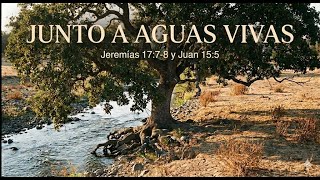
The Botanical Nexus of Spiritual Vitality: an Exhaustive Exegetical and Intertextual Analysis of Jeremiah 17:7–8 and John 15:5
Jeremiah 17:7-8 • John 15:5
Summary: A rigorous intertextual analysis reveals a profound, intentional continuity between the botanical metaphors found in Jeremiah 17:7–8 and John 15:5. Far from disparate images, these texts represent evolutionary stages in a unified theology of life. This report demonstrates that the shift from the tree, an individual entity planted *near* a divine source, to the vine, a corporate entity sharing an *organic* source, marks a fundamental transition from the Old Covenant's external reliance to the New Covenant's ontological union. Through these arboreal images, we illuminate the profound mechanisms of grace, trust, and fruitfulness.
Jeremiah 17 emerges from a crisis-laden socio-political context, where Judah’s leaders mistakenly trusted in human alliances, leading to national desolation. The prophet contrasts the cursed *arar* bush, deceptively appearing vital but ultimately fruitless in the wilderness, with the blessed tree planted by a perennial stream (*yubal*). This blessed tree, actively sending roots towards its water source, exemplifies a deep and resilient trust (*bitachon*) in Yahweh. Its proximity to life-giving water ensures survival and fruitfulness even amidst extreme heat and drought, serving as a powerful wisdom instruction on the two ways of human dependence: on man or on God.
Six centuries later, Jesus radicalizes this wisdom tradition in John 15, declaring himself the "True Vine"—a polemical claim against the backdrop of Israel's failure as God's vineyard. Here, the Father is depicted as the Vinedresser, actively tending the branches for increased fruitfulness, or removing those that bear none. Crucially, the call to *abide* (*menō*) in Christ deepens Jeremiah's concept of *trust*. This is not mere proximity but an ontological, mutual indwelling where the life-giving sap of the vine flows through the branches, signifying an absolute, organic union. "Apart from me you can do nothing," declares Jesus, underscoring the utter impossibility of independent spiritual life.
Synthesizing these texts reveals a profound theological progression from proximity to union, and from survival to supernatural abundance. Jeremiah’s perennial "stream" finds its fulfillment in the "sap" of the Johannine vine, demonstrating how the external wisdom and provision of Yahweh become an internalized, indwelling Spirit of Christ. Both metaphors culminate in the necessity of bearing fruit—be it ethical character, missional outreach, or active obedience—as the inevitable byproduct of a healthy connection. Ultimately, this analysis shows that the tree of Jeremiah finds its botanical perfection in the vine of Jesus, dismantling the illusion of self-sufficiency and asserting that true life is found only in absolute dependency on the Divine Source, ensuring enduring fruitfulness even in the harshest conditions.
1. Introduction: The Arboreal Continuity of Covenant Theology
The biblical narrative frequently employs the natural world not merely as a backdrop for human history, but as an active theological participant in the articulation of the divine-human relationship. Within this vast ecological hermeneutic, botanical metaphors serve as primary vehicles for expressing the nuances of spiritual vitality, dependence, and judgment. Two passages, separated by centuries of tumultuous history and distinct theological dispensations, stand as the twin pillars of this arboreal theology: the prophetic oracle of Jeremiah 17:7–8 and the Johannine discourse of John 15:5.
While traditional readings often treat these texts in isolation—Jeremiah as a wisdom-infused prophetic warning and John as a mystical Christological assertion—a rigorous intertextual analysis reveals a profound, intentional continuity. The "Tree Planted by Water" in Jeremiah and the "Vine and the Branches" in John are not disparate images but evolutionary stages in a unified theology of life. This report seeks to provide an exhaustive examination of the interplay between these two texts, exploring their historical contexts, textual variances, lexical depths, and theological convergences.
The analysis proceeds from the conviction that the shift from the tree (an individual entity planted near a source) to the vine (a corporate entity sharing an organic source) represents the fundamental transition from the Old Covenant's external reliance to the New Covenant's ontological union. By synthesizing over two hundred distinct research fragments, this report will demonstrate how the botanical specificities of the Judean wilderness and the Galilean vineyard illuminate the mechanisms of grace, trust, and fruitfulness.
2. Historical and Socio-Political Context of Jeremiah 17
To fully grasp the weight of Jeremiah’s metaphor, one must first excavate the socio-political soil in which it was planted. The oracle of Jeremiah 17 does not emerge in a vacuum but is a direct response to the geopolitical disintegration of the Kingdom of Judah in the late 7th and early 6th centuries B.C.E.
2.1 The Crisis of the Late Monarchic Period
The ministry of Jeremiah spans the final, agonizing decades of Judah's independence. The text places us in a world teetering on the brink of annihilation. The primary antagonist in the background of Jeremiah 17 is the political machination of the Judean court, specifically the disastrous leadership of King Zedekiah. Zedekiah, the last king of Judah, is the archetype of the "man" (hag-ga-ber) mentioned in verse 5 who "trusts in man and makes flesh his strength".
The political temptation of the era was the alliance with Egypt. Faced with the rising hegemony of the Neo-Babylonian Empire under Nebuchadnezzar, the Judean leadership sought security in the military might of Pharaoh. Jeremiah consistently warned that this trust in human cavalry and chariots was a spiritual betrayal equivalent to idolatry. The "arm of flesh" was not a metaphor for generic human weakness, but a specific reference to Egyptian military power which Zedekiah hoped would break the Babylonian siege.
The tragedy of this misplaced trust was absolute. The Egyptian alliance failed, the Babylonians laid siege to Jerusalem beginning in 588 B.C., and the city was destroyed in 586 B.C.. Thus, the "cursed" state described in Jeremiah 17:5–6 is not a hypothetical theological construct but a description of the inevitable historical outcome of Zedekiah’s foreign policy. The "parched places in the wilderness" became a literal reality for the exiles who were stripped of their land and heritage.
2.2 The Ecological Semiotics of the Judean Wilderness
Jeremiah’s imagery is deeply rooted in the distinct ecology of the Ancient Near East. The contrast between the shrub in the desert and the tree by the water relies on the audience's familiarity with the harsh dichotomy of the Levantine landscape.
2.2.1 The Arar Bush: Anatomy of Deception
The "shrub" mentioned in Jeremiah 17:6 is identified in the Hebrew text as the arar (עַרְעָר). This is not merely a generic bush but a specific desert flora, often identified by botanists as the Juniperus oxycedrus or, more compellingly in this context, the Calotropis procera (Sodom Apple), a plant known for its deceptive appearance.
Research indicates that the arar—or the plant Jeremiah alludes to—possesses a terrifying mimicry. It grows in the "salt land" (Dead Sea region) and can appear lush, green, and even fruit-bearing from a distance. It stands tall, sometimes 8–15 feet, mimicking the vitality of a healthy tree. However, this vitality is a mirage. The fruit it bears is hollow, dry, or filled with dust/fiber, offering no nourishment to the traveler.
This botanical specificity unlocks the theological force of the curse. The man who trusts in human strength (like Zedekiah) does not necessarily look weak or withered immediately. He may possess the trappings of power (monarchy, armies, alliances) and appear "green" and successful. Yet, inwardly, there is an "emptiness inside when confronted with eternity". The arar cannot see "when good comes" because it is physiologically incapable of processing the water even if it were to rain, adapted only to the saline sterility of the waste.
2.2.2 The Tree by the Yubal: A Hydraulic Theology
In stark contrast, the "blessed" man is likened to a tree planted by water. The Hebrew text utilizes specific hydrological terminology. The tree sends its roots toward the yubal (stream/river). In the arid climate where water is the most precious resource, the placement of the tree is the sole determinant of its survival.
The phrase "planted by the water" implies intentionality—it is not a wild tree growing by chance, but one that has been established near a life-source. The root system is described as "sending out" (shalach) toward the stream, signifying an active, aggressive pursuit of the source. This corresponds to the believer’s active trust—the "deep, sustaining connection" maintained through the unseen disciplines of prayer and meditation.
Table 1: Comparative Botanical Theology in Jeremiah 17
| Feature | The Arar (Cursed Shrub) | The Transformed Tree (Blessed) |
| Object of Trust | Human strength ("Arm of Flesh") | Yahweh ("Trust is the Lord") |
| Habitat | Parched places, Salt land, Uninhabited | By the waters (mayim), By the stream (yubal) |
| Visual Appearance | Potentially deceptive lushness, but hollow | Always green, genuine vitality |
| Reaction to Crisis | Cannot see when good comes | Does not fear heat; No worry in drought |
| Productivity | Fruitless or Deceptive Fruit | Never fails to bear fruit |
| Theological Status | Cursed (Arur) | Blessed (Baruch) |
| Reference ID |
2.3 Jeremiah's Wisdom and the Two Ways
Scholars such as Walter Brueggemann classify this passage as "sapiential instruction," linking it to the Wisdom tradition of the "Two Ways" found in Psalm 1 and Proverbs. The binary nature of the text—Blessed vs. Cursed—leaves no middle ground. Brueggemann argues that the "trust in man" is a form of folly that leads inevitably to death, while trust in Yahweh is the only path to life.
The text is structured around a "perfect compare and contrast" anchored by two Qal Passive Participles: Arur (Cursed) and Baruch (Blessed). This grammatical symmetry reinforces the theological absolute: there are only two orientations of the human heart. One turns inward to the self and outward to human resources; the other turns away from the self and leans the "whole weight" of existence upon God.
3. Textual Criticism and Philology of Jeremiah 17
An exhaustive analysis must address the significant textual variances between the Masoretic Text (MT) and the Septuagint (LXX) regarding Jeremiah 17, as these differences illuminate the reception history and theological nuances of the passage.
3.1 The Masoretic vs. Septuagint Divergence
The book of Jeremiah exhibits some of the most striking divergences between the Hebrew (MT) and Greek (LXX) textual traditions of any book in the Hebrew Bible. The LXX version of Jeremiah is approximately one-eighth shorter than the MT and arranges material differently.
The discovery of the Dead Sea Scrolls (specifically 4QJer^b and 4Q71) has vindicated the antiquity of the Hebrew Vorlagen (source texts) behind the LXX. These scrolls suggest that the shorter Greek text represents an earlier edition of Jeremiah, while the MT represents a later, expanded edition.
In the context of Jeremiah 17, this textual fluidity is critical. Some researchers note that verses 1–4 are missing or arranged differently in the LXX tradition compared to the MT. However, the core wisdom oracle of verses 5–8 remains largely stable across traditions, though with nuanced lexical shifts. This stability underscores the centrality of the "Two Ways" teaching to the Jeremiah tradition, regardless of the recension.
3.2 Lexical Analysis: Bitachon vs. Peithō
The Hebrew concept of trust in Jeremiah 17:7 is encapsulated in the root b-t-ch (bitachon). This word implies a sense of security, boldness, and the absence of anxiety. It is a "leaning" word—to rest one’s weight fully upon an object.
When translated into the Greek of the Septuagint (and later echoed in the New Testament), the semantic range shifts slightly. The Greek peithō (to persuade/be persuaded) is often used to convey trust.
-
Peithō: In the passive voice (to be persuaded), it implies a trust that arises from a conviction of truth. It is "the result of the inward persuasion".
-
Connection to Faith: Peithō is etymologically related to pistis (faith). To trust is to be "persuaded" of God's character.
In Jeremiah 17:7 (LXX), the focus is on the man who "has confidence" (pepoithen) in the Lord. This linguistic bridge connects the "trust" of the prophet to the "faith" of the apostle. However, as we will see in the Johannine analysis, the New Testament introduces a new, more intimate term: menō (abide).
3.3 The Problem of the "Heart" in Translation
Jeremiah 17:9—"The heart is deceitful above all things"—follows immediately after the tree metaphor. Here, a significant translation divergence occurs.
-
MT: "The heart is deceitful (aqob) and desperately sick (anush)".
-
LXX: "The heart is deep (batheia) beyond all things, and it is the man, and who can know him?".
The LXX rendering "deep" (batheia) rather than "deceitful" shifts the anthropology. Instead of emphasizing moral corruption, the Greek text emphasizes the profound, inscrutable nature of the human inner life—a depth that only God can fathom. This "deep" heart is the soil in which the trust must take root. If the heart is an abyss, only the "water" of God can fill it.
4. Exegetical Analysis of Jeremiah 17:7–8
Having established the context and text, we turn to a detailed exegesis of the verses themselves.
4.1 Verse 7: The Beatitude of Trust
"Blessed is the man who trusts in the Lord, whose confidence is in him." The structure is synonymous parallelism. The repetition of the object of trust ("in the Lord"... "is the Lord") serves to exclude all other securities. The blessing (baruch) is not a reward for the trust; rather, the state of trusting is the blessedness. To trust is to be aligned with the reality of the universe's Creator.
The "man" (geber) here is contrasted with the "strong man" of verse 5. True strength, Jeremiah argues, is paradoxical: it is found in the admission of weakness that leads one to lean entirely on Yahweh.
4.2 Verse 8: The Physiology of Resilience
"He will be like a tree planted by the water..."
The metaphor provides a detailed physiology of spiritual resilience.
-
The Roots (Shorashim): The text states the tree "sends out" its roots. This implies active agency. While the water is a gift, the rooting is a response. The roots represent the "unseen aspects of faith"—prayer, secret devotion, and the internalization of Torah.
-
The Heat (Choreb): "It does not fear when heat comes." Heat in the Near East is inevitable. It represents external trials—persecution, political turmoil (like the Babylonian siege), or personal suffering. The promise is not exemption from heat, but fearlessness within it. The tree does not wither because its supply line is independent of the immediate atmosphere.
-
The Drought (Batzshoreth): "It has no worries in a year of drought." Drought represents prolonged scarcity—times when God seems silent or provision is scarce. The tree’s lack of "worry" (anxiety) is due to its connection to the yubal (perennial stream), which flows even when the rains fail.
-
The Green Leaf and Fruit: "Its leaves are always green... nor does it cease to produce fruit." Green leaves signify vibrancy and life (healing, shade for others). Fruit signifies the tangible output of character and righteousness.
4.3 The Theological Mechanism
The mechanism of Jeremiah 17 is Proximity leading to Viability. The tree survives because it is near the water. The relationship is spatial and distinct—the tree is not the water, and the water is not the tree. The tree must "reach out" to access the blessing. This distinction is crucial for understanding the progression to John 15, where proximity evolves into union.
5. Historical and Theological Context of John 15
We now traverse six centuries to the Upper Room Discourse. The context shifts from the impending destruction of Jerusalem to the impending crucifixion of the Messiah.
5.1 The "True Vine" and the Temple Iconography
Jesus’ statement "I am the true vine" (Ego eimi hē ampelos hē alēthinē) is a polemical and theological claim of massive proportions. To understand it, we must look at the symbol of the Vine in Second Temple Judaism. Josephus records that a massive Golden Vine adorned the entrance to the Herod’s Temple. This vine was a national symbol, representing Israel as God’s chosen vineyard. It was a symbol of national pride, wealth, and covenant identity.
When Jesus, likely passing by or referencing this Temple imagery on the way to Gethsemane, declares himself the True Vine, he is engaging in a radical redefinition of the covenant people.
-
Israel as the Failed Vine: Old Testament prophets frequently lamented that Israel, the vine planted by God, had turned wild or degenerate (Isaiah 5, Jeremiah 2:21, Psalm 80).
-
Jesus as the True Israel: By calling himself "True" (alēthinos—genuine, real), Jesus asserts that he is the faithful Remnant of one. He is doing what national Israel failed to do—producing the fruit of righteousness for the Father.
This is not merely "replacement theology" in a supersessionist sense, but "fulfillment theology." The covenant is not abandoned; it is concentrated into the person of the Messiah. To belong to the people of God is no longer a matter of ethnic descent or Temple affiliation, but of organic connection to this specific Vine.
5.2 The Father as Geōrgos (Vinedresser)
In the Johannine metaphor, the Father is the Vinedresser (geōrgos—farmer/worker of the soil). This adds a layer of divine sovereignty that is less explicit in Jeremiah’s tree metaphor. The tree by the water seems to grow naturally; the vine is intensely cultivated. The Vinedresser has two actions:
-
Lifting Up / Taking Away (airei): For branches that do not bear fruit. While often translated "takes away" (judgment), some scholars argue for "lifts up" (care)—lifting a trailing branch out of the dirt so it can find the sun. However, the context of burning in verse 6 strongly suggests a judgment motif for persistent unfruitfulness.
-
Pruning (kathairei): For branches that do bear fruit. This linguistic play (airei / kathairei) highlights the Father's active role in purifying the believer through discipline and the Word to maximize yield.
6. Textual and Lexical Analysis of John 15:5
The core of the Johannine proposal is the concept of Menō (Abiding).
6.1 Menō vs. Peithō: The Deepening of Connection
While Jeremiah calls for trust (bitachon/peithō), Jesus calls for abiding (menō).
-
Trust acts as a bridge; it relies on an object.
-
Abiding implies a dwelling, a permanent residence, and an ontological blending. The Greek menō means to remain, to stay, to endure, to make one's home. In John 15:5, the relationship is mutual: "He who abides in Me, and I in him." This mutual indwelling (perichoresis) is a theological leap from the tree by the water. The water is now inside the wood; the sap of the vine flows through the branch.
6.2 The Grammar of Dependence
"Apart from me you can do nothing" (chōris emou ou dynasthe poiein ouden). The double negative in Greek emphasizes the absolute impossibility of independent spiritual life. This echoes the "cursed" state of Jeremiah’s shrub but with a new metaphysical dimension. It is not just that the separated branch lacks water; it lacks the very essence of life. It is "dead wood".
7. Thematic Synthesis: The Evolution of Botanical Imagery
Comparing the two texts reveals a sophisticated theological progression.
7.1 From Proximity to Union
Jeremiah 17: The Tree is planted by the water. The preposition suggests proximity. The tree retains its distinct identity as a tree; the water is the external resource. The tree must "send out roots" to bridge the gap. John 15: The Branch is in the Vine. The preposition suggests inclusion. The branch has no identity apart from the vine. A branch on the ground is not a "tree"; it is fuel. The connection is not bridged by roots seeking water, but by the structural integrity of the plant itself.
Insight: This shift mirrors the movement from the Old Covenant (Law external to the self) to the New Covenant (Law written on the heart/Spirit indwelling). The Jeremiah text anticipates this internalization (Jer 31:33), but John 15 articulates its mechanism: the indwelling Spirit of Christ.
7.2 From Survival to Abundance
Jeremiah 17: The focus is on survival and resilience. The tree does not fear heat; it survives drought; it keeps its leaves green. It is a defensive image of faith enduring a hostile environment (Babylonian siege/Exile). John 15: The focus is on abundance and reproduction. The Father prunes for "more fruit" and "much fruit". The goal is not just to survive the fire, but to produce a harvest that glorifies the Vinedresser. The vine is an aggressive image of the Kingdom expanding through love.
7.3 The Sap and the Stream
Hydrologically, the "stream" in Jeremiah corresponds to the "sap" in the Johannine vine.
-
The Stream: Represents the Torah, the wisdom of God, and the providential care of Yahweh.
-
The Sap: Represents the Holy Spirit and the "words" of Jesus ("If my words abide in you"). The water that was once an external stream to be drunk from has become an internal fountain springing up (John 4:14), coursing through the believer like sap through a vine.
8. The Theology of Fruit: Character, Mission, and Obedience
Both metaphors culminate in the production of "fruit." But what is this fruit?
8.1 Scholarly Consensus on "Fruit"
Research indicates a multi-layered definition of fruit in these passages:
-
Ethical Character: The most common interpretation links fruit to the "Fruit of the Spirit" (Galatians 5:22–23)—love, joy, peace, etc.. This fits Jeremiah's context of righteousness vs. wickedness.
-
Missional Fruit: Some scholars, notably D.A. Carson, argue that in John 15, fruit also implies "new converts" and effective witness.
-
Active Obedience: John 15:10 explicitly links abiding with keeping commandments. Fruit is the tangible act of love—"Jesus-like redemptive deeds".
8.2 The Necessity of Fruit
Both texts agree: a fruit-less life is a cursed life.
-
Jeremiah: The arar is cursed because it is hollow/fruitless. It "shall not see when good comes".
-
John: The branch that bears no fruit is "taken away" and burned. This severe warning underscores that internal faith must have external evidence. Fruit is the inevitable biological byproduct of a healthy connection. If there is no fruit, the connection is either dead or non-existent.
Table 2: The Theology of Fruit Comparison
| Concept | Jeremiah 17 Interpretation | John 15 Interpretation |
| Nature of Fruit | Moral righteousness, justice, "green leaves" (vitality) | Love, Obedience, Disciples, Character (Gal 5) |
| Source of Fruit | Trust in Yahweh | Abiding in Christ |
| Role of Human | "Send out roots" (Trust) | "Abide/Remain" (Obey) |
| Consequence of Lack | Desolation (Salt Land) | Destruction (Fire) |
| Reference ID |
9. Intertextual Echoes and Canonical Unity
Does John 15 intentionally allude to Jeremiah 17? The evidence suggests a strong "intertextual echo" (a la Richard Hays).
9.1 The Shared "Two Ways" Tradition
Both Jesus and Jeremiah operate within the Jewish wisdom tradition that divides humanity into two categories based on their source of trust. Jesus’ "abide in me" vs. "apart from me" mirrors Jeremiah’s "Blessed is the man" vs. "Cursed is the man." Jesus is radicalizing the Wisdom tradition: He is not just the teacher of the Way; He is the Way (John 14:6).
9.2 The Eschatological Harvest
Jeremiah looks forward to a restoration where God will "plant" his people again (Jeremiah 31-33). John 15 presents the realization of that eschatological planting. The "fruit that remains" (John 15:16) is the fulfillment of Jeremiah’s hope for a tree that "never fails to bear fruit" (Jer 17:8).
9.3 The Shift from Desert to Garden
Jeremiah writes from the precipice of Exile—the garden of Judah is becoming a wilderness. Jesus speaks on the precipice of the Cross—the wilderness of the world is about to be reclaimed as a Garden through the Resurrection (note the "Gardener" imagery in John 20). The Vine discourse is an announcement that the "desert" of the human condition can now bloom because the True Vine has been planted in the earth.
10. Conclusion
The interplay between Jeremiah 17:7–8 and John 15:5 offers a comprehensive biblical theology of spiritual vitality. Jeremiah diagnoses the human condition: the heart is deep and prone to deception, often trusting in the mirage of the arar bush rather than the reality of the Living Water. He offers the remedy of radical trust—a re-rooting of the self into the stream of Yahweh.
John 15 accepts this diagnosis and deepens the remedy. Trust is elevated to abiding. The stream is revealed to be the person of Christ. The goal is raised from survival to supernatural abundance.
Together, these texts dismantle the illusion of self-sufficiency. They assert that the human soul is not a self-sustaining battery but a branch—an organism designed for dependency. Whether described as a tree sending roots to a stream or a branch drawing sap from a vine, the message is singular: Life is found only in connection to the Source. Disconnection, whether through the pride of Zedekiah or the apostasy of a withered branch, results in the same desolation.
Ultimately, the tree of Jeremiah finds its botanical perfection in the vine of Jesus. The "man who trusts in the Lord" (Jer 17:7) is fully realized in the disciple who "abides in Me" (John 15:5). The promise remains unbroken: for the rooted and the abiding, even the year of drought cannot stop the fruit.
What do you think?
What do you think about "The Botanical Nexus of Spiritual Vitality: An Exhaustive Exegetical and Intertextual Analysis of Jeremiah 17:7–8 and John 15:5"?
Related Content
By the Living Stream
Rooted Deep, Abiding True: the Secret of an Unfading Life
Jeremiah 17:7-8 • John 15:5
My beloved friends, what a profound mystery, yet what a glorious reality, awaits our contemplation today! From the ancient echoes of Jeremiah to the v...
Rooted in Christ: the Path to Unfading Life and Abundant Fruit
Jeremiah 17:7-8 • John 15:5
The ancient prophets and our Lord Jesus Christ, though separated by centuries, both speak to the fundamental truth of our spiritual vitality through p...
Read in Context
Click to see verses in their full context.
Song (Other Languages)