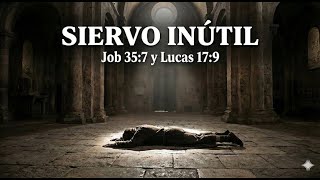
The Liberating Truth of Divine Sufficiency and Human Unprofitability
If you are righteous, what do you give Him, or what does He receive from your hand? — Job 35:7
Does he thank the servant because he did what he was told? — Luke 17:9
Summary: Humanity often presumes a transactional relationship with the Divine, yet the Judeo-Christian tradition vigorously dismantles this notion. The Book of Job reveals God's absolute self-sufficiency, clarifying that our righteousness gives Him nothing and does not enhance His inherent glory. Jesus' parable further teaches us to confess ourselves as "unprofitable servants," having merely done our duty without creating surplus merit or putting God in our debt. These two truths combine to underscore the radical nature of grace, freeing believers from the burden of earning favor or repaying God. Our service and worship, therefore, flow from gratitude for the boundless grace we have already received, transforming us from those who give to God into those who receive everything from Him.
From the earliest sacrificial cults to contemporary views of faith, humanity has often sought a transactional relationship with the Divine, assuming a reciprocal exchange where our worship or good deeds somehow "benefit" God, earning us blessings in return. Yet, the Judeo-Christian tradition vigorously dismantles this notion, establishing an immense ontological asymmetry between Creator and creature. Two pivotal insights, one from the Old Testament and one from the New, combine to declare that there can be no "profit" in our relationship with God.
The first profound truth comes from the Book of Job, where the wise Elihu challenges Job's subtle implication that human righteousness might put God in our debt. Elihu asserts that if we are righteous, we give nothing to God, nor does He receive anything from our hand. This foundational declaration unveils the doctrine of Divine Aseity – God's absolute self-existence and utter lack of need. Our sin does not diminish His essential glory, nor does our virtue enhance it. Unlike ancient Near Eastern deities who were thought to depend on human provision and worship, the God of the Bible is entirely self-sufficient. He needs no "feeding" or service from us; His justice is impartial because He cannot be bribed, and His glory is inherent, not sustained by our acknowledgment. Our worship, therefore, is not a service rendered to meet His needs, but a responsive recognition of His inherent worth and a posture of receiving from His inexhaustible fullness.
The second crucial insight emerges from a parable shared by Jesus, where He illustrates the nature of discipleship through the scenario of a master and a slave. When the apostles requested an increase in faith, Jesus redirected their focus from spiritual heroism to humble duty. He describes a servant returning from exhausting labor, only to be immediately required to serve his master's meal before tending to his own needs. The master owes no thanks to this servant, for the servant has merely done what he was commanded to do. Critically, Jesus instructs His followers to likewise declare, "We are unprofitable servants; we have done that which was our duty to do." The term "unprofitable" here does not mean "useless" or "worthless," but rather that the servant has not generated any surplus merit. He has not put the Master in his debt; he has simply expended his existence (which already belongs to the Master) in fulfilling his assigned tasks. The flow of gratitude (`charis`) is strictly one-way: from God to us, never from God back to us for our "good deeds."
Historically, these two scriptural truths have been central to defining the doctrine of merit within the Church. While some traditions sought to create categories of merit (even if ultimately rooted in God's grace), the Reformation powerfully emphasized their combined force to reject human merit altogether. Reformers like Luther and Calvin insisted that our works cannot purchase salvation or put God in our debt because God is already entirely sufficient, and we, as His creatures and property, owe Him everything by default. There is no possibility of doing "more" than our duty, no room for works of supererogation, because the command is to love God with all our being. Even perfect obedience would only bring us to the zero-point of duty, never creating a surplus to earn us favor.
For believers, this theological synthesis is profoundly liberating and edifying. It shatters the "payback trap"—the insidious belief that we must somehow earn or repay God for His salvation and blessings. Such attempts insult God's self-sufficiency and treat Him as a merchant. Instead, understanding that God needs nothing from us and that we can offer nothing to put Him in our debt frees us from the treadmill of performance and the burden of guilt. Our service and obedience, while commanded and necessary, flow not from a desire to earn God's favor, but from gratitude for the favor we have already freely received.
This understanding reshapes our worship, transforming it from a "service" we render to God into an act of receiving from Him. We come with empty hands, not to fill His, but to have ours filled. When we confess ourselves as "unprofitable servants," it is not self-abasement but truth-telling—the necessary posture to fully grasp and receive His boundless grace. The "rewards" promised in scripture are not wages for merit earned, but rather further expressions of God's abundant generosity, freely given to those who, by grace, faithfully carry out their duty.
In conclusion, the combined message of God's perfect self-sufficiency and humanity's inherent unprofitability profoundly underscores the radical nature of grace. Because God cannot be bought, salvation must be free. Because we cannot pay, redemption must be a gift. To embrace the identity of the "unprofitable servant" is to lay down the heavy yoke of self-justification and take up the light yoke of Christ's righteousness. It is to find true freedom and joy in serving a Master who needs nothing from us, yet, in His incomprehensible love, gives everything to us, making us truly profitable through His own perfect service.
What do you think?
What do you think about "The Liberating Truth of Divine Sufficiency and Human Unprofitability"?
Related Content
Unprofitable Servant
The Willingness to Be a Humble Servant of the Heavenly Father
What should be our attitude and what should be the way in which we relate to God from day to day? What should be that self-image that we have when we ...
The Ontological Asymmetry: a Systematic and Exegetical Report on the Interplay of Job 35:7 and Luke 17:9-10
Job 35:7 • Luke 17:9
1. Introduction: The Theological Crisis of Reciprocity The history of religious thought is largely the history of humanity’s attempt to establish a t...
Song (Other Languages)