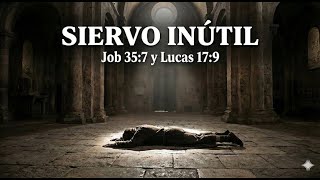
The Ontological Asymmetry: a Systematic and Exegetical Report on the Interplay of Job 35:7 and Luke 17:9-10
Job 35:7 • Luke 17:9
Summary: The history of religious thought consistently reveals humanity's impulse to establish a transactional relationship with the Divine, viewing faith as a means to extract blessings or satisfy perceived divine needs. However, the Judeo-Christian scriptural tradition vehemently challenges this notion of reciprocity. We find the twin pillars of this critique in Elihu’s wisdom disputation in Job 35:7 and the Lord’s parable of the master and the slave in Luke 17:9-10. Analyzed together, these passages dismantle the very possibility of human "profit" in our relationship with God, unveiling an ontological asymmetry so vast that human merit becomes not merely erroneous, but metaphysically impossible.
From the perspective of the Creator, Job 35:7 asks, "If thou be righteous, what givest thou him? or what receiveth he of thine hand?" This rhetorical question asserts the doctrine of Divine Aseity—God’s absolute self-existence and utter lack of need. Our righteousness cannot add to His perfection, nor can our sin diminish His essential glory. This truth stands in stark contrast to ancient near eastern religions where deities were dependent on human sacrifices. God needs nothing from us; therefore, our religious practice cannot be a system of supplying His needs in exchange for favors. Worship, then, is not a service to sustain God's glory, but an acknowledgement of His inherent, self-sufficient glory.
Conversely, Luke 17:10 illuminates the creature's inherent insufficiency: "So likewise ye, when ye shall have done all those things which are commanded you, say, We are unprofitable servants: we have done that which was our duty to do." Even perfect obedience from a servant does not generate a surplus of merit or put the master in debt. The term "unprofitable" (achreios) here means bringing no gain or economic advantage to the master. We simply fulfill our duty. Thus, the Master owes the servant no *charis*—no debt of gratitude for service rendered. The profound implication is that God is never "grateful" to us in a way that suggests He has been benefited by us, or placed in our debt. The flow of grace and gratitude remains strictly one-way, from Heaven to Earth.
This radical synthesis of divine self-sufficiency and human unprofitability became the central battleground in defining merit throughout church history. While figures like Aquinas attempted to find a place for merit based on God's ordination rather than human contribution, the Reformers, including Luther and Calvin, returned to the stark reality of the Job-Luke nexus. For them, merit is impossible; our best works are merely our duty and, if offered to earn favor, are tainted. This theological framework ultimately destroys the concept of supererogation and redefines all biblical "rewards" as pure gifts of grace. We are commanded to love God with all that we are, leaving no room for "extra" deeds.
Embracing our identity as "unprofitable servants" is, paradoxically, liberating. It frees us from the exhausting treadmill of attempting to "pay God back" for salvation, which is an affront to His Aseity. Instead, we serve not for wages or to earn His favor, but out of grateful response to the boundless grace we have already received. Our worship, therefore, becomes an act of humility, bringing empty hands to receive from a God who needs nothing, yet gives everything—a truth that allows us to find true joy in His Master's presence.
1. Introduction: The Theological Crisis of Reciprocity
The history of religious thought is largely the history of humanity’s attempt to establish a transactional relationship with the Divine. From the sacrificial cults of the Ancient Near East (ANE), which sought to feed the gods in exchange for rain and harvest, to the contemporary prosperity gospels that view faith as a lever to extract blessings, the human impulse has consistently drifted toward the concept of reciprocity. This impulse assumes a symmetry of needs: the deity needs worship, and the human needs blessing; therefore, a contract of exchange can be established.
However, the Judeo-Christian scriptural tradition launches a sustained assault on this symmetry. Two texts, separated by nearly a millennium of history and distinct literary genres, stand as the twin pillars of this critique: the wisdom disputation of Elihu in Job 35:7 and the dominical parable of the master and the slave in Luke 17:9-10. When analyzed in concert, these passages dismantle the possibility of "profit" in the God-man relationship. They posit an ontological asymmetry so vast that it renders the concept of human merit not merely theologically erroneous, but metaphysically impossible.
Job 35:7 asks the question from the perspective of the Creator’s sufficiency: "If thou be righteous, what givest thou him? or what receiveth he of thine hand?". This rhetorical interrogation asserts the doctrine of Divine Aseity—God’s absolute self-existence and lack of need. Luke 17:10 answers from the perspective of the creature’s insufficiency: "So likewise ye, when ye shall have done all those things which are commanded you, say, We are unprofitable servants: we have done that which was our duty to do".
This report provides an exhaustive analysis of the interplay between these two texts. It explores the philological nuances of the Hebrew nathan (give) and the Greek achreios (unprofitable), the historical reception of these verses in the debates over merit between Rome and the Reformation, and the existential implications for the believer’s psychology. By synthesizing the wisdom of the Old Testament with the parables of the New, we arrive at a theology of worship that is entirely non-commercial—a worship that brings an empty bucket to a fountain that cannot be filled, only enjoyed.
2. Part I: The Voice from the Whirlwind’s Antechamber (Job 35:7)
2.1. The Dramatic Context: Elihu’s Intervention
To fully grasp the theological weight of Job 35:7, one must situate it within the dramatic architecture of the Book of Job. The dialogue has stalled. Job’s three friends—Eliphaz, Bildad, and Zophar—have exhausted their arguments, which essentially amount to a rigid retribution theology: suffering is the result of sin; therefore, Job must have sinned. Job, maintaining his innocence, has effectively backed himself into a corner where his vindication seems to require God’s indictment. If Job is innocent, and he is suffering, then God must be unjust.
Into this impasse steps Elihu. Scholarly opinion on Elihu has historically been divided. Some critics view him as an arrogant youth, a mere repetition of the three friends, or even a later editorial insertion meant to soften the transition to God’s appearance. However, a close reading suggests a distinct theological function. Unlike the three friends, Elihu is not rebuked by God in the epilogue of the book. While God commands Eliphaz and his companions to offer sacrifices for their folly (Job 42:7), Elihu is passed over in silence. This silence is often interpreted not as dismissal, but as tacit endorsement. Elihu serves as the "antechamber" to the Whirlwind, preparing the theological ground for Yahweh’s own self-disclosure.
Elihu’s speech shifts the focus from the anthropocentric (Job’s suffering) to the theocentric (God’s nature). In Chapter 35, he addresses Job’s subtle implication that righteousness is futile if it does not guarantee favorable treatment. Job is quoted as asking, "What profit shall I have, if I be cleansed from my sin?" (Job 35:3). Elihu’s response in verses 6-7 is a radical decoupling of human morality from divine necessity.
2.2. Exegesis of Job 35:7
The text of Job 35:7 reads in the King James Version: "If thou be righteous, what givest thou him? or what receiveth he of thine hand?". The Hebrew structure relies on two parallel rhetorical questions that demand a negative answer.
| Hebrew Lemma | Transliteration | Meaning | Theological Implication |
| צָדַק | tsadaq | To be righteous/just | Refers to adherence to the covenantal or moral standard. |
| נָתַן | nathan | To give | Implies a transfer of goods, adding to the recipient's assets. |
| לָקַח | laqach | To take/receive | Implies the recipient had a lack that is now filled. |
| יָד | yad | Hand | Anthropomorphic symbol of human agency and capability. |
The Argument Against "Theomorphic Projection": Elihu is attacking the error of projecting human limitations onto God. In human relationships, righteousness is profitable. If a citizen obeys the law, the king’s realm is stable. If a child obeys a parent, the household runs smoothly. Human authority figures need the obedience of their subordinates to succeed. Elihu argues that Job has committed a category error by applying this sociopolitical dynamic to the Creator.
-
The Sin Argument (v. 6): "If thou sinnest, what doest thou against him?" Human rebellion does not diminish God’s essential glory. It does not threaten His throne. God is not "hurt" by sin in the way a human victim is hurt by a crime. His judgment against sin is, therefore, not an act of self-defense or emotional lashing out, but an act of pure, dispassionate justice.
-
The Righteousness Argument (v. 7): Conversely, human virtue does not "add" to God. He does not "receive" (laqach) anything. This verb is crucial; it denotes taking something into one's possession that was previously external. If God were to "receive" something from a human hand, it would imply that God was previously lacking that thing, or that the thing originated independently of God.
2.3. Ancient Near Eastern Context: The Rejection of Divine Dependence
The radical nature of Job 35:7 is best appreciated against the backdrop of ANE religion. In the Babylonian creation epic, Enuma Elish, and the Atra-hasis epic, humanity is created specifically to relieve the gods of labor. The lower gods (Igigi) rebel against the toil of digging canals, so the high gods create humans to take over the workload and to provide food through sacrifices.
In this worldview, the relationship is symbiotic. The gods provide order and rain; humans provide food and housing (temples). If humans stop sacrificing, the gods starve (as depicted in the flood narrative of Gilgamesh, where the gods swarm like flies around the first sacrifice after the waters recede).
Elihu’s theology, which is later confirmed by Yahweh’s speech in Job 38-41, represents a polemical rejection of this symbiosis. Yahweh does not need "feeding." As Psalm 50:12 echoes, "If I were hungry, I would not tell thee: for the world is mine, and the fulness thereof". Job 35:7 is the philosophical formulation of this truth: God is Self-Sufficient. He has no needs that human hands can supply. Therefore, religion cannot be a system of meeting God’s needs in exchange for favors.
2.4. The Doctrine of Divine Aseity
The theological term for the truth of Job 35:7 is Aseitas (Aseity)—from the Latin a se, meaning "from himself." God’s existence and beatitude are derived solely from His own nature.
-
Implications for Justice: Because God needs nothing, His justice is impartial. He cannot be bribed by human righteousness because He has no price. A judge who needs money can be corrupted; a Judge who owns the universe cannot.
-
Implications for Worship: Worship is not a "service" to God in the sense of maintenance. It is a response to reality. We do not worship to sustain God’s glory, but to acknowledge it.
The Open Theism Debate: Contemporary debates regarding Open Theism challenge the classical understanding of Aseity. Open Theism suggests a more mutually influential relationship, where God is arguably "affected" by human choices to the point of changing His plans. However, texts like Job 35:7 stand as a bulwark against this. While God relates to humans relationally (grieving, rejoicing), Elihu insists this does not cross the threshold into ontological dependence. God’s essence remains untouched by human "profit" or "loss".
3. Part II: The Sociology of Grace (Luke 17:7-10)
3.1. The Literary Context: From Faith to Duty
If Job 35:7 establishes the view from above (God’s independence), Luke 17:7-10 establishes the view from below (Man’s dependence). The placement of this parable is critical. In Luke 17:5, the apostles ask the Lord, "Increase our faith." The context implies a desire for visible power—faith that can perform miracles, faith that validates their status as leaders.
Jesus responds first with the image of the mustard seed (v. 6), suggesting that the quantity of faith is less important than its presence. He then immediately launches into the parable of the master and the servant. The juxtaposition is jarring but intentional. Jesus is diagnosing a hidden pride in the disciples' request. They viewed "increased faith" as a means to spiritual heroism. Jesus counters by framing the life of the disciple not as a hero’s journey, but as a slave’s duty.
3.2. Historical Criticism: The Reality of 1st-Century Slavery
To feel the force of Jesus’ argument, one must suspend modern democratic sensibilities and enter the harsh sociology of the 1st-century Roman and Jewish world.
-
The Doulos: The Greek word doulos describes a bond-servant or slave. In the agrarian economy, the slave was an extension of the master’s household. The slave had no legal standing to demand "rights" or "rest" before the master was satisfied.
-
The Scenario: A slave returns from "plowing or feeding cattle" (v. 7)—exhausting physical labor. A modern employer might say, "Great job, take a break." But the master in the parable operates on the logic of ownership: "Make ready wherewith I may sup, and gird thyself, and serve me... and afterward thou shalt eat and drink" (v. 8).
Jesus does not endorse the cruelty of the institution; rather, He uses the acknowledged reality of the master-slave dynamic to illustrate a theological point. If a human master, who is merely a man, expects total priority over his servant, how much more does the Creator, who is the source of the servant’s very life? The disciples are told to identify not with the master, but with the slave. The "thanks" (charis) of the master is not owed to the slave, because the slave is merely functioning according to his design.
3.3. Philological Deep Dive: The Meaning of Achreios
The pivot point of the parable—and its connection to Job 35—is the adjective in verse 10: "Say, We are unprofitable (achreios) servants." The translation of achreios has generated significant debate among lexicographers and theologians, as it shapes the anthropology of the text.
Table 1: Lexical Analysis of Achreios (ἀχρεῖος)
| Translation | Source/Context | Nuance | Theological Risk |
| Useless | Lit. derivation (a + chreios) | "Of no use," "good for nothing." (See Matt 25:30). | Contradicts the context—the servant did plow and serve. He was useful. |
| Worthless | NRSV, Some Patristics | Emphasizes moral depravity or lack of value. | Can lead to a theology of self-hatred or "worm theology." |
| Unprofitable | KJV, NKJV, Douay-Rheims | Economic metaphor. Bringing no gain or surplus. | Aligns best with Job 35. The servant balances the books but creates no surplus. |
| Unworthy | NASB, NIV, ESV | Relational/Meritorious. Deserving no special praise. | Captures the humility required, but loses the economic link to "profit." |
The "Profit" Connection:
The KJV/NKJV translation "unprofitable" preserves the link to the Joban wisdom tradition. In Job 35:7, man cannot "give" to God. In Luke 17:10, man is "unprofitable."
-
Why Unprofitable? The servant has done "all those things which are commanded." He has been perfectly obedient. How is he unprofitable?
-
The Explanation: He is unprofitable because he has not generated a surplus of merit. He has not put the Master in his debt. The Master is not "richer" in a way that requires him to pay the servant a dividend. The servant has simply consumed his own existence (which belongs to the Master) in the service of the Master.
3.4. The Grammar of Gratitude: Charis
Verse 9 asks: "Doth he thank (me echei charin) that servant?"
Literally, "Does he have grace toward that servant?" In this context, charis implies a debt of gratitude, a favor owed in return for service. Jesus expects the answer "No."
This is the linguistic key to the connection with Job 35.
-
Job 35: God receives nothing -> God owes nothing.
-
Luke 17: The servant gives only duty -> The Master owes no charis. The theological implication is shattering: God is never grateful to us. Gratitude implies that the recipient has been benefited by the giver. Since God cannot be benefited (Job 35), He never owes us gratitude. Conversely, we owe Him infinite gratitude. The flow of charis is strictly one-way, from Heaven to Earth.
4. Part III: The Wars of Merit – Historical Theology
The interplay of these texts became the central battlefield in the Western Church's struggle to define the doctrine of merit. How can a just God reward works if those works are "unprofitable" and "due"?
4.1. The Patristic Consensus
The early Church Fathers generally used Luke 17:10 to preach humility. Augustine of Hippo, in his debates with Pelagius, wielded this text to destroy the idea that human free will could initiate salvation. Augustine’s famous dictum, "God crowns his own gifts, not our merits," is essentially an exposition of the Job-Luke synthesis. If we are unprofitable servants, then any reward we receive is a result of God’s generosity, not our generated value.
4.2. The Medieval Synthesis: Aquinas on Job and Luke
Thomas Aquinas faces the tension head-on in the Summa Theologiae (I-II, q. 114, a. 1). He asks: Can man merit anything from God?
-
Objection 1: Cites Luke 17:10 ("We are unprofitable servants") to argue merit is impossible because we only do our duty.
-
Objection 2: Cites Job 35:7 ("What receiveth he of thine hand?") to argue merit is impossible because our works do not benefit God.
Aquinas’s Solution:
Aquinas distinguishes between two types of value in human works: Profit and Glory.
-
Profit (Reply to Obj. 2): Aquinas concedes that man cannot "profit" God. God is perfect. Therefore, strict commutative justice (giving equal value for value received) does not exist between God and man.
-
Glory/Ordination (Reply to Obj. 1): However, Aquinas argues that God seeks Glory—the manifestation of His goodness. He has ordained that man should receive eternal life as a reward for working by grace.
This leads to the distinction between Condign Merit and Congruous Merit:
-
Condign Merit: A claim to reward based on the intrinsic value of the work. Aquinas denies this in the absolute sense between Creator and creature but allows it in a relative sense because the Holy Spirit moves the believer.
-
Congruous Merit: A reward given because it is "fitting" for God’s generosity.
Aquinas uses Job 35 and Luke 17 to set the boundary (we don't profit God), but he constructs a system of merit within that boundary based on God’s ordination.
4.3. The Reformation Rupture: The Death of Merit
The Reformers viewed the Thomistic distinction as too subtle and prone to abuse (e.g., indulgences). They returned to the "brute fact" of the Job-Luke synthesis.
-
Martin Luther: For Luther, the "unprofitable servant" is the definition of the Christian. He famously argued that all our good works are "mortal sins" if done with the intention of earning justification. He utilized Job 35:7 to argue that God does not need our works; our neighbors need our works. Therefore, the "profit" of righteousness (Job 35:8) is entirely horizontal.
-
John Calvin: In his commentary on Luke 17, Calvin is ruthless. He argues that the parable proves God "claims all that belongs to us as his property." There is no room for merit because there is no room for private ownership of our actions. If I am God’s property, my actions are God’s property. One does not pay one's hammer for hitting the nail.
Comparison of Confessional Standards:
| Document | Usage of Texts | Doctrinal Conclusion |
| Heidelberg Catechism (Q. 63) | Cites Luke 17:10 to explain why good works cannot be our righteousness. |
Reward is of Grace, not Merit. Even "best works" are stained with sin. |
| Westminster Confession (Ch. 7 & 16) | Cites Job 35:7-8 and Luke 17:10 to establish the "infinite distance" between God and man. |
Reward is only possible by "voluntary condescension" (Covenant). Merit is impossible by nature. |
| Council of Trent (Canon 32) | Implicitly rejects the Protestant reading of "unprofitable" as "sinful." |
Upheld that good works are meritorious (condignly) for the increase of grace, though grounded in Christ. |
4.4. Karl Barth: The Christological Servant
Karl Barth, the great neo-orthodox theologian, reframed the discussion in the 20th century. For Barth, the only true "Servant" who fulfilled the command of Luke 17:10 is Jesus Christ.
-
The Vicarious Humanity: Humans are not just "unprofitable"; they are rebellious. Only Christ obeyed "all those things which are commanded."
-
The Divine Humility: Barth interprets the "unprofitable servant" not just as human lack, but as a reflection of the Divine Son’s willingness to be "no reputation" (Phil 2:7). The interplay of Job 35 (God’s height) and Luke 17 (Man’s depth) is resolved in the Incarnation, where the High God becomes the Low Servant.
5. Part IV: Systematic Synthesis – The Economy of Grace
Having traversed the exegetical and historical landscape, we must now synthesize the theological data into a coherent system. The interplay of Job 35:7 and Luke 17:10 constructs a distinct "Economy of Grace."
5.1. The Impossibility of Supererogation
Supererogation is the performance of good works beyond what is commanded. This concept is foundational to the idea of a "Treasury of Merit" (where saints' excess merits are stored).
The synthesis of Job and Luke destroys the possibility of supererogation:
-
The Extent of the Command (Luke 17): We are commanded to love God with all our heart, soul, mind, and strength.
-
The Limit of Performance: It is impossible to do more than "all."
-
The Result: Even if one achieved perfection, they would only reach the zero-point of duty. There is no "extra" righteousness possible. Therefore, every saint is an "unprofitable servant" in terms of surplus.
5.2. The Definition of "Reward" as "Gift"
If merit is impossible, what do we make of biblical rewards? The scriptures promise crowns, authority over cities, and the phrase "Well done, good and faithful servant" (Matt 25:21).
-
The Contrast with Matthew 25: In Matthew 25, the "unprofitable" (achreios) servant is cast into outer darkness. In Luke 17, the achreios servant is simply doing his duty.
-
Resolution: Matthew 25 condemns the lazy servant (who did nothing). Luke 17 describes the faithful servant (who did everything).
-
The Paradox: The faithful servant of Luke 17 is still achreios (without merit) but is not condemned. He is rewarded. Why?
-
The Answer: Because the reward is a Gift. The Master in Luke 12:37 ("he shall gird himself... and serve them") does exactly what the Master in Luke 17:7 says he won't do.
-
Synthesis: By Law (Luke 17), the Master owes nothing. By Grace (Luke 12), the Master gives everything. The transition from Luke 17 to Luke 12 is the transition from the Covenant of Works to the Covenant of Grace.
-
5.3. Psychological Implications: The Freedom of Debt
The modern mind views "debt" as negative. However, the Job-Luke synthesis presents spiritual debt as the source of joy.
-
The Payback Trap: Many Christians live in a cycle of guilt, trying to "pay God back" for salvation. This assumes God can be profited (denying Job 35).
-
Piper’s "Future Grace": John Piper argues that trying to pay God back is an insult. It treats God like a merchant. God is a Mountain Spring. We honor the spring not by hauling buckets of water up to it (works of merit), but by drinking freely from it (works of faith).
-
Application: The "unprofitable servant" identity liberates the believer from the treadmill of performance. We work hard (Luke 17 duty) not to buy God’s favor, but because we have already received it freely. The pressure to "balance the books" is gone because the books are un-balanceable.
5.4. Worship: The Empty Bucket
The final implication is for corporate worship. Job 35:7 teaches that God receives nothing from our hands. This means our songs, our tithes, and our prayers do not "enrich" God.
-
Theocentric Worship: We do not gather to "meet God’s needs." We gather to have our needs met by Him.
-
The "Unworthy" Liturgy: When the church confesses "We are unworthy servants," it is not groveling. It is truth-telling. It is the necessary posture to receive grace. Only the empty hand can be filled. As long as the servant thinks he is "profitable," he is clutching his own coins and cannot receive the Master’s gold.
6. Conclusion: The Joy of the Unprofitable
The interplay of Job 35:7 and Luke 17:9-10 offers a devastating critique of human pride and a glorious affirmation of divine sufficiency.
Job 35:7 establishes the Height of God: He is the Self-Sufficient One, above all need, beyond all profit, the Uncaused Cause who cannot be placed in debt by human morality.
Luke 17:10 establishes the Depth of Man: We are commanded servants, owning nothing but our duty, incapable of generating merit, forever dependent on the Master’s provision.
In the vast space between this Height and Depth, the Gospel of Grace emerges. Because God cannot be bought, salvation must be free. Because man cannot pay, redemption must be a gift.
The synthesis of these texts teaches us that the only "profit" in the universe flows from God to Man, not Man to God. Our righteousness cannot save us, but His righteousness can. Our service cannot enrich Him, but His service to us—in the form of the Suffering Servant who "came not to be ministered unto, but to minister" (Mark 10:45)—enriches us eternally.
To embrace the identity of the "unprofitable servant" is, paradoxically, to enter into the "joy of the Master." It is to lay down the heavy burden of merit-keeping and pick up the light yoke of gratitude. The "unprofitable servant" of Luke 17 is the only one who can truly sing the "songs in the night" mentioned in Job 35:10. For only when one abandons the hope of earning the daylight can one receive the song as a pure, unmerited gift from the Maker who needs nothing, yet gives everything.
The servant who knows he is unprofitable is the only servant who is truly free. He serves not for the wage, but for the love of the Master. And in that service, he finds a profit that was never his to earn, but was always the Master's to give.
Appendix A: Comparative Textual Analysis
| Feature | Job 35:7 (OT Wisdom) | Luke 17:7-10 (NT Parable) | Synthesis |
| Primary Question | "What givest thou him?" | "Doth he thank that servant?" | Both question the "value add" of the human agent. |
| Direction of Flow | Man -> God (Denied) | Master -> Servant (Denied) | Rejection of upward flow of benefit/debt. |
| Key Term | Nathan (Give/Add) | Achreios (Unprofitable) | Human works add no asset value to the Divine. |
| Outcome | God is unaffected. | Servant is un-thanked. | Relationship is defined by Duty and Grace, not Commerce. |
| Underlying Doctrine | Divine Aseity (Self-Sufficiency) | Divine Sovereignty (Ownership) | Total dependence of the creature on the Creator. |
Appendix B: Historical Interpretations of Merit
| Tradition | Interpretation of "Unprofitable" | View of Merit |
| Roman Catholic (Aquinas) | We cannot profit God essentially, but can glorify Him. | Congruous Merit: God rewards works because it fits His generous nature and ordination. |
| Lutheran (Luther) | We are truly unworthy; works justify us before men (Job 35:8), not God. | Rejection: Merit is a "mortal sin" of pride. Justification is by faith alone. |
| Reformed (Calvin/Westminster) | We are God's property; we owe Him everything. | Covenantal: Reward is a "voluntary condescension," not a payment for value received. |
| Modern Evangelical (Piper/Keller) | We cannot put God in debt ("Payback"). | Future Grace: Obedience is banking on God's future promises, not paying for past grace. |
What do you think?
What do you think about "The Ontological Asymmetry: A Systematic and Exegetical Report on the Interplay of Job 35:7 and Luke 17:9-10"?
Related Content
Unprofitable Servant
The Willingness to Be a Humble Servant of the Heavenly Father
What should be our attitude and what should be the way in which we relate to God from day to day? What should be that self-image that we have when we ...
The Liberating Truth of Divine Sufficiency and Human Unprofitability
Job 35:7 • Luke 17:9
From the earliest sacrificial cults to contemporary views of faith, humanity has often sought a transactional relationship with the Divine, assuming a...
Song (Other Languages)