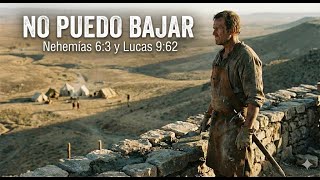
The Architecture of Consecration: a Comprehensive Intertextual Analysis of Nehemiah 6:3 and Luke 9:62
Nehemiah 6:3 • Luke 9:62
Summary: The biblical narrative, through texts like Nehemiah 6:3 and Luke 9:62, articulates a consistent theology of vocation requiring a radical reordering of priorities for divine service. Though separated by half a millennium and distinct genres, these passages converge to define the psychological and spiritual prerequisites for those engaged in God's work. This unified framework centers on unwavering focus, rendering the servant immune to compromise and the nostalgic pull of the past.
Nehemiah 6:3, arising from the intense pressure of rebuilding Jerusalem's walls, declares a vertical hierarchy of value: "I am doing a great work and I cannot come down." This statement is not merely about logistics; it’s a theological assertion that God’s work occupies an elevated moral plane, from which any departure for diplomatic engagement with enemies like Sanballat constitutes a degradation. To descend from this high calling is to risk the cessation of the essential work, demonstrating that faithful service demands an uncompromised commitment to divine purpose.
Parallel to this, Luke 9:62 presents a linear imperative from the ministry of Jesus. To the prospective disciple who hesitates, Jesus states with severe clarity: "No one who puts his hand to the plow and looks back is fit for the kingdom of God." This agricultural metaphor illustrates that a backward glance, driven by sentiment or distraction, inevitably leads to a crooked furrow, rendering the worker useless for the Kingdom's forward movement. It reveals that service demands an absolute forward trajectory, where dwelling on the past or divided loyalties makes one functionally incapable of the task at hand.
Synthesizing these texts reveals a complex "geometry of consecration." Nehemiah's refusal to "come down" addresses the danger of external pressures and compromise, while Jesus' command not to "look back" confronts internal hesitations and nostalgia. Both pathways of distraction, whether interruption or deviation, lead to the incompletion of God's assignment. Ultimately, Christ Himself stands as the supreme example of this focus, refusing to "come down" from the cross and setting His face resolutely toward Jerusalem, thereby becoming the model for all who would be "fit" for the Kingdom.
Therefore, the Kingdom of God is built by those who possess a monopoly of focus. This demands that we, like Nehemiah, maintain our spiritual elevation by refusing to engage in compromising distractions, saying, "I cannot come down." It also requires us, like the Master Plowman, to maintain our forward trajectory, setting our gaze on the task ahead and refusing to "look back" at the allure of the past. In an age of pervasive distraction, this radical, militant focus is not merely an option, but a divine prerequisite for finishing the great work to which we are called.
1. Introduction: The Geometry of Divine Focus
The biblical narrative, spanning the vast chronological and cultural chasm between the Persian restoration period and the Roman occupation of Judea, maintains a startling continuity regarding the psychological and spiritual prerequisites of divine service. Within the canon of Scripture, two texts stand as monumental pillars defining the posture of the servant of God: Nehemiah 6:3 and Luke 9:62. While separated by nearly half a millennium, a change in language from Hebrew to Greek, and a shift in genre from historical memoir to gospel narrative, these two passages converge to articulate a unified theology of vocation. This theology is predicated on a radical reordering of priorities that renders the servant immune to the gravitational pull of compromise and the nostalgic allure of the past.
The first text, Nehemiah 6:3, emerges from the gritty reality of physical reconstruction. Nehemiah, the cupbearer-turned-governor, stands atop the partially completed fortifications of Jerusalem. Faced with a relentless diplomatic insurgency led by regional warlords, he issues a declaration of vocational immobility: "I am doing a great work and I cannot come down." This statement establishes a vertical hierarchy of value, positing that the work of God occupies a moral elevation from which any departure is a degradation.
The second text, Luke 9:62, arises from the itinerant ministry of Jesus of Nazareth. As He sets His face toward the inevitable confrontation in Jerusalem, He encounters the hesitant, the comfort-seeking, and the double-minded. To the prospective disciple who wishes to negotiate the terms of following, Jesus employs an agricultural metaphor of severe clarity: "No one who puts his hand to the plow and looks back is fit for the kingdom of God." Here, the imperative is linear. The Kingdom demands a forward trajectory so absolute that the very act of turning one's head constitutes a disqualification.
This report undertakes an exhaustive analysis of the interplay between these two scriptures. It serves not merely to juxtapose them but to synthesize them into a robust theological framework for leadership and discipleship. By examining the historical contexts, linguistic nuances, and typological resonances of the "Great Work" (melakah gedolah) and "Kingdom Fitness" (euthetos), we reveal a singular spiritual law: that the magnitude of a divine assignment necessitates a corresponding magnitude of focus. The analysis will demonstrate that the "Plain of Ono"—the site of Nehemiah's proposed compromise—and the "looking back" of the Lukan plowman are spiritual equivalents, representing the perennial threat to the completion of God's work.
2. Historical and Situational Context of Nehemiah 6:3
To fully grasp the weight of Nehemiah’s refusal, one must first inhabit the precarious political landscape of fifth-century Yehud. The reconstruction of Jerusalem was not merely a civic improvement project; it was a geopolitical provocation.
2.1 The Geopolitics of Reconstruction
The year is approximately 445 B.C., during the twentieth year of Artaxerxes I. The Jewish remnant, returned from Babylonian exile, exists as a vulnerable minority surrounded by hostile provincial powers. Nehemiah, having arrived with royal letters of authority, disrupted the delicate balance of power in the Trans-Euphrates region.
The opposition was not monolithic but a coalition of regional powers representing the cardinal directions surrounding Jerusalem:
-
North: Sanballat the Horonite, the governor of Samaria. He represents the established political rival, fearing the resurgence of Jerusalem as a capital that would eclipse Samaria.
-
East: Tobiah the Ammonite. Likely a Jewish-Ammonite official with deep family ties into the Jerusalem nobility, representing the enemy within the gates—the danger of syncretism and nepotism.
-
South: Geshem the Arab. Ruler of the Qedarite confederacy, controlling trade routes and representing the broader Gentile opposition.
By the time the narrative reaches Nehemiah 6, the project has entered its most critical and dangerous phase. The text notes that "the wall was built, and there was no breach left in it," though "the doors had not yet been set in the gates". This detail is architecturally and strategically significant. A wall without gates is a funnel; it channels traffic but cannot stop an army. The city was enclosed but not yet secure. The physical work was 90% complete, but the functional security was at 0% until the gates were hung. It is precisely at this moment of "almost finished" that the enemy's strategy shifts from direct military intimidation (Nehemiah 4) to subtle diplomatic deception.
2.2 The Strategic Trap: The Plain of Ono
Sanballat and Geshem send a message: "Come, let us meet together in some one of the villages in the plain of Ono" (Nehemiah 6:2). The geography of this invitation is laden with subtext. The Plain of Ono was located in the coastal plain (the Shephelah), roughly twenty to thirty miles northwest of Jerusalem, near the border of Samaria and Ashdod.
This location offered a veneer of neutrality. It was neither in Sanballat's Samaria nor in Nehemiah's Jerusalem. It was a "middle ground," a place for reasonable men to iron out their differences. However, the geographic reality betrayed the intent. For Nehemiah to travel to Ono would require a journey of at least a day, leaving the work site leaderless at its most critical juncture. Furthermore, Ono was dangerously close to the territory of Ashdod, another enemy of the Jews. Nehemiah’s discernment is immediate and blunt: "But they thought to do me mischief" (Nehemiah 6:2). The invitation was an assassination plot masked as a peace summit.
The persistence of the enemy—sending the same message four times (Nehemiah 6:4)—reveals a strategy of attrition. They calculated that Nehemiah, weary from the labor and pressure, might eventually succumb to the desire for a reprieve or the fear of appearing unreasonable. When the private invitations failed, Sanballat escalated to an "open letter" (Nehemiah 6:5), a form of ancient propaganda designed to spread rumors of rebellion among the populace and the Persian officials.
2.3 The Theological Significance of "Coming Down"
In this context, Nehemiah’s response in verse 3—"I am doing a great work and I cannot come down"—is not merely a scheduling conflict. It is a theological declaration of the incompatibility of the holy and the profane.
The phrase "come down" (yarad) carries a double meaning.
-
Topographical: Jerusalem is situated in the Judean highlands, roughly 2,500 feet above sea level. Ono, in the coastal plain, is significantly lower. To meet Sanballat required a literal descent.
-
Moral and Vocational: The work of rebuilding the City of God is an "ascent"—a high calling. To leave this work to engage in the petty squabbles and treacherous negotiations of Sanballat is a moral descent. Nehemiah recognizes that the "Great Work" elevates him. He cannot descend because his duty binds him to the higher elevation of God's purpose.
Nehemiah's rhetorical question, "Why should the work cease while I leave it and come down to you?", exposes the zero-sum nature of the conflict. There is no such thing as a harmless break. In the economy of the "Great Work," absence is cessation. The momentum of the entire community depended on the singular focus of the leader. Nehemiah understood that his physical presence on the wall was the glue holding the fragile coalition of builders together. To "go down" was to unravel the work.
3. Literary and Theological Context of Luke 9:62
If Nehemiah provides the architectural model of perseverance, Luke 9 provides the agricultural model. The context of this saying is the "Travel Narrative" or the "Journey to Jerusalem" (Luke 9:51–19:27), a massive section of the Third Gospel where Jesus instructs His disciples on the nature of the Kingdom while marching toward His own passion.
3.1 The Turning Point: Setting the Face
The section begins with a deliberate echo of the determined leader: "When the days drew near for him to be taken up, he set his face to go to Jerusalem" (Luke 9:51). This phrase, "set his face," is drawn from the Suffering Servant prophecy of Isaiah 50:7 ("I have set my face like a flint"). It parallels Nehemiah’s resolve. Jesus acts as the Greater Nehemiah, moving toward the Holy City not to build a wall of stone, but to tear down the wall of sin through His death.
As He journeys, He encounters three prospective followers (Luke 9:57-62). These encounters are designed to strip away the romanticism of discipleship and reveal its brutal cost.
-
The Volunteer: A man offers to follow anywhere. Jesus responds with the "Foxes have holes" proverb, stripping away the expectation of material security.
-
The Procrastinator: Jesus calls a man, who asks to first bury his father. Jesus responds, "Leave the dead to bury their own dead," stripping away the priority of social and familial duty.
-
The Hesitant: A man offers to follow but asks to first say farewell to his family. This request triggers the plow metaphor of verse 62.
3.2 The Agricultural Metaphor: The Plow and the Furrow
To understand the severity of Jesus' pronouncement—"No one who puts his hand to the plow and looks back is fit for the kingdom of God"—we must reconstruct the agricultural reality of first-century Palestine.
The plow in question was likely a light wooden scratch plow (ard), drawn by oxen or donkeys. Unlike modern heavy machinery which holds its line mechanically, the ancient plow required intense physical engagement and constant visual focus from the plowman. The plowman had to hold the handle with one hand and the goad with the other, leaning his weight to keep the share in the soil.
Crucially, the plowman had to fix his eyes on a distant object—a tree, a rock, or a hill—at the far end of the field. This focal point guided the oxen. If the plowman turned his head to look back, the shift in his shoulder and hand position would inevitably cause the plow to veer. A crooked furrow was disastrous for several reasons:
-
Inefficiency: It wasted land, leaving patches uncultivated.
-
Difficulty: It made the subsequent rows harder to plow.
-
Harvest Failure: It resulted in poor water retention and uneven crop growth.
Therefore, "looking back" was not merely a sentimental gesture; it was an act of vocational sabotage. A plowman looking backward is physically incapable of performing his task. He destroys the very work he claims to be doing.
3.3 The Elisha Precedent and the New Standard
The request of the third man ("Let me first say farewell to those at my home") is a direct allusion to the call of Elisha in 1 Kings 19:19-21. When Elijah cast his mantle on Elisha, the younger prophet asked to kiss his father and mother goodbye. Elijah granted this request ("Go back again, for what have I done to you?").
Jesus, however, refuses the request. This deliberate contrast signals a shift in the economy of salvation. The call of the Kingdom of God is more urgent than the call of the prophets. The "Greater Elijah" demands an allegiance that supersedes the deepest human ties. While Elisha eventually burned his plow and oxen to signify his total commitment, Jesus demands that the commitment be present at the moment of the call. There is no time for the farewell tour. The urgency of the harvest dictates the immediacy of the labor.
3.4 Linguistic Analysis: Euthetos
The Greek adjective used by Jesus is euthetos (εὔθετος). It is a compound word derived from eu (well) and tithemi (to place). It literally means "well-placed" or "suitable".
The translation "fit" can be misleading if understood as "worthy" (i.e., deserving of salvation). The context, however, is vocational utility. A plowman who looks back is not "bad"; he is "useless." He cannot be used to produce a straight furrow. Therefore, Jesus is defining the functional requirements for service in the Kingdom. The Kingdom is a realm of labor (Matthew 9:37), and God requires laborers who are euthetos—useful, adaptable, and focused. The double-minded man, the nostalgic man, the distracted man—these are "unfit" not because they are unforgiven, but because they are functionally incapable of the single-minded focus required to drive the Gospel furrow through the hard soil of the world.
4. Intertextual Synthesis: The Mechanics of the "Great Work"
When Nehemiah 6:3 and Luke 9:62 are overlaid, a complex "geometry of consecration" emerges. The two texts operate on perpendicular axes—the vertical and the linear—yet they describe the exact same spiritual phenomenon.
4.1 The Vertical Axis: Elevation vs. Degradation
Nehemiah establishes the vertical axis. The "Great Work" exists on a plane of high moral and spiritual elevation.
-
The Upward Call: To engage in God's work is to ascend. The wall of Jerusalem is physically higher than the Plain of Ono, but more importantly, the nature of the work is higher. It deals with covenant, protection, and the glory of Yahweh.
-
The Downward Pull: Distraction is always described as a descent. "Come down," say the enemies. To leave the work of God for the arguments of men is to step down from the throne of purpose into the mud of politics. The compromised leader is a "fallen" leader, even if they have not committed a "gross" sin. The simple act of engaging the enemy on their terms is a degradation.
4.2 The Linear Axis: Progression vs. Regression
Luke establishes the linear axis. The Kingdom of God is a movement forward in time and space.
-
The Forward Gaze: The plowman drives forward. The "face set like flint" is the posture of the Messiah and His followers. The Kingdom is eschatological; it lies ahead.
-
The Backward Glance: Distraction is described as a regression. "Looking back" (blepo eis ta opiso) is an attempt to live in two time zones simultaneously. It is the sin of Lot's wife—movement toward safety with a heart tethered to destruction.
4.3 The Convergence: The Geometry of Failure
Intersecting these axes reveals that spiritual failure has a specific geometry.
-
In Nehemiah, failure is interruption. "Why should the work cease?" The enemy wants to stop the progress by pulling the worker down.
-
In Luke, failure is deviation. The crooked furrow is a line that has lost its integrity. The enemy (or the flesh) wants to ruin the work by pulling the worker's gaze back.
Whether it is the "ceased work" of Nehemiah or the "crooked furrow" of Luke, the result is identical: the incompletion of the divine assignment. The wall remains vulnerable; the field remains barren. The theology of both texts is a theology of finishing. Nehemiah is recorded as having "finished the wall" (Nehemiah 6:15). Jesus cries out from the cross, "It is finished" (John 19:30). The "fit" servant is the one who refuses to stop or turn until the task is complete.
5. The Anatomy of Distraction: From Ono to Nostalgia
The comparative analysis further illuminates the nature of the distractions that threaten the "Great Work." While the mechanics of focus are similar, the sources of distraction in the two texts differ, covering the full spectrum of threats to the believer.
5.1 External Coercion: The "Plain of Ono"
In Nehemiah, the distraction is external and hostile. Sanballat and Tobiah are active agents of destruction.
-
The Guise of Reasonableness: The danger of Ono is that it looks like diplomacy. The enemy rarely says, "Stop building the wall so we can kill you." They say, "Let us meet together." They appeal to the leader's desire for peace, consensus, and reasonableness.
-
The Strategy of Fear: When diplomacy fails, they turn to intimidation (the open letter, the hired prophets). They try to make Nehemiah afraid of the consequences of not stopping. "It is reported that you are rebelling..." (Nehemiah 6:6). This is the pressure of public opinion and slander.
-
Modern Parallel: This corresponds to the external pressures on the Church or the believer—legal threats, cultural mockery, the demand to "dialogue" on issues where Scripture is clear, or the accusation of being "intolerant" (rebelling against the cultural king). The Nehemiah protocol requires the discernment to see the "mischief" behind the "meeting".
5.2 Internal Hesitation: The "Leeks of Egypt"
In Luke, the distraction is internal and sentimental. There is no Sanballat dragging the disciple away. The disciple is tethered by his own affections.
-
The Pull of the Good: The distractions listed—burying a father, saying farewell—are inherently "good" things. They are violations of the "Best" by the "Good." The plowman looks back not at a burning building, but at a warm home.
-
The Strategy of Nostalgia: "Looking back" is a symptom of dissatisfaction with the present hardship of the plow. It is the Israelites longing for the "leeks and onions" of Egypt (Numbers 11:5) when the manna became boring. It is the leader who, in the midst of a difficult building project, idealizes the "simpler times" before the call.
-
Modern Parallel: This corresponds to the internal battles of the believer—the desire for the financial security of the secular marketplace, the longing for the approval of non-believing family, or the emotional attachment to a past identity.
Table 1: Comparative Taxonomy of Distraction
| Feature | Nehemiah 6:3 | Luke 9:62 |
| Primary Metaphor | The Wall (Construction) | The Plow (Agriculture) |
| Source of Distraction | External Enemies (Sanballat/Tobiah) | Internal Affections (Self/Family) |
| Nature of the Lure | Compromise / "Peace Talks" / Fear | Nostalgia / Social Duty / Comfort |
| Strategic Goal | Cessation of Work ("Stop") | Deviation of Path ("Crooked") |
| Directional Error | Descent (Coming Down) | Regression (Looking Back) |
| Required Response | "I Cannot" (Volitional Boundary) | "Follow Me" (Linear Obedience) |
| Outcome of Focus | Wall Finished in 52 Days | Fit/Useful for the Kingdom |
6. Typological and Christological Dimensions
The interplay between these texts is not merely thematic; it is deeply Christological. Nehemiah serves as a potent "type" of Christ, and Luke 9:62 is the call to follow the Anti-Type.
6.1 Nehemiah as the Type of the Focused Savior
Nehemiah's behavior in chapter 6 prefigures the passion of Christ.
-
The Builder of the New Jerusalem: Just as Nehemiah left the palace of Susa to rebuild the ruined city of his fathers, Jesus left the glory of heaven to rebuild the ruined nature of humanity. "I will build my church," Jesus declared (Matthew 16:18), echoing Nehemiah's "Let us rise up and build" (Nehemiah 2:18).
-
The Refusal to Compromise: Nehemiah's refusal to "come down" to the Plain of Ono finds its ultimate fulfillment at the Cross. In Matthew 27:40-42, the religious leaders and passersby mock Jesus with the exact same language: "If you are the Son of God, come down from the cross." "He saved others; he cannot save himself. Let him come down now from the cross, and we will believe in him."
-
The Theological Necessity: Just as Nehemiah realized that "coming down" would mean the work would cease, Jesus understood that coming down from the cross would mean the work of atonement would cease. He stayed on the cross—the ultimate "Great Work"—until He could say, "It is finished" (John 19:30). His refusal to "come down" is the reason for our salvation.
6.2 The Plowman as the Imitator of Christ
Consequently, the command in Luke 9:62 is a call to imitatio Christi.
-
Jesus the Plowman: Jesus is the ultimate Plowman. In Luke 9:51, He "set his face" toward Jerusalem. Throughout the journey, He was tempted to turn aside—by Peter (who tried to stop Him from going to the cross), by the crowds (who wanted to make Him king), and by Gethsemane (where His human will wrestled with the cup). Yet, He never looked back. He drove the furrow of redemption straight through the hill of Calvary.
-
The Disciple's Form: Therefore, when Jesus tells the disciple not to look back, He is saying, "Walk as I walk." A disciple who looks back is trying to follow a forward-looking Savior while facing the wrong direction. The structural integrity of the Body of Christ depends on the members sharing the Head's orientation. We cannot be "fit" for the Kingdom if we operate with a different spirit than the King.
7. Ecclesiological and Vocational Implications
The synthesis of Nehemiah and Luke provides a blueprint for the Church's mission and the individual believer's vocation.
7.1 The Church as Builder and Cultivator
The metaphors of the Wall and the Plow offer a balanced ecclesiology.
-
The Wall (Defense and Identity): The Church must be like Nehemiah. We are called to build walls—not to keep people out, but to keep the holy distinct from the profane. This involves the "Great Work" of sound doctrine, church discipline, and moral formation. We must say "I cannot come down" to the culture's demands for theological compromise or the "Plain of Ono" of syncretism. A church without walls (distinctions) is a city without defense.
-
The Plow (Cultivation and Mission): Simultaneously, the Church must be like the plowman. We are called to break up the "fallow ground" of the world (Hosea 10:12). This is the "Great Work" of evangelism and mercy. This requires movement, sweat, and a forward orientation. A church that only builds walls becomes a fortress/ghetto; a church that only plows without focus becomes a crooked field.
-
Synthesis: The healthy church refuses to "come down" from its biblical fidelity while simultaneously refusing to "look back" in its missional zeal.
7.2 The Theology of the "Great Work" in the Marketplace
This analysis redeems the concept of work for the believer.
-
Defining the Work: Nehemiah did not view his work as "secular" masonry. It was done "of our God" (Nehemiah 6:16). Every believer has a "Great Work"—whether in the home, the marketplace, or the academy.
-
The Dignity of Labor: By applying the title "Great Work" (melakah gedolah) to the physical act of building, Scripture elevates all lawful vocations done for God's glory. The Christian mechanic, teacher, or parent can say to the distractions of sin and triviality, "I am doing a great work (raising children, fixing cars, teaching truth) and I cannot come down." The magnitude of the work is defined by the one for whom it is done, not the nature of the task itself.
-
The "Fit" Employee: In the workplace, the Christian should be the most "fit" (euthetos) employee—focused, reliable, and not given to "looking back" (regret, complaining, or distractedness). The Christian work ethic is a plowman's ethic: straight furrows, finished tasks.
8. Homiletical and Historical Reception
The profound nature of these texts has not been lost on the history of preaching. The resonance of Nehemiah's refusal and Jesus' plow has echoed through centuries of pulpits.
8.1 Spurgeon and the "Fickle Followers"
Charles Haddon Spurgeon, the "Prince of Preachers," frequently turned to these texts to address the issue of spiritual resolve. In his sermon "Fickle Followers," Spurgeon links the "looking back" of Luke 9 to a lack of reliance on divine grace. He argues that the man who says "I will follow" without calculating the cost is trusting in his own resolve, whereas the true plowman knows he must grip the plow with hands strengthened by God. Regarding Nehemiah, Spurgeon emphasized the "Holy refusal." He noted that Nehemiah did not dialogue with the enemy because he had nothing to say to them. "You don't satisfy men like Sanballat with facts," Spurgeon notes. "You satisfy them by giving in to their demands." Thus, the only appropriate response to the devil's invitation is a closed door.
8.2 The Modern Pulpit: Perseverance in a Distracted Age
Contemporary homiletics, such as those by Chuck Smith or preachers on SermonCentral, often apply Nehemiah 6:3 to the "tyranny of the urgent." The "Plain of Ono" is reinterpreted as the endless stream of emails, meetings, and social obligations that clutter modern life.
-
The "Good" is the Enemy of the "Best": Preachers use Nehemiah to teach that saying "no" to good things (meeting with neighbors) is essential to saying "yes" to the best thing (building the wall).
-
The "Unfinished" Tragedy: Sermons on Luke 9:62 often focus on the tragedy of the "almost" Christian—the one who starts the race but never finishes. The visual of the crooked furrow is used to depict a life of wasted potential—activity without progress.
9. Conclusion: The Unwavering Gaze
The exhaustive analysis of Nehemiah 6:3 and Luke 9:62 leads to a singular, inescapable conclusion: The Kingdom of God is built by those with a monopoly of focus.
God does not use the casual, the distracted, or the nostalgic to accomplish His "Great Works." He uses the Nehemiahs who are too busy building to come down for a chat. He uses the plowmen who are too intent on the harvest to wave goodbye to the past.
The interplay of these texts provides the believer with a complete coordinate system for spiritual success:
-
Maintain Your Elevation: Like Nehemiah, recognize the high calling of God upon your life. Realize that to engage with the enemy's distractions is a descent. Say to every temptation, "I cannot come down."
-
Maintain Your Trajectory: Like the Master Plowman, set your face toward the finish line. Recognize that the past is a dead land that cannot be plowed. Say to every regret and nostalgia, "I will not look back."
In an age of infinite distraction, where the "Plain of Ono" is now a digital landscape designed to fragment our attention, and where "looking back" is the default cultural posture, the Bible calls us to a radical, militant focus. The wall must be built. The field must be plowed. The work is great. The time is short. We cannot come down.
Table 2: Linguistic Key Terms and Implications
| Term | Original Language | Literal Meaning | Theological Implication |
| Great Work | Melakah Gedolah (Hebrew) | A task of immense magnitude or deputation. | Elevates mundane service to divine assignment. Defines the believer's identity as a "worker of God." |
| Come Down | Yarad (Hebrew) | To descend; to go to a lower place. | Spiritual compromise is always a descent. Interaction with the enemy's agenda lowers the believer's standing. |
| Fit / Useful | Euthetos (Greek) | Well-placed; suitable for a specific function. | Salvation is about grace, but service is about utility. God requires workers who are functionally capable of focus. |
| Look Back | Blepo eis ta opiso (Greek) | To gaze to the rear. | A divided heart. Spiritual double-vision that renders one incapable of steering a straight course in ministry. |
| Set His Face | Sterizo prosopon (Greek) | To fix the face firmly (like flint). | The prerequisite for finishing. The volitional hardening against distraction required for the "Great Work." |
What do you think?
What do you think about "The Architecture of Consecration: A Comprehensive Intertextual Analysis of Nehemiah 6:3 and Luke 9:62"?
Related Content
I Cannot Come Down
Let Nothing Distract You from Your Calling
Nehemiah 6:3 • Luke 9:62
In the bustling rhythm of life, have you ever felt an insistent tug, pulling you away from what you know truly matters? It’s a common experience. Our ...
Unwavering Focus: the Divine Call to Build and Plow
Nehemiah 6:3 • Luke 9:62
The journey of faith, whether in ancient Jerusalem or the modern world, demands a singular and profound commitment: an unwavering focus on God’s purpo...
Read in Context
Click to see verses in their full context.
Song (Other Languages)