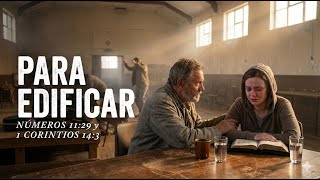
The Spirit's Journey: from Moses' Wish to Our Collective Calling
But Moses replied, “Are you jealous on my account? I wish that all the LORD’s people were prophets and that the LORD would place His Spirit on them!” — Numbers 11:29
But he who prophesies speaks to men for their edification, encouragement, and comfort. — 1 Corinthians 14:3
Summary: From Moses' profound wish for all God's people to be prophets to Paul's practical instruction, we see a divine trajectory toward universal spiritual empowerment. God desires His Spirit to dwell within every believer, equipping us for ministry that builds up the entire community. Therefore, we are called to earnestly desire spiritual gifts, especially prophecy, not for self-display but for the edification, encouragement, and consolation of others. This requires us to cultivate a spiritual environment guided by love and order, ensuring our collective expression becomes a powerful witness to God's presence among us.
The biblical narrative beautifully unfolds the divine plan for the Spirit's presence among God's people. We journey from the solitary burden of a great leader in the wilderness to the vibrant, yet sometimes chaotic, life of the early church, discovering a profound truth: God desires all His people to be spiritually empowered for the good of the community.
In the ancient wilderness, Moses bore an immense responsibility for the murmuring Israelites. Overwhelmed, he cried out to God, and in His mercy, God took some of the Spirit resting on Moses and placed it upon seventy elders. This act of sharing divine enablement was meant to help carry the load of leadership. What followed was a remarkable event: even two men, Eldad and Medad, who had remained in the camp and not gathered at the designated holy place, began to prophesy. This sovereign act demonstrated that God's Spirit is not confined to sacred spaces or official channels. Young Joshua, zealous for Moses' exclusive authority, urged him to silence these unexpected prophets. But Moses, with a heart truly aligned with God's ultimate intention, uttered a visionary wish: "Would that all the Lord's people were prophets, that the Lord would put His Spirit on them!" This was a longing for a universal outpouring, a democratization of spiritual power, where the burden of spiritual care could be shared by all.
Centuries later, in the bustling city of Corinth, the Apostle Paul found a community rich in spiritual gifts, yet struggling with their proper use. The Corinthian believers, often driven by self-display and a desire for status, were allowing their gifts, particularly speaking in tongues, to lead to disorder and confusion during their gatherings. It was in this context that Paul echoed Moses' ancient wish, not as a wistful hope, but as a practical instruction. He commanded them to "earnestly desire" prophecy above other gifts. Why? Because prophecy, he explained, serves a clear and vital purpose for the entire community: it speaks to people for their upbuilding, their encouragement, and their consolation. Unlike uninterpreted spiritual utterances that might only edify the speaker, true prophecy is intelligible and aims to strengthen, uplift, and comfort everyone present.
This progression marks a pivotal shift in God's redemptive plan. Moses' profound wish finds its glorious fulfillment in the New Covenant. The Spirit, once resting primarily "upon" select leaders for specific tasks, now dwells "within" every believer, empowering them for ministry. The exclusive spiritual authority Joshua sought to protect is dissolved in Christ, and the prophetic gift is made accessible to all who genuinely pursue love and spiritual gifts. No longer confined to a priestly class or a sacred tent, the Spirit now makes His presence known in the gathered assembly of believers, transforming the church itself into a place of divine encounter.
However, this widespread empowerment comes with a responsibility to maintain order and love. Paul, much like Moses, knew that spiritual gifts, though divine, could be misused. He did not silence the Spirit's manifestations (like Joshua wished), but he provided clear guidelines for their exercise. He insisted that all things be done "decently and in order," not for the sake of rigid control, but for the collective good and effective witness of the church. He called for discernment, reminding believers that the spirits of prophets are subject to prophets, and that others must "weigh what is said." The ultimate regulatory principle for all spiritual activity, Paul declared, is love. When love guides our pursuit and use of gifts, our aim shifts from self-promotion to the sincere desire to build up, encourage, and console our brothers and sisters.
This divine trajectory also challenges us to embrace inclusivity. Moses’ desire for "all the Lord's people" clearly includes every member of the covenant community, a truth echoed by later prophets and explicitly affirmed in the New Covenant's outpouring of the Spirit on "sons and daughters." While issues of authority and order are still carefully maintained in the church, the prophetic gift itself is broadly distributed. The church is called to be a community where every individual, guided by love and order, can contribute their Spirit-given insights and encouragements, ensuring that no one is left to carry the spiritual burden alone.
Therefore, for believers today, this journey from Numbers to Corinthians serves as a powerful call to action. We are invited to earnestly desire the spiritual gifts, especially prophecy, not for personal recognition or chaotic display, but for the edification of the body of Christ. We are to cultivate a spiritual environment where hearts are built up, courage is instilled, and comfort is abundantly shared. When we engage our gifts with humility, love, and a commitment to order, our collective spiritual expression becomes a powerful witness to a watching world, revealing the very presence of God in our midst. We embody Moses' ancient wish, becoming a prophetic community that declares, through word and deed, that "God is truly among you." This requires a bold desire for the Spirit's fire, a humble submission to divine order, and an unwavering commitment to speak only what builds others up in love.
What do you think?
What do you think about "The Spirit's Journey: From Moses' Wish to Our Collective Calling"?
Related Content
To Build Us Up
The Gifts Are of Strengthening and of Benefit for the Life of the Church
The entire 14th chapter of First Corinthians is a detailed elaboration of the importance of balancing also the different considerations that a Church ...
The Prophetic Community: a Pneumatological and Intertextual Analysis of Numbers 11:29 and 1 Corinthians 14:3
Numbers 11:29 • 1 Corinthians 14:3
1. Prolegomena: The Trajectory of Pneumatic Experience The biblical narrative reveals a progressive unfolding of the relationship between the Divine ...
Read in Context
Click to see verses in their full context.
Song (Other Languages)