The Gifts Are of Strengthening and of Benefit for the Life of the Church
But Moses replied, “Are you jealous on my account? I wish that all the LORD’s people were prophets and that the LORD would place His Spirit on them!” — Numbers 11:29
But he who prophesies speaks to men for their edification, encouragement, and comfort. — 1 Corinthians 14:3

Author
Dr. Roberto Miranda
Summary: The 14th chapter of First Corinthians emphasizes the importance of balancing the use of gifts of the Holy Spirit in a Church. Paul highlights the importance of prophecy, which includes speaking under the inspiration of the Holy Spirit, exhorting, confronting, and proclaiming biblical teachings. Prophecy serves to edify, exhort, and console people in an understandable language, which makes it more important than speaking in tongues that may not be understood. Paul's concern is for what benefits the Church and produces results, not just sensational and supernatural manifestations. The Church must prioritize spiritual growth, effective evangelism, organization, discipling, and growth in the character of Jesus Christ, along with supernatural manifestations.
The entire 14th chapter of First Corinthians is a detailed elaboration of the importance of balancing also the different considerations that a Church must take into account when it is moving in the effusiveness and explosive character of the gifts of the Holy Spirit. --break -> We see that that effusiveness of which we have spoken is in manifestation at the beginning of chapter 14 where Paul says: "Follow love" and there he is connecting with the previous chapter, chapter 13 where he talks about the preminence of love: "Follow love and seek spiritual gifts." There is chapter 12 right? "I don't want you to ignore the spiritual gifts. Then Paul says:" But above all, that you prophesy "and there we go directly into chapter 14.
Why does Paul say this that above all, apart from the gifts and the importance of love, that we, if we are going to use some gift or some of the things that can be used in the Christian life, this that it is rather prophesy? And there we have to understand the complexity of that concept of prophecy.
Many Christians are under the idea that prophecy is only when one says: my son thus says the Lord, and then one enters a prediction about the future or a supernaturally given direction by God that speaks of something that is totally hidden from the mind. human etc. And the truth is that this is one of the aspects of the prophecy, but it is not the only one.
The subject of prophecy has many different aspects and complexities. We see through Scripture that prophesying can also mean: to speak yes under the inspiration of the Holy Spirit, but it can be simply to exhort, it can be to confront a person with something that comes from the Word of God, it can even have overtones of a proclamation of biblical teaching, inspired by God at a given time.
Prophecy is everything that comes from the Holy Spirit at a given time for a given person or group, and that has a very specific purpose and is evidently directed by the Holy Spirit.
So here we see something and it is that when Paul speaks of prophecy, that we prophesy, it is that communication from God for a Church in this case, which is understandable. Unlike for example: speaking in tongues, where one can speak in tongues and be speaking in angelic tongues that are not understandable to anyone around one, and then everyone is left, well, without understanding what is being said , although the person who is speaking in tongues is building up spiritually because evidently the Spirit of God is running through him or her.
And that is why Paul in chapter 14 says: "For he who speaks in a tongue does not speak to men, but to God, for no one understands him, although by the Spirit he speaks mysteries; but he who prophesies speaks to men for edification, exhortation and consolation. "
We see here some of the reasons why prophecy is important, because it serves those dimensions of the Christian life when we need encouragement or when we need to be confronted, or when we need to be encouraged to seek God's Will for our lives.
So Paul is saying that those things, which are of benefit to God's people and which are immediately accessible because they are spoken in an understandable language, are in a sense more important than those that do not edify people, although they are expressing mysterious things. from the Holy Spirit.
Paul asks a rhetorical question in verse 6, he says: "Now then, brothers: if I go to you speaking in tongues, what will benefit you? If I do not speak to you with revelation or with science, or with prophecy, or with doctrine?"
What matters most to me in all this is to see that the apostle Paul's concern is in those things that are strengthening and beneficial for the life of the Church. He is not so concerned that they are sensational, spectacular, obviously supernatural manifestations, but his concern is a very pastoral and very practical concern: of what benefit is this manifestation to the Church? And that invites us to think that in the Church we must seek above all what produces results, what edifies the people, what advances the things of God.
Many times the churches are more concerned with having noisy services and that there are supposed manifestations of the Spirit, and that there is a lot of movement, many people falling to the floor and we believe that because that happened, God's purpose in the service has already been given. But the question we have to ask ourselves is: what result does it produce, what benefit, and what benefit does it ultimately bring?
Many churches are immature churches because they glorify the gifts so much and do not care enough about the aspect of spiritual growth, effective Evangelism, the organization of the Church, the discipling of believers, the growth in the character of Jesus Christ; These things are as important as the supposed supernatural manifestations. That is why Paul repeatedly brings this up.
In the Corinthian Church, for example, there were many supernatural manifestations, but there was immorality, there were struggles between believers, and Paul says: what use are those things if you are divided among themselves and are fighting that I am Paul's, that I am of Apollos and this, and the other?
So over and over we see that right? that in congregational life, what matters most to the Holy Spirit is: what benefit is spiritual manifestations doing to the Kingdom of God or to the children of God? And that should be the number one consideration in determining how we manage the movement of the gifts in our congregations. We will continue with this study later. May the Lord bless you.
What do you think?
What do you think about "The gifts are of strengthening and of benefit for the life of the Church"?
Related Content
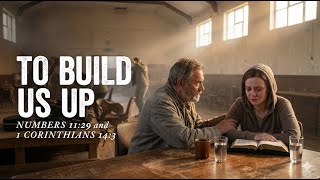
To Build Us Up
The Spirit's Journey: from Moses' Wish to Our Collective Calling
Numbers 11:29 • 1 Corinthians 14:3
The biblical narrative beautifully unfolds the divine plan for the Spirit's presence among God's people. We journey from the solitary burden of a grea...
The Prophetic Community: a Pneumatological and Intertextual Analysis of Numbers 11:29 and 1 Corinthians 14:3
Numbers 11:29 • 1 Corinthians 14:3
1. Prolegomena: The Trajectory of Pneumatic Experience The biblical narrative reveals a progressive unfolding of the relationship between the Divine ...
Read in Context
Click to see verses in their full context.
Song (Other Languages)