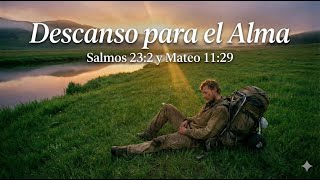
Finding True Rest: Embracing the Shepherd's Gentle Yoke
He makes me lie down in green pastures; He leads me beside quiet waters. — Psalms 23:2
Take My yoke upon you and learn from Me, for I am gentle and humble in heart, and you will find rest for your souls. — Matthew 11:29
Summary: We all deeply yearn for a profound rest and peace for our souls, a divine promise woven through our human experience. This essential restoration, first foreshadowed by the Divine Shepherd creating conditions for fearless repose, finds its ultimate fulfillment in the Messiah's liberating invitation. He calls us, the burdened and weary, to come and take His easy yoke, for He is gentle and lowly in heart. Our journey into this rest is not passive inactivity, but an active discipleship—learning from Him and working *from* the grace already provided, not *for* it. In Him, we find the true, soul-restoring peace that brings our weary souls home.
The profound yearning for rest, a deep peace for the soul, is a thread woven through all of human experience, from the earliest stories of creation to our modern, often-weary lives. The divine narrative reveals that this essential restoration is not an elusive fantasy but a gracious promise, made accessible through obedient trust in God’s unwavering care. We are invited to understand the Shepherd's provision for His flock as a profound foreshadowing of the Messiah's liberating invitation to find rest.
Consider the ancient image of the Divine Shepherd. In a rugged land of scarcity, the shepherd king, Yahweh Himself, leads His sheep not to sprawling, effortless abundance, but to precisely what is needed for the moment: "green pastures" and "still waters." This isn't about stockpiled luxury, but about consistent, timely provision, an "abundance of reliance" where the sheep learn daily trust. For a sheep to lie down in such places, it must be completely free from fear, hunger, and internal strife. Thus, when the Shepherd "makes" us lie down, it’s not coercion, but the creation of perfect safety and sufficiency, neutralizing all threats so the soul can find vulnerable repose. The "waters of rest" are more than simple hydration; they are a deep, theological stability, a participation in the very peace and settledness of God, guiding us gently, accommodating our pace to our weakest moments.
Millennia later, the Messiah echoes and fulfills this ancient promise. He extends an urgent, authoritative call to "come," specifically to those burdened by the heavy yokes of human expectation, self-striving, and the oppressive weight of sin. This invitation is a direct challenge to the systems that add burdens rather than alleviate them. When the Messiah offers His "yoke," He draws upon a familiar image of submission and work, yet radically transforms it. His yoke is described as "easy" and His burden "light." This doesn't mean life will be effortless, but that His yoke is perfectly fitted to the human soul, designed with divine craftsmanship to enable true flourishing without chafing or pain. It's a yoke borne in partnership, where the Master carries the heavier load, and the disciple learns by walking in step with Him.
The very nature of this Master is the foundation of our trust: He is "gentle and lowly in heart." This is not weakness, but strength under perfect control, an unparalleled humility that refuses to exploit power for self-gain. It stands in stark contrast to earthly rulers and religious authorities who often pride themselves on status and domination. The divine omnipotence, in the Messiah, is exercised through radical lowliness.
The promise of "rest for your souls" is the glorious convergence of these two divine narratives. It is the fulfillment of ancient longings, the very "waters of rest" that the Divine Shepherd promised. This rest is both a present reality – freedom from the crushing burden of self-justification and striving – and an eschatological hope for the final, eternal Sabbath.
This journey into rest is not a passive experience but an active discipleship. To "lie down in green pastures" is to sit at the feet of the Messiah, to learn from His wisdom. His yoke, then, becomes the divine instrument that guides us into these nourishing teachings, protecting us from spiritual predators and preventing us from wandering from the paths of righteousness. The comfort derived from the Shepherd’s authority, symbolized by the rod and staff, finds its ultimate expression in the "ease" of the Messiah’s yoke. It’s comforting to know we are bound to the Stronger One, guided by His benevolent power, freed from the crushing responsibility of carrying life's burdens alone.
Indeed, the early believers understood this profound connection, seeing in these passages a sacramental journey: the "green pastures" as the nourishing instruction of faith (catechesis), preparing the heart; the "still waters" as the purifying grace of baptism, washing away the heavy burden of sin and offering true spiritual rest; and the table prepared, as the Holy Eucharist, the King's feast for His rested and redeemed people.
In our performance-driven world, this message is a radical counter-cultural truth. Biblical rest is not mere inactivity, but the cessation of striving for our own justification. It is found not in isolation, but in a profound relationship—yoked to the Savior, constantly near the Divine Source. Our discipleship is not about earning rest, but about working from the rest already provided by grace. The God who orchestrates the conditions for us to lie down is the same God who is gentle and lowly in heart. He does not drive us with the whip of an oppressor, but lovingly leads us with the call of the Beloved. To accept the Messiah's yoke is to step onto the path to the green pastures of His wisdom; to learn from Him is to drink deeply from the waters of true, soul-restoring peace. In Him, the weary soul finds its eternal home.
What do you think?
What do you think about "Finding True Rest: Embracing the Shepherd's Gentle Yoke"?
Related Content
Rest for the Soul
Rest for the Soul
A great contemporary human problem is fatigue. "How tired or tired I am" many people repeat every day. Others simply say: "I can't take it anymore" an...
The Shepherd’s Yoke and the Waters of Rest: an Exhaustive Exegetical and Theological Synthesis of Psalm 23:2 and Matthew 11:29
Psalms 23:2 • Matthew 11:29
Executive Abstract The theological concept of "rest" serves as a fundamental connective tissue throughout the biblical canon, linking the creation na...
Read in Context
Click to see verses in their full context.
Song (Other Languages)