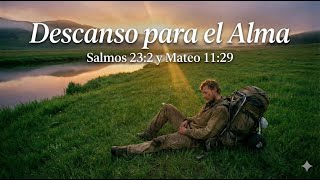
The Shepherd’s Yoke and the Waters of Rest: an Exhaustive Exegetical and Theological Synthesis of Psalm 23:2 and Matthew 11:29
Psalms 23:2 • Matthew 11:29
Summary: The theological concept of "rest" forms a fundamental connective tissue throughout the biblical canon, linking the creation narrative's seventh day to the eschatological hope of the New Creation. This analysis focuses on two pivotal texts, Psalm 23:2 and Matthew 11:29, which, despite their historical and literary separation, converge on the assertion that human soul restoration is contingent upon submission to Divine authority. This study demonstrates that Matthew 11:29 is not merely a parallel but a hermeneutical fulfillment of Psalm 23:2, revealing the Messiah's "yoke" as the functional equivalent through which the "green pastures" of divine wisdom are accessed.
A rigorous examination of Psalm 23:2 reveals the "Shepherd" metaphor as regal and divine in the Ancient Near East, asserting Yahweh as Israel's true Sovereign. The "green pastures" (Hebrew *na'ot deshe*) signify a dynamic, daily provision in a semi-arid landscape, emphasizing reliance on the Shepherd's intimate knowledge. The phrase "He makes me lie down" highlights the Shepherd's active role in creating conditions of safety and sufficiency, neutralizing fear and want. Furthermore, "still waters" (*mei menuchot*) are understood as "waters of rest," carrying the profound Old Testament theological weight of divine stability, including the Promised Land, the Temple, and the Sabbath.
The bridge to Matthew 11 involves understanding the rabbinic "yoke" (Hebrew *ol*, Greek *zygos*) as a technical term for submission to authority and obligation. Jesus, in offering "My yoke," directly critiques the burdensome religious structures of His day, presenting Himself as Incarnate Wisdom, echoing Sirach 51's invitation but uniquely offering *to give* rest to the weary. Crucially, the Septuagintal translation of *menuchah* as *anapausis* in Psalm 23:2 directly links to Jesus' promise of *anapausis* for the soul in Matthew 11:29, thus presenting Him as the Shepherd who leads His people to this definitive rest.
Jesus characterizes His yoke as "easy" (*chrestos*, well-fitting) and His burden as "light" (*elaphron*), a profound contrast to the heavy burdens of human tradition. This "easy" yoke is borne in partnership with the gentle (*praus*) and lowly (*tapeinos*) Messiah, signifying strength under control and divine humility rather than weakness. The synthesis of these texts clarifies that the "green pastures" are the nourishing teachings of the Master, and the "still waters" are the grace of divine stability. The Shepherd's rod and staff, symbols of authority and guidance in Psalm 23, find their culmination in the yoke of discipleship, which binds the believer to the stronger One, guiding them in paths of righteousness and providing comfort through benevolent authority.
Ultimately, this intertextual synthesis confirms a high Christology, where Jesus assumes the functional role of Yahweh, the Shepherd who provides divine *menuchah*. The "rest" offered is not mere inactivity but a profound cessation of striving for self-justification, a relational experience found in proximity to the Divine Source. This spiritual refreshment, promised in the Psalter and embodied in Christ, redefines Christian obedience as working *from* rest, rather than *for* rest, and finds sacramental expression in the catechetical instruction, baptismal cleansing, and Eucharistic nourishment within the Church.
Executive Abstract
The theological concept of "rest" serves as a fundamental connective tissue throughout the biblical canon, linking the creation narrative’s seventh day to the eschatological hope of the New Creation. Within this broad trajectory, two specific texts—Psalm 23:2 and Matthew 11:29—stand as monumental pillars of divine provision and human restoration. While separated by nearly a millennium, distinct literary genres, and divergent cultural contexts, these passages converge on a singular assertion: the restoration of the human soul is contingent upon submission to Divine authority, characterized alternatively as the leading of a Shepherd and the instruction of a Messiah.
This report provides a comprehensive analysis of the interplay between the Psalmist’s declaration, "He makes me lie down in green pastures; He leads me beside still waters," and the Christological invitation, "Take My yoke upon you and learn from Me... and you will find rest for your souls." Through a rigorous examination of the Hebrew menuchah and the Greek anapausis, alongside the agrarian realities of the Ancient Near East and the rabbinic pedagogy of the Second Temple period, this study demonstrates that Matthew 11:29 is not merely a parallel to Psalm 23:2 but its hermeneutical fulfillment. The analysis reveals that the "yoke" of the Messiah is the functional equivalent of the "rod and staff," serving as the instrument through which the "green pastures" of divine wisdom are accessed. Furthermore, through the lens of patristic reception, these texts are shown to outline a sacramental theology of initiation, moving the believer from the catechetical pastures to the baptismal waters of rest.
Chapter I: The Hebraic Foundation — Exegesis of Psalm 23:2
To grasp the full weight of the interplay between the Psalmist’s confidence and the Messiah’s invitation, one must first perform a deep excavation of the linguistic and cultural soil of Psalm 23:2. This verse is frequently sentimentalized in Western reception history, often divorced from the harsh geopolitical and agricultural realities of the Judean wilderness that shaped its imagery.
1.1 The Shepherd Metaphor in Ancient Near Eastern Royal Ideology
The opening declaration, "The Lord is my shepherd" (Yahweh Ro'i), immediately situates the text within a specific socio-political lexicon of the Ancient Near East. In this cultural milieu, the title of "shepherd" was not merely agricultural but regal and divine. Mesopotamian monarchs, such as Hammurabi, explicitly designated themselves as divinely appointed shepherds, commissioned by the gods to provide justice, order, and sustenance to their subjects. The staff of the shepherd was the scepter of the king.
By appropriating this royal metaphor for Yahweh, David is engaging in a subtle polemic. He is asserting that the true Sovereign of Israel is not a human monarch but Yahweh Himself. This has profound implications for the interpretation of verse 2. If the Shepherd is the King, then the "green pastures" and "still waters" are not merely acts of animal husbandry but acts of statecraft and kingdom administration. The provision of rest is the primary duty of the benevolent King.
The metaphor implies a relationship defined by the absolute dependence of the sheep and the total responsibility of the shepherd. Sheep are notoriously prone to wandering, defenseless against predators, and incapable of finding sustenance in difficult terrain without guidance. Thus, the assertion that Yahweh "makes" the psalmist lie down is a confession of surrendered autonomy. It acknowledges that survival is impossible through self-reliance; it requires the active, intervening governance of the Divine Shepherd.
1.2 Na’ot Deshe: The Theology of Scarcity and Sufficiency
The phrase "He makes me lie down in green pastures" translates the Hebrew bin’ot deshe yarbitzeini. A rigorous philological and geographical analysis corrects common misconceptions and deepens the theological import of this provision.
The Agricultural Reality of Judea Western artistic tradition often depicts "green pastures" as vast, lush meadows reminiscent of European landscapes, with knee-deep grass extending to the horizon. However, the Judean wilderness—the historical context of Davidic shepherding—is a semi-arid terrain characterized by rocky hills, dry wadis, and scarce vegetation. In this context, na’ot (pastures/abodes) of deshe (young grass/vegetation) often refers to transient tufts of grass found in rock crevices or sudden blooms following seasonal rains.
This geographical reality shifts the theological focus from an "abundance of accumulation" to an "abundance of reliance." The sheep does not see a stockpile of food; it sees enough for the moment. The shepherd must lead the flock constantly, moving from one small patch of grazing to another to ensure survival. Therefore, the "green pastures" represent a dynamic experience of daily provision dependent entirely on the shepherd’s intimate knowledge of the terrain. This anticipates the later petition in the Lord’s Prayer for "daily bread"—provision that is sufficient for the day but requires renewed trust for the morrow.
The Verb Rabat: The Ethology of Rest The Hebrew verb yarbitzeini is the Hiphil (causative) form of the root rabat, meaning to stretch out or lie down, used specifically for four-footed animals. The causative stem is crucial: "He causes me to lie down." This is not an act of coercion, but of creating the conditions that make rest possible.
Ethologically, sheep are prey animals dominated by instinctual fear. They refuse to lie down if they are afraid, hungry, tormented by parasites, or experiencing friction within the flock social hierarchy. For a sheep to lie down, it must be completely free from anxiety and want. Consequently, the statement "He makes me lie down" serves as a testimony to the Shepherd’s ability to neutralize all threats. It implies that Yahweh has dealt with the external enemies (predators) and internal needs (hunger/thirst) so thoroughly that the soul can enter a state of vulnerable repose. The "green pasture" is less about the grass itself and more about the safety required to stop eating and rest.
1.3 Mei Menuchot: Linguistic Archaeology of "Rest"
The second hemistich of verse 2, "He leads me beside still waters," translates al-mei menuchot yenahaleini. This phrase contains profound linguistic depth that bridges directly to New Testament concepts.
The Meaning of Menuchah The Hebrew noun menuchah is derived from the root nuach, meaning to rest, settle down, or remain. While English translations often render this as "still" or "quiet" waters—conveying the physical calmness of the water (necessary because sheep fear rushing currents that can waterlog their wool )—the construct mei menuchot literally means "waters of resting places" or "waters of rest".
Menuchah carries a heavy theological load in the Old Testament canon. It is used to describe:
-
The Promised Land: "You have not yet come to the rest (menuchah) and the inheritance that the Lord your God is giving you" (Deut 12:9).
-
The Temple: "This is my resting place (menuchah) forever; here I will dwell" (Psalm 132:14).
-
The Sabbath: A cessation from labor that mimics the divine rest of creation.
Thus, the "waters" are not merely for hydration; they are the medium through which the sheep partakes of divine stability. To drink from mei menuchot is to internalize the peace and settledness of Yahweh. It is a sacramental participation in the stability of the Temple and the Land.
The Guidance of Nahal The verb yenahaleini (He leads me) suggests a gentle, accommodating guidance. It is distinct from verbs that imply driving or forcing livestock. It connotes a journey undertaken with care, matching the pace of the flock to the capacity of the weakest member (cf. Gen 33:14). This "gentle leading" stands as a philological precursor to the "gentleness" (praus) of the Messiah in Matthew 11, distinguishing the Good Shepherd from the hireling or the tyrant.
Chapter II: The Rabbinic and Hellenistic Bridge
To successfully traverse the distance between the Judean wilderness of David and the Galilean ministry of Jesus, one must cross the bridge of Second Temple Judaism. During this period, the agricultural metaphors of the Old Testament were codified into specific theological concepts, most notably the "Yoke" and the personification of "Wisdom."
2.1 The Yoke of the Torah vs. The Yoke of the Kingdom
By the first century, the metaphor of the "yoke" (ol in Hebrew, zygos in Greek) had become a standard technical term in rabbinic pedagogy. The yoke represented submission to authority and the acceptance of obligation.
-
The Yoke of the Kingdom of Heaven (Ol Malkhut Shamayim): This referred to the fundamental allegiance to the One God, accepted daily through the recitation of the Shema ("Hear O Israel, the Lord our God, the Lord is One"). It was the yoke of sovereignty.
-
The Yoke of the Torah (Ol Torah): This referred to the obligation to observe the commandments (mitzvot).
-
The Yoke of the Commandments (Ol Mitzvot): Specifically, the detailed observance of the Halakha (the "way of walking").
In the time of Jesus, the Pharisees and scribes were perceived by many as having made this yoke heavy. Through the proliferation of "hedges" around the Law—meticulous regulations designed to prevent accidental transgression—the Torah, originally a gift of grace, risked becoming a crushing burden of performance. Jesus explicitly critiques this in Matthew 23:4: "They tie up heavy burdens, hard to bear, and lay them on people's shoulders, but they themselves are not willing to move them with their finger."
This context is vital for interpreting Matthew 11. When Jesus offers His yoke, he is engaging in a direct polemic against the prevailing rabbinic structures. He is claiming the authority to issue a new Halakha—a new interpretation of God’s will—that fulfills the Law while stripping away the heavy burdens of human tradition.
2.2 Wisdom Incarnate: The Sirach 51 Connection
The most significant intertextual bridge between the Old Testament and Matthew 11 is found in the deuterocanonical book of Sirach (Ecclesiasticus), written around 180 BC. Scholars have long noted the striking structural and lexical parallels between Jesus' invitation and the poem in Sirach 51.
| Matthew 11:28-30 | Sirach 51:23-27 |
| "Come to me, all you who are weary..." | "Draw near to me, you who are uneducated..." |
| "Take my yoke upon you and learn from me..." | "Put your neck under the yoke, and let your souls receive instruction." |
| "...and you will find rest for your souls." | "...I have labored but little and found for myself much serenity (anapausin)." |
In Sirach, it is personified Wisdom (Lady Wisdom) who speaks. She invites the simple to dwell in her "house of instruction" and take on her yoke. By echoing this language so precisely, Jesus is identifying Himself as Incarnate Wisdom. He is not merely a teacher pointing to Wisdom; He is the source of Wisdom itself.
However, a critical inversion occurs. In Sirach, the sage says, "I have labored but little and found rest." Jesus, conversely, invites those who have labored (the weary) and offers to give them rest. He assumes the labor upon himself. This shifts the focus from the attainment of wisdom through human effort to the reception of rest through divine grace.
2.3 The Septuagintal Transformation: From Menuchah to Anapausis
The translation of the Hebrew Scriptures into Greek (the Septuagint or LXX) provided the linguistic vocabulary for the New Testament authors. This is nowhere more evident than in the translation of "still waters" in Psalm 23:2.
The Hebrew mei menuchot ("waters of rest") was translated in the LXX (Psalm 22:2) as hydatos anapauseos ("water of rest/refreshment"). The Greek noun anapausis signifies a cessation of labor, a refreshment, or a temporary rest for renewal.
This linguistic choice is decisive. When Jesus says in Matthew 11:29, "You will find rest (anapausin) for your souls," he is using the exact word the LXX used for the waters of Psalm 23. To a Greek-speaking Jewish audience familiar with the Psalter, the resonance would be unmistakable. Jesus is claiming to be the Shepherd who leads the people to the hydatos anapauseos. The "rest" of the Gospel is the "water" of the Psalm.
Chapter III: The Evangelical Invitation — Exegesis of Matthew 11:29
Matthew 11:28-30 is unique to the First Gospel, absent from Mark and Luke. It appears at a narrative pivot point where Jesus turns from denouncing the unrepentant cities of Galilee to embracing the "little children" (the humble/unlearned) to whom the Father has revealed the mysteries of the Kingdom.
3.1 The Authority of the Invitation ("Come to Me")
The imperative Deute pros me ("Come to me") asserts a divine prerogative. In the Old Testament, the invitation to find rest is issued by Yahweh (Isa 55:1-3) or Wisdom. By centering the invitation on His own person ("to Me"), Jesus implicitly assumes the functional role of Yahweh. He does not point the weary to the Temple, the Torah, or a sacrificial system; He points to Himself as the locus of menuchah.
The recipients of this call are "all who labor and are heavy laden" (pantes hoi kopiontes kai pephortismenoi). The perfect passive participle pephortismenoi ("those having been loaded down") suggests a state of passivity—burdens have been placed upon them. Historically, this refers to the weight of the oral law and the existential weariness of sin. Jesus offers himself as the relief from this imposed crushing weight.
3.2 The Paradox of the Yoke (Zygos)
The central metaphor of the passage is the "yoke" (zygos). In the agrarian society of first-century Galilee, a yoke was a wooden frame placed on the necks of oxen to enable them to pull a plow or cart. It was an instrument of work, submission, and control.
The "Easy" Yoke Jesus characterizes His yoke as chrestos ("easy" or "kind") and his burden as elaphron ("light"). The adjective chrestos does not mean "effortless" or "lax." It literally means "well-fitting," "useful," or "kind". Legend suggests that Jesus, as a tekton (carpenter), may have crafted yokes, and a "kind" yoke was one that was hand-shaped to fit the specific animal, distributing the weight to avoid chafing or pain.
The theological implication is that the yoke of Christ fits the design of the human soul. Unlike the yoke of the law, which chafes against human inability, or the yoke of sin, which destroys, the yoke of discipleship is compatible with true human flourishing. It is "easy" not because it makes no demands—indeed, the Sermon on the Mount demands perfection (Matt 5:48)—but because it is borne in the power of the Spirit and in partnership with the Son.
The Double Yoke Theory Some exegetes propose that the imagery implies a "double yoke" where two animals are yoked together. In this view, the disciple is yoked with Jesus. The Master bears the heavy end of the load, while the disciple walks in step, learning the rhythm of the work. While the text primarily focuses on the disciple taking the yoke, this partnership model aligns with the concept of "learning from Me"—one learns by walking beside.
3.3 The Heart of the Shepherd: Praus and Tapeinos
The motivation for taking the yoke is the character of the Master: "for I am gentle (praus) and lowly (tapeinos) in heart."
-
Praus (Gentle/Meek): This term does not signify weakness but strength under control. It is used in the LXX to describe Moses (Num 12:3) and in Zechariah 9:9 to describe the Messianic King riding on a donkey. It denotes a refusal to exploit power for violence or self-aggrandizement.
-
Tapeinos (Lowly/Humble): In Greco-Roman culture, humility was often viewed as a vice (servility). Jesus elevates it to a divine virtue. He aligns himself with the anawim, the "poor of the Lord" who depend entirely on God.
This self-disclosure stands in stark contrast to the ANE shepherd-kings who ruled with iron rods of domination, and the religious elites who prided themselves on status. Jesus reveals that the omnipotence of God is exercised through the "lowliness" of the Incarnation.
3.4 The Eschatological Promise: Anapausis for the Psyche
The result of taking the yoke is finding "rest for your souls" (anapausin tais psychais hymon). This phrase is a direct quotation of Jeremiah 6:16: "Stand by the roads, and look, and ask for the ancient paths, where the good way is; and walk in it, and find rest for your souls."
In Jeremiah, the people refused this rest, saying, "We will not walk in it." Jesus now presents Himself as the embodiment of the "ancient path" (the halakha of God). He guarantees the rest that the Law pointed toward but could not provide due to human rebellion. This anapausis is both a present reality (relief from the burden of self-justification) and an eschatological hope (the final Sabbath rest).
Chapter IV: The Intertextual Synthesis
Having analyzed the texts individually, we can now synthesize the theological interplay. The "Shepherd's Yoke" emerges as a unifying concept that harmonizes the authority of God with the comfort of salvation.
4.1 The Convergence of Imagery: Pasture as Instruction, Yoke as Guidance
The "Green Pastures" of Psalm 23 and the "Learning" of Matthew 11 are functionally identical.
-
Mechanism of Feeding: In the ANE, the shepherd leads the sheep to pasture. The sheep's primary task is to eat and rest. In the Gospel, the disciple comes to Jesus to "learn."
-
The Pasture is the Word: Interpreted through the Wisdom tradition, the "grass" that restores the soul is the instruction (didache) of the Messiah. Just as the physical grass sustains the biological life (nephesh), the revelation of the Father through the Son (Matt 11:27) sustains the spiritual life (psyche).
Therefore, to "lie down in green pastures" is to sit at the feet of Jesus and take His yoke of instruction. The Yoke is the tool that keeps the disciple in the pasture.
4.2 The Rod, The Staff, and The Yoke: Reconciling Authority and Gentleness
A potential tension exists between the "gentleness" of Jesus and the "rod" of the Shepherd in Psalm 23:4 ("Your rod and your staff, they comfort me"). The rod (shebet) was a club for defense and discipline, while the staff (mishenah) was for guidance.
Table 1: Comparative Analysis of Shepherding Implements
| Implement | Function in Ps 23 | Function in Matt 11 | Synthesis |
| Rod (Shebet) | Protection/Authority: Used to beat off wolves and count/inspect sheep. | Authority: "All things have been handed over to Me" (v.27). | The Yoke protects the disciple by binding them to the Stronger One, offering safety from spiritual predators. |
| Staff (Mishenah) | Guidance/Rescue: Used to hook sheep and pull them from danger. | Guidance: "Learn from Me." | The Yoke guides the disciple in the "paths of righteousness," preventing wandering. |
| Yoke (Zygos) | N/A (Agrarian equivalent) | Submission/Partnership: Instrument of work and direction. | The Yoke combines the Rod's authority and the Staff's guidance into a single instrument of discipleship. |
The Comfort of Authority The synthesis reveals that the "comfort" of the rod (Ps 23:4) and the "ease" of the yoke (Matt 11:30) are rooted in the same reality: the safety of being under divine authority. The sheep is comforted by the rod because it implies the Shepherd is armed and capable. The disciple finds the yoke "easy" because it implies they are not responsible for the outcome of the harvest, only for the submission to the Master. The "gentleness" of Jesus is not the absence of authority, but the benevolent exercise of it.
4.3 Typological Fulfillment: Jesus as the Yahweh-Shepherd
The interplay confirms a high Christology. Jesus does not merely model the behavior of David; He assumes the role of Yahweh.
-
Psalm 23: Yahweh is the Shepherd who gives Menuchah.
-
Matthew 11: Jesus is the Son who gives Anapausis.
-
Conclusion: Jesus is the Yahweh-Shepherd of Psalm 23. The "rest" He offers is the divine rest of God Himself.
Chapter V: Patristic and Sacramental Reception
The interplay between these texts is not merely academic; it was encoded into the life of the early Church through liturgy and sacraments. The Church Fathers read Psalm 23 not just as a song of trust, but as a "mystagogical" text outlining the sacraments of initiation, culminating in the "rest" of Matthew 11.
5.1 The Catechetical Pasture
Patristic writers like Cyril of Alexandria and Gregory of Nyssa interpreted the "green pastures" as the Catechumenate—the period of instruction preceding baptism.
-
The "grass" is the teaching of the Scriptures.
-
Before one can enter the waters, one must be fed on the Word.
-
This aligns with Matthew 11:29: "Learn from Me." The yoke of learning is the entry point to the rest.
5.2 The Baptismal Waters of Rest
The "still waters" (hydatos anapauseos) were almost universally identified by the Fathers with Baptism.
-
Augustine: "By the water of refreshing has He brought me up... the water of baptism, whereby they are refreshed who have lost health and strength".
-
Athanasius: "The water of repose without doubt signifies holy Baptism by which the weight of sin is removed".
Here, the "heavy burden" of Matthew 11 is identified specifically as the guilt of sin. The "rest" Jesus gives is the remission of sins in the baptismal font. The "Yoke" is the baptismal vow.
5.3 The Eucharistic Table
Psalm 23:5 ("You prepare a table before me") serves as the climax of the sacramental progression.
-
Cyprian & Ambrose: Identify the "Table" as the Eucharist (the altar) and the "Cup that overflows" as the Chalice of Christ’s Blood.
-
Connection to Matthew 11: The Eucharist is the meal of the "rested." Having laid down the burden of sin at the waters (Baptism), the disciple now feasts at the table of the King. The "anapausis" is the spiritual refreshment received through the Body and Blood.
Table 2: The Sacramental Trajectory of Psalm 23 and Matthew 11
| Psalm 23 Image | Matthew 11 Reality | Sacramental Rite |
| Green Pastures | "Learn from Me" | Catechesis / Liturgy of the Word |
| Still Waters | "I will give you rest" | Baptism (Washing of Regeneration) |
| Table Prepared | The Light Burden / Refreshment | Eucharist (The Holy Communion) |
| Oil on Head | Gentle & Lowly Heart (Spirit) | Confirmation / Chrismation |
Chapter VI: Pastoral and Theological Implications
The interplay of Psalm 23:2 and Matthew 11:29 extends beyond ancient exegesis into the lived reality of the contemporary believer.
6.1 The Theology of Rest in a Secular Age
In a modern "burnout society" driven by performance and exhaustion, the synthesis of these texts offers a counter-cultural theology.
-
Rest is not Inactivity: Psalm 23 depicts a sheep that walks through valleys; Matthew 11 depicts an ox that works in a yoke. Biblical rest is not the cessation of activity but the cessation of striving for self-justification.
-
Rest is Relational: Rest is found "beside" the waters and "yoked" to the Savior. It is a function of proximity to the Divine Source.
6.2 Discipleship as Yoked Existence
The "Easy Yoke" redefines Christian obedience. It is not an autonomous attempt to keep a code (the heavy burden of the Pharisees), but a participatory obedience where the power to obey comes from the One to whom we are yoked. The "Green Pastures" are not a reward for hard work, but the starting place of grace. The disciple works from rest, not for rest.
Conclusion
The interplay between Psalm 23:2 and Matthew 11:29 offers a panoramic view of divine care that spans the history of redemption. Psalm 23 presents the archetypal promise: Yahweh is the Shepherd who provides menuchah in the wilderness. Matthew 11:29 reveals the Incarnate fulfillment: Jesus is the Shepherd who provides anapausis in the midst of spiritual exhaustion.
Through the hermeneutical key of Matthew 11, the "green pastures" are revealed as the nourishing teachings of the Master, and the "still waters" as the grace of baptism. The "rod and staff" are transformed into the "easy yoke" of discipleship. Ultimately, both texts converge on the singularity of the Divine character: The God who "makes us lie down" is the same God who is "gentle and lowly in heart." He does not drive His people with the whip of the oppressor but leads them with the call of the Beloved. To accept the Yoke of Jesus is to find the path to the Green Pastures; to learn from Him is to drink from the Waters of Rest. In this synthesis, the weary soul finds its true home.
What do you think?
What do you think about "The Shepherd’s Yoke and the Waters of Rest: An Exhaustive Exegetical and Theological Synthesis of Psalm 23:2 and Matthew 11:29"?
Related Content
Rest for the Soul
Rest for the Soul
A great contemporary human problem is fatigue. "How tired or tired I am" many people repeat every day. Others simply say: "I can't take it anymore" an...
Finding True Rest: Embracing the Shepherd's Gentle Yoke
Psalms 23:2 • Matthew 11:29
The profound yearning for rest, a deep peace for the soul, is a thread woven through all of human experience, from the earliest stories of creation to...
Read in Context
Click to see verses in their full context.
Song (Other Languages)