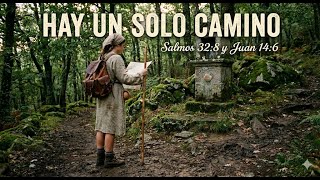
Navigating Life's Journey: Christ, Our Perfect Way and Guide
I will instruct thee and teach thee in the way which thou shalt go: I will guide thee with mine eye. — Psalms 32:8
Jesus saith unto him, I am the way, the truth, and the life: no man cometh unto the Father, but by me. — John 14:6
Summary: Our life's journey is fundamentally about finding the way back to the Creator. The ancient promise reveals God as our meticulous Guide, instructing and teaching us, particularly after we humble ourselves in confession to cultivate a willing heart. Jesus, however, radically redefines this, declaring, "I am the Way, the Truth, and the Life," making Him the sole path to the Father. This means true guidance isn't just external instruction, but an intimate, indwelling relationship with Christ, for He *is* the journey and our ultimate destination, providing unwavering assurance. Our path is a living relationship to be cherished.
Life's journey, from humanity's earliest wanderings to our ultimate hope, is fundamentally about finding "the way." How does one, a finite creature in a world fraught with moral and spiritual challenges, find the path back to the Creator? The biblical narrative unfolds this question with two profound, interconnected answers: the ancient promise of divine instruction and the radical declaration of an incarnate Person.
The Old Testament, particularly in its wisdom literature, presents God as a meticulous Guide. In a significant penitential psalm, we encounter a divine voice promising to "instruct you and teach you in the way you should go; I will guide you with My eye." This promise is not given in a vacuum but arises from the experience of confessed sin. Prior to confession, the individual suffers the heavy burden of unacknowledged guilt, a "silence" that drains life and obscures discernment. Only after humble confession, when the soul is ready to learn, does this divine pedagogy become active.
This Old Testament guidance is comprehensive: it aims to make one prudent and wise, to point out the right trajectory, and to offer personal counsel. It’s about learning a divine "way of walking" that aligns with God's will. The metaphor of the "guiding eye" is particularly striking. It speaks not of distant surveillance or harsh command, but of intimate, vigilant care—like a shepherd carefully watching over his flock, or a wise master subtly directing a trusted servant with a mere glance. This guidance contrasts sharply with the "mule" spirituality—stubbornness that requires external force, like a bit and bridle, to be controlled. The ultimate desire is for willing, understanding obedience, not coerced compliance.
Centuries later, in a moment of deep anxiety among His disciples, Jesus radically redefines this concept of "the way." When asked by a perplexed follower about the destination and the route, Jesus declared, "I am the way, the truth, and the life. No one comes to the Father except through Me." This is far more than an instruction or a map; it is an assertion of divine identity. Jesus doesn’t just teach the way; He is the Way.
His declaration is profoundly holistic:
This claim of exclusivity—that no one comes to the Father except through Him—is not a limitation but a profound comfort. It offers absolute certainty to the believer: there is no possibility of getting lost, for the Guide is the destination, and the Path is the Presence.
The connection between these two profound statements bridges the testaments. The ethical "way of walking" (halakhah) taught in the Old Testament, the path of wisdom and obedience, finds its ultimate fulfillment and power in the Person of Christ. He is the wisdom of God incarnate; the Teacher has become the Teaching.
The mechanics of divine guidance also evolve and deepen. The Old Testament's "guiding eye" speaks of God's watchful providence and objective instruction—His Word and His leading in circumstances. But in the New Covenant, this external oversight is transformed into the internal indwelling of the Holy Spirit. Jesus promises that the Spirit of Truth will "guide you into all the truth." The Spirit animates the believer from within, providing the understanding and willingness that the "mule" lacks, enabling a voluntary, heartfelt obedience born of love, not coercion.
For believers today, these truths offer invaluable lessons:
The journey of faith is not about mastering a complicated set of directions, but about intimately knowing the One who is the Way. The ancient promise, "I will teach you the way," finds its magnificent and personal fulfillment in Jesus' declaration, "I am the Way." Our path is not a rigid set of coordinates to be memorized, but a living relationship to be cherished.
What do you think?
What do you think about "Navigating Life's Journey: Christ, Our Perfect Way and Guide"?
Related Content
One True Way
The Way
The Spanish poet Antonio Machado said in his time: Caminante no hay camino. The path is made by walking. Many years later, a popular Catalan singer t...
The Way of Wisdom and the Person of Christ: an Exhaustive Intertextual and Theological Analysis of Psalm 32:8 and John 14:6
Psalms 32:8 • John 14:6
1. Introduction: The Locus of Divine Guidance in Biblical Theology The biblical narrative is fundamentally structured around the concept of movement—...
Read in Context
Click to see verses in their full context.
Song (Other Languages)