The Anointing of Peace: When Heaven Touches Earth
Behold, how good and how pleasant it is for brethren to dwell together in unity! It is like the precious ointment upon the head, that ran down upon the beard, even Aaron's beard: that went down to the skirts of his garments; As the dew of Hermon, and as the dew that descended upon the mountains of Zion: for there the Lord commanded the blessing, even life for evermore. — Psalms 133:1-3
Glory to God in the highest, and on earth peace, good will toward men. — Luke 2:14
Summary: True peace and unity are not structures we build from the ground up, but blessings that flow down from the heart of God. Through the ancient imagery of anointing oil and falling dew, we see that we do not manufacture the Spirit's unity; we simply receive it from Christ, our Head. Just as the angels proclaimed peace to men of God's favor, our standing is secured by His sovereign pleasure rather than our human effort. Let us therefore position ourselves under this flow of grace, living as a community where the commanded blessing of God’s presence rests upon us.
A profound theological dialogue exists between the songs of the Old Testament pilgrims and the angelic hosts of the New Testament. Together, they reveal that true peace and unity are not things we build from the ground up, but blessings that flow down from the heart of God.
1. The Vertical Architecture of Grace
In a world that often attempts to construct unity through human effort—much like the Tower of Babel—Scripture presents a different architecture. Both the ancient song of David (Psalm 133) and the proclamation of the angels (Luke 2:14) describe a "theology of descent."
In Psalm 133, the anointing oil runs down Aaron’s beard, and the dew falls down upon Zion. In Luke 2, the glory of God appears in the highest and brings peace down to earth. The edifying message for the believer is clear: We do not manufacture the unity of the Spirit; we simply receive it. Our task is to position ourselves under the flow of God's grace.
2. Psalm 133: The Beauty of the Anointed Body
The Psalmist calls us to behold something "good and pleasant": brethren dwelling together in unity. This unity is described through two powerful images that speak to our spiritual vitality today.
The Sacerdotal Anointing (The Oil)David compares unity to the sacred anointing oil poured over the High Priest, Aaron. This oil was a unique "perfumer's blend" of myrrh, cinnamon, and cassia—ingredients that speak of sweetness, healing, and holiness.
The Psalm also compares unity to the heavy dew of Mount Hermon falling on the dry hills of Zion. Geographically, this is a paradox; Hermon is far to the north. Theologically, it is a promise.
3. Luke 2:14: The Subversion of False Peace
When the angels split the sky to announce the birth of Jesus, they proclaimed, "Glory to God in the highest, and on earth peace, good will toward men."
True Peace vs. The World's PeaceThis announcement was a direct challenge to the political powers of the day. The Roman Empire boasted of the Pax Romana —a peace kept by the sword. But the Gospel announces Eirene (Shalom)—a peace of wholeness, flourishing, and reconciliation.
A deeper look at the text reveals that this peace is granted to anthropois eudokias —"men of [God's] good pleasure." This is not a peace earned by human goodwill, but a peace granted by God’s sovereign favor.
The Lesson: We are the recipients of a "commanded blessing." Just as God chose to send the dew to Zion, He chose to send His Son to us. Our standing in grace is secure not because of our performance, but because of His pleasure.Conclusion: The Commanded Blessing
These two texts merge to form a beautiful picture of the Church. Psalm 133 anticipates what Luke 2 fulfills.
The Oil on Aaron’s beard was a shadow; the Spirit on Christ is the substance.For the believer, this is a call to "keep the unity of the Spirit in the bond of peace" (Ephesians 4:3). We are called to live as a community where the oil is flowing and the dew is falling—a counter-cultural refuge where the world can see that God has indeed descended to dwell among His people.
What do you think?
What do you think about "The Anointing of Peace: When Heaven Touches Earth"?
Related Content
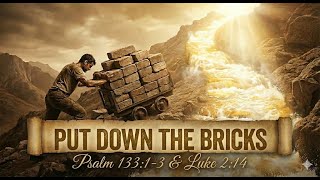
Put Down the Bricks
The Gravity of Grace: Putting Down Your Bricks
Psalms 133:1-3 • Luke 2:14
The Gravity of Grace: Putting Down Your Bricks Do you ever feel like you are endlessly working on a spiritual construction site? We often approach our...
The Descent of Grace: a Comprehensive Exegetical and Theological Synthesis of Psalm 133 and Luke 2:14
Ps 133:1 • Luke 2:14
1. Introduction: The Vertical Architecture of Peace The theological landscape of the Judeo-Christian tradition is frequently characterized by a disti...
Read in Context
Click to see verses in their full context.
Song (Other Languages)