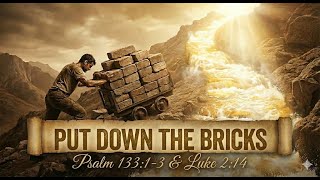
The Descent of Grace: a Comprehensive Exegetical and Theological Synthesis of Psalm 133 and Luke 2:14
Ps 133:1 • Luke 2:14
Summary: The theological landscape of our tradition is defined by a specific geometry: the downward trajectory of divine benevolence meeting the horizontal plane of human existence. When we examine the intertextual dialogue between the ancient poetry of Psalm 133 and the angelic proclamation in Luke 2:14, we encounter a singular, robust assertion: true sociopolitical unity and existential peace are not constructed by human ingenuity from the ground up. Rather, they are poured out from the "highest" realms as a sovereign gift of grace.
In Psalm 133, we celebrate this reality through the visceral metaphors of anointing oil flowing down the High Priest’s beard and the miraculous transport of Hermon’s dew to the arid hills of Zion. This is not merely a poetic description of tribal solidarity; it establishes a hierarchy of blessing where sanctification originates with the Head and flows down to cover the Body. By prohibiting the secular reproduction of this oil, we understand that true unity is a holy sacrament, a supernatural transfer of life that sustains the community during spiritual dry seasons.
The *Gloria in Excelsis* of Luke 2:14 serves as the eschatological fulfillment of this typological shadow. Here, the "peace on earth" is not the enforced *Pax Romana* of empire, but a divine intrusion of favor (*eudokia*) upon those whom God has chosen. The "Good and Pleasant" unity of the Psalter transforms from a localized blessing in Zion to a cosmic reality centered on the Incarnation of Christ. This peace challenges the world's definitions of power, asserting that the remedy for human fragmentation is found in a manger rather than a palace.
The connective tissue binding these texts is the Theology of Vertical Descent. Both narratives refute the spirit of Babel—the human attempt to build unity upward—by demonstrating that God descends to gather us. Whether through the oil upon Aaron or the Incarnation of the Son, the trajectory is always from the "Highest" to the "Earth." Jesus serves as the Greater Aaron, the Anointed One through whom the Spirit is poured out without measure, flowing down to reach the very skirts of humanity’s garments.
Ultimately, we must recognize that the movement from enmity to peace is impossible from below; it requires a "commanded blessing" from above. Our engagement with these texts reveals a relationship of anticipation and realization: the oil was the shadow, and Christ is the substance. The "Good and Pleasant" life we seek is found only where the "Glory in the Highest" has touched the earth, binding us together in the peace of His good pleasure.
1. Introduction: The Vertical Architecture of Peace
The theological landscape of the Judeo-Christian tradition is frequently characterized by a distinct spatial geometry: the downward trajectory of divine benevolence meeting the horizontal plane of human existence. This intersection is nowhere more poignantly illustrated than in the intertextual dialogue between the ancient Hebrew poetry of Psalm 133 and the angelic proclamation of the Lukan Nativity narrative in Luke 2:14. While separated by centuries of history, a shift in covenantal administration, and a transition from the Levitical cultus to the Messianic Incarnation, these two texts converge upon a singular, robust theological assertion: that true sociopolitical unity and existential peace are not constructed from the ground up by human ingenuity, but are poured out from the "highest" realms as a sovereign gift of grace.
Psalm 133, a liturgical "Song of Ascents," celebrates the visceral, sensory experience of fraternal unity within the covenant community of Israel. It employs the lavish metaphors of anointing oil descending upon the Aaronic priesthood and the miraculous transport of Hermon’s dew to the arid hills of Zion. Luke 2:14, theGloria in Excelsis, announces the arrival of the ultimate Anointed One (Christos), proclaiming a peace (eirene) that challenges the imperialPax Romanaand redefines the parameters of divine favor (eudokia).
This report aims to provide an exhaustive, expert-level analysis of these two seminal texts. By engaging with historical-critical exegesis, systematic theology, and the history of interpretation—ranging from Patristic monasticism to Reformed soteriology and modern political theology—we will demonstrate that the "good and pleasant" unity of the Psalter is the typological precursor to the incarnational "peace on earth" announced in the Gospel. The investigation will traverse the geography of the Levant, the sociology of ancient pilgrimage, the chemistry of sacred anointing oil, and the political subversion of the Roman Imperial cult, ultimately synthesizing these elements into a coherent theology of divine descent.
2. Psalm 133: The Liturgy of Ascending Unity
2.1 The Historical and Cultic Context of theShirei HaMa'alot
Psalm 133 is situated as the fourteenth of the fifteenShirei HaMa'alot(Songs of Ascents), comprising Psalms 120 through 134. To understand the theological weight of this short poem, one must first grasp the sociological and liturgical movement it represents. These psalms were the hymnal of the Jewish pilgrims travelling upward—both topographically and spiritually—to Jerusalem for the three major Levitical festivals:Pesach(Passover),Shavuot(Pentecost), andSukkot(Tabernacles).
The pilgrimage was a liminal experience. The Israelites, divided by tribal geography, economic disparity, and regional sub-cultures, were mandated to leave their distinct locales and converge upon the centralized sanctuary. The Songs of Ascents trace a psychological journey: starting in the alienation of "Meshech and Kedar" (Psalm 120), moving through the dangers of the road (Psalm 121), and culminating in the communal joy of arrival in Zion. Psalm 133, placed near the very end of the collection, functions as the realized eschatology of the pilgrimage. It is the song sung not on the road, but upon arrival, where the disparate tribes have dissolved into a singular worshipping body.
2.1.1 Authorship and Historical Setting
The superscription attributes the psalm to David (LeDavid). Historical-critical scholarship offers two primary loci for its composition, both of which enrich the theological reading:
The Coronation at Hebron:Many commentators, including classic Jewish sources and conservative Christian exegetes, link this to the cessation of the civil war between the house of Saul and the house of David (2 Samuel 5). Here, the "unity" is the political reunification of the Northern and Southern tribes under a single Davidic messiah-king.
The Post-Exilic Restoration:Critical scholars often view the Songs of Ascents as a post-exilic compilation. In this view, the psalm addresses the fragile unity of the returnees from Babylon, urging cohesion in the face of external pressure and internal discouragement. The reference to "Aaron" serves to legitimize the restored priesthood.
Regardless of the specific date, thesitz im leben(setting in life) is clear: it is a reaction to the trauma of division and a celebration of the fragile, miraculous restoration of community.
2.2 Verse 1: The Phenomenology ofYachad
"Behold, how good and how pleasant it is for brethren to dwell together in unity!"(Psalm 133:1)
The psalm opens with the particleHineh("Behold" or "Look!"). This acts as a deictic marker, arresting the attention of the pilgrim. It implies that the sight of unity is rare, visible, and objectively verifiable.It is not a theoretical abstraction but a phenomenal reality to be gazed upon.
2.2.1 The Aesthetic and the Ethical:TovandNa'im
The psalmist predicates two distinct qualities to this unity:Tov(Good) andNa'im(Pleasant).
Tov (Functional and Moral Goodness):This term resonates with the Genesis creation narrative. It implies that unity is functionally viable and morally right. It is "good" in the sense that it works; it produces stability and aligns with the divine order. In the context of Deuteronomy 15, "brother" implies a covenant obligation to the poor; thus, "good" unity involves economic solidarity.
Na'im (Aesthetic Delight):This term introduces a sensory dimension. It refers to sweetness, musical harmony, or beauty. Spurgeon famously noted the rarity of this combination: "Not everything that is good is pleasant, and not everything that is pleasant is good".Medicine may betovwithout beingna'im; sin may bena'imwithout beingtov. The unity of the saints is unique in possessing both utility and beauty.
2.2.2 The Lexicography ofYachad
The Hebrew term translated as "unity" isyachad. Etymologically related toechad(one), it functions here as an adverb meaning "as one" or "together in oneness."
Tribal Solidarity:In the ancient Near Eastern context,yachadsignifies the closing of ranks. It is the overcoming of the "fraternal strife" motif that dominates the Hebrew Bible (Cain vs. Abel, Isaac vs. Ishmael, Jacob vs. Esau, Joseph vs. his brothers).
Theological Oneness:It implies a community moving with a singular purpose, "hearts beating in harmony".It is not merely the proximity of bodies (crowding) but the alignment of wills (community).
2.3 Verse 2: The Sacerdotal Metaphor (The Oil)
"It is like the precious oil upon the head, that ran down upon the beard, even Aaron's beard: that went down to the skirts of his garments;"(Psalm 133:2)
The first simile draws from the cultic sphere of the Tabernacle/Temple. The "precious oil" (shemen ha-tov) is specifically the holy anointing oil prescribed in Exodus 30:22-33.
2.3.1 Chemistry and Holiness
This was no common olive oil. The Torah mandated a specific "perfumer's blend" containing:
Liquid Myrrh(500 shekels)
Sweet Cinnamon(250 shekels)
Sweet Calamus(250 shekels)
Cassia(500 shekels)
Olive Oil(one hin)
The prohibition against reproducing this oil for secular use (Exodus 30:32-33) underscores theholinessof the unity described in Psalm 133.By comparing fraternal unity to this restricted substance, David elevates social cohesion to the level of a sacrament. It is set apart; it is holy to the Lord.
2.3.2 The Typology of Aaron and Descent
The specific mention of Aaron is crucial. As the High Priest, Aaron represents the mediator of the covenant. The imagery focuses on thequantityand thetrajectoryof the oil. It is not merely dabbed; it is poured in such abundance that it flows (yored- runs down) from the head, saturates the beard, and reaches the "collar" or "skirts" (pi) of his robes.
Theological Implication: The Head and the BodyThis establishes a hierarchy of blessing. The anointing does not originate with the robes (the people); it originates with the head (the High Priest/Representative) and flows down to cover the body.
Corporate Personality:In Hebraic thought, the High Priest carried the nation (represented by the twelve stones on the breastplate) into the presence of God. When the Head is anointed, the Body is sanctified.
Christian Typology:Patristic and Reformed commentators universally identify Aaron as a type of Christ. Jesus is the Anointed One (Messiah) who receives the Spirit without measure. The "oil" then flows down from the ascended Christ to the Church (His Body) at Pentecost. Thus, Christian unity is the result of sharing in the anointing of the Head.
2.4 Verse 3: The Meteorological Metaphor (The Dew)
"As the dew of Hermon, and as the dew that descended upon the mountains of Zion: for there the Lord commanded the blessing, even life for evermore."(Psalm 133:3)
The second simile shifts from the olfactory (scented oil) to the elemental (water/dew). It compares unity to theTal(dew) of Hermon falling upon the mountains of Zion.
2.4.1 The Geographical Paradox
This imagery presents a geographical impossibility that serves a theological point. Mount Hermon is located in the far north (Bashan), rising to 9,232 feet—a majestic, snow-capped peak known for copious precipitation. Mount Zion (Jerusalem), over 100 miles to the south, sits at approximately 2,500 feet in a semi-arid, rain-shadowed region.
Literal Impossibility:Dew from Hermon does not physically fall on Zion.
Theological Truth:The psalmist utilizes hyperbole to describe a supernatural transfer of resources. The life-giving abundance of the North is transported to the arid South. This symbolizes the reunification of the Divided Monarchy (Israel and Judah) and the sharing of spiritual vitality.
2.4.2 The Necessity of Dew
In the Levant, where rain is absent from May to October, dew is not a poetic nicety; it is an agricultural necessity for survival. It represents the quiet, nightly sustenance provided by God when the "rains" of dramatic intervention are absent.Unity, therefore, is portrayed as the daily, sustaining grace that keeps the community alive during dry seasons.
2.4.3 The Command of Life
The psalm concludes by grounding all blessing in Zion:"For there the Lord commanded the blessing."
Locative Specificity:God's blessing is not diffuse; it is located where His people dwell in unity.
Eschatological Horizon:The blessing is defined asChayyim ad-ha'olam("life forevermore" or "life into the age"). While originally referring to the continuity of the family line, in the light of later revelation, this points to eternal life. It suggests that the unity of the saints is a foretaste of the eternal state.
3. Luke 2:14: The Gloria and the Subversion of Empire
3.1 The Narrative and Political Context
Moving from the localized heights of Zion to the Judean hillsides of Bethlehem, Luke 2:14 records the angelic proclamation to the shepherds. This verse, theGloria in Excelsis, must be read against the backdrop of Luke 2:1—the decree of Caesar Augustus.
3.1.1 The Theology of thePax Romana
Augustus Caesar was not merely a political ruler; he was a theological figure. The Priene Calendar Inscription (9 BC) hails Augustus as a "savior" (soter) who has put an end to war and set all things in order. His birth was celebrated as the beginning of "good news" (euangelion) for the world. The Roman peace (Pax Romana) was the state religion, maintained by the sword and celebrated as the ultimate achievement of human governance.
Luke's narrative is a systematic co-opting of imperial titles. By announcing a "Savior, who is Christ the Lord" (Luke 2:11) and proclaiming "Peace on Earth," the Gospel writer is engaging in high-stakes political subversion. He asserts that the true peace of the world comes not from the Palatine Hill in Rome, but from a manger in the City of David.
3.2 Textual Criticism: The Pivot ofEudokia
The interpretation of Luke 2:14 hinges entirely on a single Greek letter—the sigma (ς) at the end of the wordeudokia.
Manuscript Tradition
Greek Text
Translation
Theology
Textus Receptus(KJV, NKJV)
en anthropois eudokia(Nominative)
"Good will toward men"
Tripartite hymn (Glory to God / Peace on Earth / Good will to men). Suggests universal benevolence to all humanity.
Critical Text(P75, Sinaiticus, Vaticanus)
en anthropois eudokias(Genitive)
"Peace among men of [His] good will"
Bipartite hymn (Glory to God in highest / Peace on earth to men of favor). Suggests peace is for a specific group: those who are the objects of God's favor.
Modern scholarship overwhelmingly supports thegenitivereading (eudokias). This fundamental shift changes the meaning from a general wish for humanity to a specific covenantal bestowal. The peace is granted toanthropois eudokias—literally, "men of [God's] good pleasure".
3.2.1 DefiningEudokia
The termeudokiadoes not refer to human good will (i.e., men of good character). Rather, it refers to God's sovereign, elective pleasure. It is the same word used at Jesus' baptism ("This is my beloved Son, in whom I amwell pleased" -eudokesa).
Calvinist/Reformed View:This supports the doctrine of particular redemption; peace is the possession of the elect, those whom God has chosen.
Qumran Parallels:The phrase strongly echoes the language found in the Dead Sea Scrolls (1QH 4:32), referring to the "sons of His good pleasure." This situates the terminology within Jewish apocalyptic expectations of a remnant.
3.3 The Concept ofEirene(Peace) vs.Shalom
The Greekeirenein Luke 2:14 serves as the vessel for the Hebrewshalom. The Roman concept of peace (pax) was negative: the absence of war, usually achieved by the suppression of dissent. The Hebraicshalom, however, is positive: it is wholeness, flourishing, justice, and the restoration of right relationships.
When the angels proclaimeirene, they are announcing the arrival of the Messianic Age (Isaiah 9:6), where the "Prince of Peace" reorders the cosmos. This peace is vertical (reconciliation with God) and horizontal (reconciliation between Jew and Gentile, as later expounded in Ephesians 2).
4. Synthesis: The Theology of Vertical Descent
The "Explore" prompt asks for the relationship between these texts. The primary connective tissue is theTheology of Vertical Descent. Both texts construct a worldview where the solution to human fragmentation (disunity/war) is an intrusion from above.
4.1 The Trajectory of Grace:YoredandGloria
In Psalm 133, the operative verb isYored(running down/descending), used three times to describe both the oil and the dew.
Oil:Head→Beard→Robes.
Dew:Heaven→Hermon→Zion.
In Luke 2:14, the trajectory is identical:
Glory:In the Highest (Hypsistois).
Peace:On Earth (Ges).
Insight:Both texts refute the Tower of Babel narrative (Genesis 11). At Babel, humanity attempted to buildupto heaven to create a name and enforce unity ("lest we be scattered"). God descended to scatter them. In Psalm 133 and Luke 2, God descends (via Oil, Dew, Incarnation) togatherthem. Unity is not a human construction project; it is a divine reception.
4.2 The Typology of the Anointed One
The most profound link is Christological.
Psalm 133:Centers on the anointing ofAaron. The oil makes him the "Anointed One" (Mashiach). The oil flows from him to the people.
Luke 2:Centers on the birth ofJesus. The angel identifies him asSoter(Savior),Christos(Anointed One), andKurios(Lord).
The fulfillment:Jesus is the Greater Aaron. He is the ultimate High Priest (Hebrews 4:14). The "Peace" proclaimed in Luke 2 is the "Precious Oil" of Psalm 133.
In the Incarnation, the Oil (Holy Spirit) is poured upon the Head (Jesus) without measure (John 3:34).
Through his life, death, and resurrection, this Oil flows down to the "skirts of his garments"—the Church.
The "Unity of the Spirit" (Ephesians 4:3) is the result of standing under the flow of this anointing.
4.3 From "Brothers" to "Men of Favor"
The texts track the expansion of the covenant community.
Psalm 133:The blessing is forAchim(Brothers)—specifically the tribes of Israel gathering at the centralized cult in Zion.
Luke 2:The blessing is forAnthropois(Men/Humans)—transcending tribal lines.
However, a continuity of restriction remains. The peace of Luke 2 is not a blanket universalism; it is for "men of favor" (eudokias). Just as the oil was specifically for the consecrated priesthood and the dew specifically for the covenant land, the Messianic peace is specifically for those who enter the new covenant. Yet, this "brotherhood" is now open to all nations through faith, fulfilling the Abrahamic promise.
5. Historical Reception and Intertextual Echoes
5.1 Patristic Monasticism: Augustine's "Trumpet"
St. Augustine, in his exposition of the Psalms, famously called Psalm 133 the "trumpet" that gathered the brethren into monasteries. He viewed the "dwelling together in unity" as the foundational text for the cenobitic life (monks living in community). Augustine connected this directly to the early church in Acts 4:32 ("one heart and one soul"). For the Fathers, the "oil" was the grace of the Spirit that made communal living—notoriously difficult for fallen humans—possible.
5.2 Reformed Theology: Calvin on the Invisible Church
John Calvin took a less institutional view. For him, the "unity" of Psalm 133 was the spiritual bond of the invisible church, held together by the "dogma of faith." Commenting on Luke 2, Calvin rigorously defended theeudokiasreading, arguing that the peace of Christ causes division in the world (Matthew 10:34) and is only peace for the elect who are reconciled to God. For Calvin, the "Dew of Hermon" was a picture of the mutual edification of believers—the gifts of the strong (Hermon) flowing to the weak (Zion).
5.3 Karl Barth and Political Theology
In the 20th century, Karl Barth engaged deeply with the "Peace on Earth" of Luke 2 in the context of the World Wars. He argued that theEireneof Christmas is an intrusion that judges the false peace of the nations. Barth saw the state's role as maintaining a provisional peace, but the Church's role (Psalm 133) as witnessing to the ontological peace of God. The "Good Will" (Eudokia) is God's "Yes" to humanity in Christ, which creates a community of witness distinct from the "friend-enemy" distinction of secular politics.
6. Practical Implications: The Sociology of Grace
6.1 Unity as Counter-Cultural Witness
Walter Brueggemann suggests that Psalm 133 provides a "counter-world" to the scarcity and violence of the broader culture. In a world of resource hoarding, the psalm speaks of oil "running down" wastefully and dew falling abundantly. This connects to the "economy of grace" in Luke 2, where the humble shepherds are the first recipients of the news. The church is called to be a community of "brotherly solidarity" that shares resources (Acts 4), thereby making the "good and pleasant" reality visible to a fractured world.
The theological trajectory culminates in Ephesians 4:3, where Paul urges believers to "keep the unity of the Spirit in the bond of peace." Here, theUnityof Psalm 133 and thePeaceof Luke 2 are fused.
The Mechanism:"Bearing with one another in love."
The Source:"One Lord, one faith, one baptism" (The Anointing).
The Result:The body builds itself up in love.
6.3 Liturgical enactment
When the church gathers, it reenacts the pilgrimage of Psalm 133. It ascends to the presence of God. In the Eucharist, it receives the "Life Forevermore" (the body and blood of Christ). By exchanging the "Sign of Peace" (deriving from Luke 2:14), the community declares that the vertical peace with God has established a horizontal peace with the neighbor. The liturgy becomes the place where Hermon's dew falls on Zion's hills.
7. Conclusion
The exploration of Psalm 133 and Luke 2:14 reveals a profound theological symmetry. Psalm 133 provides theparadigm: a community unified by a descending anointing, described with the sensory language of fragrance and moisture, resulting in life. Luke 2:14 provides thefulfillment: the descent of the Divine Glory in the person of Jesus, the Anointed Savior, who inaugurates the "peace on earth" that the psalmist could only poeticize.
The relationship between the texts is one ofanticipation and realization. The oil on Aaron's beard was a shadow; the Spirit on Christ is the substance. The dew on Zion was a type; the grace of the Gospel is the reality. The unity of the tribes was a political necessity; the communion of the saints is an ontological miracle.
Ultimately, both texts declare that the healing of the human condition—the movement from fragmentation to unity, from enmity to peace—is impossible from below. It requires a "commanded blessing" from above. The "Good and Pleasant" life is found only where the "Glory in the Highest" has touched the earth.
Data Summary Tables
Table 1: Lexical Parallels
Feature
Psalm 133
Luke 2:14
Theological Significance
Core Value
Yachad(Unity/Oneness)
Eirene(Peace/Wholeness)
Relational harmony grounded in divine order.
Source
Shemen(Oil) &Tal(Dew)
Doxa(Glory) &Eudokia(Favor)
Physical symbols of spiritual grace descending from God.
Direction
Yored(Running Down)
Hypsistois→Ges(Highest→Earth)
The monergistic nature of grace; God reaches down.
Mediator
Aaron (High Priest)
Christos(Messiah/Anointed)
Mediation is required for the blessing to flow to the people.
Recipients
Achim(Brothers/Israel)
Anthropois Eudokias(Men of Favor)
The expansion of the covenant community.
Outcome
Chayyim(Life Forevermore)
Soter(Savior/Salvation)
The ultimate defeat of death and fragmentation.
Table 2: The Ingredients of Anointing (Exodus 30 vs. Spiritual Reality)
Ingredient
Quantity
Typological/Spiritual Significance
Liquid Myrrh
500 shekels
Often associated with suffering/death (burial spice); Christ's passion.
Sweet Cinnamon
250 shekels
Sweetness and uprightness; moral beauty of unity.
Sweet Calamus
250 shekels
A reed growing in marshes; symbolizes humility/resurrection.
Cassia
500 shekels
Striped bark; healing and purging properties.
Olive Oil
1 Hin
The base; symbol of the Holy Spirit and vitality.
💬
What do you think?
What do you think about "The Descent of Grace: A Comprehensive Exegetical and Theological Synthesis of Psalm 133 and Luke 2:14"?