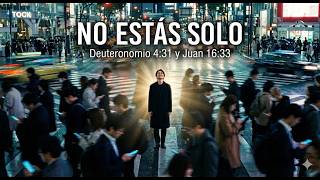
Unwavering Grace: Our Anchor in the Storm
For the LORD your God is a merciful God; He will not abandon you or destroy you or forget the covenant with your fathers, which He swore to them by oath. — Deuteronomy 4:31
I have told you these things so that in Me you may have peace. In the world you will have tribulation. But take courage; I have overcome the world! — John 16:33
Summary: God's grand narrative consistently reveals His profound reassurance to His people amidst trials. From Moses' ancient pronouncements of preservation through "distress" to Jesus' climactic declarations of victory over "tribulation," a singular truth echoes: God’s faithfulness remains steadfast. Our peace in Christ isn't an absence of conflict, but a profound, divinely empowered strength derived from His completed triumph over the world. We are not forsaken, for the Merciful God, through His Victorious Son and the indwelling Holy Spirit, secures us through every challenge until His glorious return.
The grand narrative of God's interaction with humanity is consistently marked by His profound reassurance to His people, particularly during times of great uncertainty and impending hardship. Across vast expanses of redemptive history, a singular truth echoes: God’s faithfulness remains steadfast, even as His people face inevitable trials. This divine promise isn't a mere philosophical concept; it’s a living reality, profoundly illuminated when we understand the deep connections between the ancient pronouncements of Moses and the climactic declarations of Jesus.
Moses, standing on the edge of the Promised Land, addressed a nation poised for both fulfillment and potential failure. He foresaw a future where comfort could breed complacency and lead to spiritual wandering. He warned of a time of "distress"—a period of intense pressure and "narrow straits"—that would serve as a covenantal tool to bring Israel back to God. Yet, even in this somber prophecy of judgment and exile, Moses delivered a blinding flash of grace: God, in His infinite mercy, would never abandon or utterly destroy His people. This promise was rooted not in Israel's fleeting obedience, but in the unshakeable, unconditional covenant made with their ancestors. The very nature of God, described as "Merciful God" (El Rachum), a compassion akin to a mother's deepest love, guaranteed their preservation. Though they might lose the physical land, they would never lose their Lord. This was an eschatological guarantee, spanning beyond immediate exiles to secure His people through the ultimate challenges of the "latter days."
Millennia later, Jesus, in the intimate setting of the Upper Room, echoed a similar sentiment, yet with a pivotal shift. He prepared His disciples for His imminent departure and the inevitable hostility of the world they would face. Like Moses, He spoke of future "tribulation"—a crushing pressure from a world rebellious against God. But Jesus' message was not just a promise of preservation; it was a declaration of decisive victory and a new quality of peace.
He offered a peace (eirene/shalom) that was not the absence of conflict but a profound relational state found "in Him." This peace was an objective reality of reconciliation, fueling a subjective stability even amidst the storm. The tribulation His followers would endure was not primarily a punishment for sin, but a direct consequence of their identification with Him, the Righteous One. It was an inevitable part of living "in the world" while not being "of the world."
Crucially, Jesus commanded His disciples to "take courage" (tharseite). This was not a call for self-generated confidence, but an imperative to look outward to His accomplished work. "I have overcome the world," He declared. This wasn't a future hope but a present, completed victory, spoken in the perfect tense. His impending cross, resurrection, and ascension were so certain in the divine plan that their triumph was already secured. He had conquered the power of sin, the dominion of Satan, and the sting of death.
The continuity between Moses’ promise and Jesus’ declaration is profound. The "distress" Moses predicted, a divinely orchestrated pressure to drive His people to repentance, finds its counterpart in the "tribulation" Jesus foretold, which now serves to refine the faith of believers and bear witness to Christ's victory. The cause of suffering shifts from retributive discipline to participatory identification with Christ, yet its redemptive function remains.
The divine solution to the problem of perceived absence or abandonment also culminates in Christ. Where Israel feared God's hidden face, Jesus' disciples feared being left as "orphans." Jesus solved this not by staying physically, but by promising an even greater presence: the Holy Spirit, the Helper and Advocate. This Spirit internalizes God's presence, moving it from being merely among the people to dwelling within them forever. Thus, the Merciful God’s promise of "not abandoning you" finds its ultimate fulfillment in the indwelling Spirit, securing the believer against ultimate forsaking. The Spirit enables us to experience Jesus' victory subjectively, even as outward tribulation rages.
Ultimately, God’s unwavering covenant fidelity ties these truths together. Moses grounded hope in the unbreakable oath sworn to the Patriarchs—a unilateral promise that guaranteed preservation. Jesus, through His decisive victory over the world, is the fulfillment of that ancient oath. His triumph on the cross is the ultimate act of God's mercy, where He, the Son, absorbed the ultimate "distress" and abandonment, so that His people would never be truly forsaken. The "Merciful God" of the Old Covenant becomes the "Victorious Son" of the New, purchasing our peace with His suffering.
For believers today, these interconnected truths offer immense encouragement.
- Embrace Reality with Hope: Expect tribulation, for it is the predicted environment of faith in this world, not a sign of God's disapproval.
- Anchor in His Nature: Our peace is not the absence of trouble, but the certainty of God's unwavering mercy and unshakeable covenant. He cannot abandon us without denying His very character.
- Draw Courage from Christ's Victory: The call to "take heart" is not a command to muster self-strength, but to fix our gaze on Jesus, whose victory over sin, death, and the world is already secured. Our struggles are the arena where His accomplished triumph is displayed.
- Live in the Spirit's Presence: We are not orphans. The indwelling Holy Spirit is our constant Helper, sealing us in Christ's victory and reminding us of His words, providing stability and power even in the most crushing pressures of life.
- Remember His Faithfulness: Actively recall God's merciful character and Christ's victorious work. This remembrance fuels enduring courage and transforms our understanding of suffering from a sign of defeat into a pathway for proving our union with the Victor.
Therefore, the peace we have in Christ is not a naive idealism, but a profound, divinely empowered strength to overcome the world from within. We take heart not because our troubles will magically disappear, but because the Merciful God, through His Victorious Son, has already conquered the ultimate enemy, and dwells within us, holding us fast through every "distress" until His glorious return.
What do you think?
What do you think about "Unwavering Grace: Our Anchor in the Storm"?
Related Content
You Are Not Alone
Loneliness
One of the great problems of modern life is loneliness. We can be surrounded by thousands of people and feel alone. Despite living in the age of commu...
The Covenant of Presence and the Victory of Peace: an Exhaustive Intertextual and Theological Analysis of Deuteronomy 4:31 and John 16:33
Deuteronomy 4:31 • John 16:33
1. Introduction: The Canonical Arc of Divine Assurance The biblical metanarrative is bracketed by the voice of God addressing the fragility of His pe...
Read in Context
Click to see verses in their full context.
Song (Other Languages)