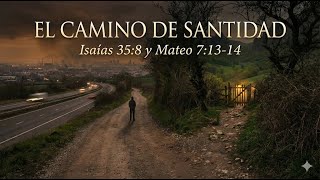
The Pilgrim's Path: Embracing the Narrow Way to God's Secure Highway
And there will be a highway called the Way of Holiness. The unclean will not travel it—only those who walk in the Way—and fools will not stray onto it. — Isaiah 35:8
Enter through the narrow gate. For wide is the gate and broad is the way that leads to destruction, and many enter through it. But small is the gate and narrow the way that leads to life, and only a few find it. — Matthew 7:13-14
Summary: Our spiritual journey is presented as "the Way," encompassing both a challenging "Narrow Gate" and a secure "Highway of Holiness." The Narrow Gate demands radical commitment and repentance, serving as our critical entry point and a decisive break from worldliness. Once we pass through this difficult gate, we find ourselves on the Highway of Holiness, where God's grace preserves us despite the pressures of living in a fallen world. Both the gate and the highway find their ultimate fulfillment in Christ, who is both our exclusive access to God and the divine path itself. Therefore, we must agonize to enter His narrow way, trusting in His unwavering protection and finding assurance on our journey towards Him.
Our journey through life, when viewed through a spiritual lens, is consistently presented in scripture as a profound pathway. This metaphor of "the Way" is not merely poetic but serves as a foundational framework for understanding our salvation and how we are called to live. Two significant scriptural visions, separated by centuries, offer us complementary insights into this divine path: a triumphant highway and a restrictive gate.
The prophetic vision speaks of a magnificent, elevated causeway—a "Highway of Holiness"—constructed by divine power through the wilderness. This is no ordinary track, but a royal road, engineered to be permanent, visible, and utterly secure. It is a path uniquely designated as holy, meaning it inherently possesses purity and therefore excludes anything unclean or morally corrupt. The promise is profound: those who traverse it are divinely protected, journeying with joy towards their ultimate destination.
In striking contrast, another vision, presented by our Lord himself, describes an entrance through a "Narrow Gate" and a subsequent walk on a "Hard Way." This gate is restrictive, demanding, and suggests a shedding of all unnecessary baggage. The path itself is not merely confined but described as "pressurized," evoking images of being hemmed in or afflicted. It immediately signals that the journey will involve struggle, friction, and perhaps even persecution. A stark warning accompanies this: many will choose the broad, easy path that leads to destruction, while only a few will find and persevere on the narrow, difficult way to true life.
At first glance, these descriptions might seem to contradict each other. How can the same divine journey be both a secure, joyful highway and a challenging, pressurized way? The profound truth lies in understanding that they represent distinct yet sequential aspects of our spiritual walk, culminating in the person of Christ himself.
The "Narrow Gate" is the critical point of entry—our justification and radical break from the world. It demands a personal, deliberate decision to forsake self-reliance, pride, and the allure of the broad path. This gate, though challenging to find and enter, is not exclusive in its offer but in its demand . It requires repentance, humility, and a singular commitment. The initial "pressure" felt upon entering is the purifying work of God, stripping away what cannot accompany us into His Kingdom.
Once we have entered through this Narrow Gate, we find ourselves upon the "Highway of Holiness." This is the path of our sanctification, where God's grace actively preserves and guides us. The difficulty of the entrance guarantees the security of the journey. Because the gate is narrow, it filters out all that is wicked and unfit, ensuring that the highway itself remains pure and safe for those called to travel it. The "fools" – those who stubbornly cling to their own corrupt wisdom or ways – are excluded, making the path free from internal spiritual threats.
The "pressurized" nature of the path following the Narrow Gate reflects the reality of living out our faith in a fallen world. Discipleship is not a comfortable stroll; it involves real struggles and resistance against cultural norms and our own sinful inclinations. Yet, even in this pressure, there is an underlying safety. The highway, built by God, protects us from ultimate spiritual destruction. We may feel the friction of holiness in a hostile world, but we are guarded from the "lion" of final ruin. This is the paradoxical "joyful struggle" of the Christian life: we embrace the hardship and find liberation, which in turn fuels our joy.
Ultimately, both the Gate and the Highway find their ultimate fulfillment in Jesus Christ. He declared, "I am the door" (the Gate), emphasizing that access to God is exclusively through Him. He also proclaimed, "I am the way" (the Highway), signifying that the journey itself is sustained by His presence and power. The "narrowness" is the exclusivity of faith in Him alone; the "security" is His unshakeable promise to carry us through. We do not navigate this path by our own skill, but by relying on Him, the Way itself.
For believers, this unified vision offers powerful lessons:
- Embrace the Call to Radical Discipleship: Do not shy away from the demands of the Narrow Gate. True entry into God's Kingdom requires a decisive break from worldliness and self-sufficiency. This initial commitment, though difficult, is essential.
- Understand Holiness as Distinction and Endurance: To walk the "Highway of Holiness" means to live a life set apart, one that can withstand the "pressure" of opposing forces. Holiness is not passivity but active resistance and steadfastness in Christ.
- Find Assurance in God's Unfailing Grace: Once you have truly committed to Christ and entered His Way, rest in the profound assurance that He will preserve you. The path itself, being Christ, secures you. Even when the journey feels "pressurized," you are eternally safe on His Highway, destined for Zion.
- Reject Universalist Delusions: The biblical witness is clear: the path to life is specific and exclusive. It is open to all who will humble themselves and enter through Christ, but it remains closed to those who insist on bringing their unrepentant sin.
Therefore, let us agonize to enter the Narrow Gate, knowing that it leads directly onto the glorious Highway of Holiness. There, protected by our Savior and purified by His grace, we march forward, confident in our journey, knowing that we will ultimately return to the presence of God with everlasting joy and no more sorrow or sighing.
What do you think?
What do you think about "The Pilgrim's Path: Embracing the Narrow Way to God's Secure Highway"?
Related Content
The Way of Holiness
Holiness, Purpose, and Challenge of the Christian
Holiness is walking according to God's standards in our spiritual pilgrimage here on earth. It is the great challenge of the Christian. When we speak ...
The Via Sacra and the Porta Angusta: an Exhaustive Exegetical, Historical, and Theological Analysis of the Interplay Between Isaiah 35:8 and Matthew 7:13-14
Isaiah 35:8 • Matthew 7:13-14
1. Introduction: The Topographical Metaphor in Biblical Theology The conceptualization of human existence as a journey—a linear progression through t...
Read in Context
Click to see verses in their full context.
Song (Other Languages)