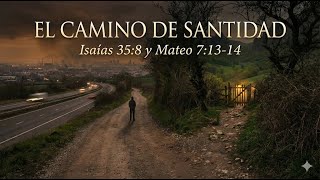
The Via Sacra and the Porta Angusta: an Exhaustive Exegetical, Historical, and Theological Analysis of the Interplay Between Isaiah 35:8 and Matthew 7:13-14
Isaiah 35:8 • Matthew 7:13-14
Summary: The enduring archetype of human existence as a journey finds its primary structural framework within biblical soteriology and ethics, particularly through the metaphor of the "Way." Our analysis focuses on two monumental texts at opposing ends of the biblical redemptive arc: Isaiah 35:8, which presents the "Highway of Holiness," and Matthew 7:13-14, with its warning of the "Narrow Gate." While these passages, separated by centuries, offer distinct visions of the path to God—Isaiah's high triumphalism versus Matthew's vision of restriction and difficulty—we uncover a sophisticated theological dialectic rather than a contradiction. Our central thesis posits that the tension between Isaiah’s divinely constructed, foolproof highway and Matthew’s hard-to-find, pressurized gate resolves into a unified soteriology where the exclusivity of the entrance guarantees the security of the journey.
Isaiah's "Highway of Holiness" (Derek HaQodesh) is depicted as a raised causeway, a maslul, engineered by divine initiative through a blossoming wilderness. It is an extraordinary act of creation, a road that conquers geography, ensuring permanence and visibility. This Way is inherently holy, functioning as a mobile sanctuary that cannot tolerate the presence of the "unclean." Crucially, our exegetical investigation into the phrase ve-evilim lo yita'u reveals that the "fool" (evil), understood as the morally wicked, is explicitly excluded from this highway. This means the road is safe not because the foolish are guided, but because the unholy are barred, establishing boundaries of purity for the redeemed.
In stark contrast, Matthew 7:13-14 presents a formidable challenge. Jesus commands entry by a "narrow gate" (pylēs stenēs) and emphasizes a way that is "hard" or, more accurately, "pressurized" (hodos tethlimmenē), evoking a path of tribulation and affliction. This imagery suggests that entrance to the Kingdom demands the shedding of earthly baggage, requiring an individual act of seeking that few manage to "find." The path itself is not merely constricted in width but is actively characterized by external pressure and friction between the Kingdom of Heaven and the present age, aligning with later New Testament teachings on persecution and suffering for discipleship.
The apparent paradoxes of visibility and experience between these two texts are resolved within the "already/not yet" tension of the Kingdom. The hiddenness of Matthew's Narrow Gate serves as the mechanism for spiritual sight; only those who strive to enter this gate, representing repentance and justification, gain the spiritual perception to recognize Isaiah's gloriously visible Highway of Holiness, which then becomes their path of sanctification. While Matthew emphasizes the pressure and struggle of the journey, Isaiah underscores the spiritual safety and ultimate joy for those on the Way. This "joyful struggle" means that the external pressures inherent in walking the hard way are precisely what liberate believers, preparing them for the unshakable peace promised on the Highway.
Ultimately, these texts offer a profound theological progression, mapping onto the order of salvation. Matthew focuses on the crisis of decision and the disciplined walk of justification and early sanctification. Isaiah, on the other hand, describes the divine preservation and final glorification awaiting those who have entered. In Christ, these metaphors find their ultimate fulfillment: He is both the exclusive Narrow Gate—demanding repentance and self-denial—and the Holy Highway itself, the Person who sustains and carries the traveler. This unified vision fundamentally rejects universalism, defines holiness as a counter-cultural, pressure-bearing distinctiveness, and provides robust assurance that for those who have entered the Narrow Gate, the Highway of Holiness leads inevitably and safely to Zion, with songs of everlasting joy.
1. Introduction: The Topographical Metaphor in Biblical Theology
The conceptualization of human existence as a journey—a linear progression through time and space toward a definitive telos—is perhaps the most enduring archetype in religious literature. Within the biblical canon, this metaphor transcends mere poetic illustration to become the primary structural framework for soteriology and ethics. The "Way" (Derek in Hebrew, Hodos in Greek) is not merely a method of conduct but a locus of divine encounter, a specific spiritual geography that demands navigation, endurance, and discernment. Among the manifold iterations of this motif, two texts stand as monumental pillars at opposite ends of the biblical redemptive arc: the prophetic vision of the "Highway of Holiness" in Isaiah 35:8 and the dominical warning of the "Narrow Gate" in Matthew 7:13-14.
These two passages, separated by centuries of history and distinct theological crises, offer complementary yet paradoxically distinct visions of the path to God. Isaiah 35:8 presents a vision of high triumphalism, a raised causeway (maslul) constructed by divine initiative through the blossoming wilderness, reserved exclusively for the redeemed and characterized by safety, joy, and an intrinsic protection from error. It is the path of the "New Exodus," where the returning exiles are carried by the momentum of grace. In sharp contrast, Matthew 7:13-14, situated at the climax of the Sermon on the Mount, presents a vision of restriction, pressure, and immense difficulty. The "Narrow Gate" (pylēs stenēs) and the "Hard Way" (hodos tethlimmenē) suggest a journey that is not a procession of ease but an agonizing struggle against the entropic pull of the "Broad Way" that captivates the majority of humanity.
The interplay between these texts is frequently smoothed over in popular piety, which conflates them into a singular image of the "straight and narrow." However, a rigorous academic investigation reveals a complex intertextual relationship rooted in the "Two Ways" tradition of Second Temple Judaism—a tradition spanning Deuteronomy, Jeremiah, the Dead Sea Scrolls, and early Christian catechesis. This report provides an exhaustive analysis of these texts, dissecting their philological roots, their historical contexts in Ancient Near Eastern engineering and city defense, and their reception in Jewish and Christian thought.
The central thesis of this analysis posits that the tension between Isaiah’s "foolproof" highway and Matthew’s "hard-to-find" gate is not a contradiction but a sophisticated theological dialectic. Matthew’s rigorous "Narrow Gate" serves as the necessary entrance requirement—the point of justification and radical break from the world—that grants access to Isaiah’s "Highway of Holiness," the path of sanctification where the believer is protected by the very holiness that bars the unclean. By examining the specific vocabulary of "pressure" (thlipsis) in Matthew and "elevation" (sll) in Isaiah, alongside the contentious translation of the "fool" (evil) in Isaiah 35:8, we uncover a unified soteriology: the exclusivity of the entrance guarantees the security of the journey.
2. The Isaianic Highway: Exegesis of Isaiah 35:8
To understand the "Highway of Holiness," one must first situate it within the literary and historical context of the Book of Isaiah. Chapter 35 acts as a glorious hinge, pivoting from the apocalyptic judgment of the nations in Chapter 34—where Edom is reduced to a chaotic wasteland of pitch and void (tohu)—to the historical narrative of Hezekiah and the eventual consolation of the Exile. The "Highway" is the structural answer to the "Void" of judgment.
2.1 Philological and Material Context: The Maslul
The Hebrew text of Isaiah 35:8 introduces a specific architectural term that is often flattened in English translation:
Ve-hayetah sham maslul va-derek (וְהָיָה שָׁם מַסְלוּל וָדֶרֶךְ) — "And a highway will be there and a way."
2.1.1 The Etymology of Elevation
The noun maslul is derived from the root sll (סלל), meaning "to cast up," "to mound," or "to lift up". This is not a generic term for a path. In the topographical reality of the Ancient Near East (ANE), distinct types of roads existed. The common derek was merely a beaten track formed by the habitual passage of feet or caravans. Such paths were susceptible to the elements; they could be washed away by the flash floods that roar through the wadis of the Arabah or obscured by shifting desert sands.
A maslul, however, was an engineered structure. It refers to a causeway raised above the surrounding terrain. This construction technique was utilized for royal processional roads and military supply lines, ensuring that the king’s passage would be unimpeded by the mud, mire, or irregularities of the natural landscape. The maslul implies permanence, visibility, and intentionality. It is a road that conquers the geography rather than submitting to it.
2.1.2 Ancient Near Eastern Road Construction
The imagery of the maslul would have evoked the grand processional ways of the Mesopotamian empires, such as the famous Procession Street of Babylon, paved with limestone and breccia, raised above the city to keep the sacred icons of the gods elevated and clean during festivals. In Isaiah’s prophetic imagination, YHWH is constructing His own Via Sacra through the desert. This is not a human discovery (a path found by seeking) but a divine creation (a path built for transport).
The archaeological context of the Levant reinforces this. The "King's Highway" (Via Regia) was a major trade route running north-south through the Transjordan. However, Isaiah’s highway is distinct; it is not for trade but for return. The engineering feat described—raising a road in a "thirsty land"—mirrors the hydraulic feats described in verses 6-7, where water breaks forth in the wilderness. The maslul is the civil engineering counterpart to the hydrological miracle; both are impossible acts of creation that reverse the entropy of the fall.
2.2 The Designation: Derek HaQodesh (The Way of Holiness)
The road is given a proper name: Derek HaQodesh. In Hebrew thought, the name denotes essence. The road is not merely a route to a holy place; the road itself possesses the quality of qodesh (holiness/separateness).
This designation introduces the Levitical category of contagion. In the priestly worldview, holiness and uncleanness are incompatible states. Leviticus and Haggai (2:12-13) discuss the transmission of holiness and impurity. By designating the road as "Holy," Isaiah immediately establishes boundaries of exclusion. A holy road cannot tolerate the presence of the "unclean" (tame) without the road becoming defiled or the unclean being destroyed.
Thus, the text explicitly states: "The unclean shall not pass over it" (lo ya'brennu tame). This is a cultic exclusion. The "unclean" refers to those ritually or morally unfit for the presence of God. Just as the Temple had restricted zones of access, the Highway is an extension of the Temple’s sacred space stretching all the way back to the lands of exile. It is a mobile sanctuary.
2.3 The Interpretive Crux: The Fate of the "Fool" (Evil)
One of the most significant debates in the history of interpretation—and one that directly impacts the interplay with Matthew 7—concerns the translation of the phrase ve-evilim lo yita'u (וֶאֱוִילִים לֹא יִתְעוּ). The syntax allows for two divergent readings, leading to two different theological conclusions regarding the "difficulty" of the Way.
2.3.1 The "Foolproof" Interpretation (Traditional/KJV)
The King James Version, following a specific reading of the vav conjunction, renders the verse: "The wayfaring men, though fools, shall not err therein.".
-
Syntactical Rationale: The vav is treated as concessive ("even if" or "though"). The subject of the verb lo yita'u (shall not wander/err) is understood to include the fools.
-
Theological Implication: This reading champions the security of grace. It suggests that the Highway is so clearly marked, so bounded by divine protection, and so elevated above the confusing terrain of the wilderness, that even a person of limited intellectual capacity or spiritual maturity ("a fool") cannot get lost once they are upon it.
-
Pastoral Legacy: This interpretation has been a source of immense comfort in the Protestant tradition. It emphasizes that salvation is not dependent on the navigator’s skill but on the Architect’s design. Spurgeon and other preachers have utilized this to encourage the "simple" believer that their lack of sophistication will not debar them from Zion.
-
Comparison with Matthew: If this reading is correct, it stands in tension with Matthew 7:14 ("Few there be that find it"). It implies that the way is easy to follow, whereas Jesus implies the way is hard to find and keep.
2.3.2 The Exclusionary Interpretation (Critical/Modern)
Most modern scholarly translations (ESV, NIV, NASB, NET) adopt a different syntactical approach: "Wicked fools will not go about on it" or "Fools will not wander onto it.".
-
Lexical Rationale: The Hebrew word evil (אֱוִיל) is rarely used in the Bible for someone who is merely "simple" or "uneducated" (which is usually pethi). In Wisdom Literature (Proverbs 1:7, 12:15), the evil is the moral fool—the one who rejects wisdom, despises correction, and is inherently wicked. To allow an evil on the Way of Holiness would be a contradiction in terms.
-
Syntactical Rationale: The vav is treated as conjunctive, linking the "fools" with the "unclean" in the previous clause. The verb ta'ah, while meaning "to err/wander," in this context implies wandering onto the path illicitly.
-
Contextual Evidence: Verse 9 states that "No lion shall be there, nor any ravenous beast." The exclusion of the physical threat (the lion) parallels the exclusion of the moral threat (the fool). The safety of the road is preserved not by guiding the fool, but by banning him.
-
Theological Implication: This reading emphasizes the exclusivity of holiness. The road is safe because it is purged of the wicked.
Synthesis for this Report: The textual evidence heavily favors the Exclusionary Interpretation. The "Way of Holiness" is a zone of purity. This creates a stronger continuity with Matthew 7’s "Narrow Gate," which also functions as a filter to exclude the "many" who travel the broad road of destruction. However, the affective power of the "Foolproof" reading points to a deeper truth about the preservation of the saints (Isaiah 35:10) which will be discussed in the theological synthesis.
2.4 The Septuagint (LXX) Transformation: Hodos Kathara
The Greek translation of Isaiah 35:8, produced in the Hellenistic period, offers a vital bridge to the New Testament vocabulary.
-
The Pure Way: The LXX translates Derek HaQodesh not just as "Holy Way" but introduces the phrase hodos kathara (pure way).
-
The Diaspora Connection: Crucially, where the Masoretic Text (MT) is ambiguous about "wayfaring men," the LXX explicitly identifies the travelers as hoi diesparmenoi—"the dispersed ones".
-
Significance: This explicitly eschatologizes the text. The Highway is not just a metaphor for a good life; it is the specific mechanism for the Ingathering of the Exiles. The "Way" is the route home from the Diaspora. When Jesus speaks of the "Way leading to Life" in Matthew, he is tapping into this Jewish expectation of a "New Exodus" route that gathers the scattered people of God back to Zion.
3. The Matthean Gate: Exegesis of Matthew 7:13-14
Turning to the New Testament, we find the metaphor of the path repurposed in the conclusion of the Sermon on the Mount. Matthew 7:13-14 does not appear in a vacuum; it follows the "Golden Rule" (7:12) and serves as the first of four binary warnings (Two Ways, Two Trees, Two Claims, Two Foundations) that demand a verdict from the hearer.
3.1 The Architecture of Exclusion: Pylēs Stenēs
Jesus commands: "Enter by the narrow gate" (Eiselthete dia tes stenes pyles).
The imagery here is architectural. In the ancient walled city, the gate was the locus of commerce, judgment, and security.
-
Stenos (στενός): The adjective means "narrow," "thin," or "restricted." It implies a lack of "wiggle room".
-
City Defense Context: While major city gates were wide enough for chariots and trade caravans, they also featured smaller, pedestrian-sized doors (sometimes called "needle's eyes," though the literal camel/needle connection is debated) for use when security was high or at night. The "Narrow Gate" implies a restriction of flow. One cannot enter this gate en masse or as a collective group. One must enter individually.
-
Theological Import: The narrowness suggests that the entrance to the Kingdom requires the shedding of baggage. The "Broad Gate" (plateia pyle) allows for the retention of the self—one’s pride, Pharisaic traditions, or Gentile distinctives. The Narrow Gate strips the entrant down to the bare essence of the repentant soul.
3.2 The Physics of the Path: Hodos Tethlimmenē
While the gate is narrow, the description of the road itself is even more visceral. The KJV's "narrow is the way" misses the nuance of the Greek participle tethlimmenē (τεθλιμμένη).
3.2.1 Philology of Pressure
Tethlimmenē is the perfect passive participle of the verb thlibo (θλίβω).
-
Definition: Thlibo means "to press," "to squash," "to hem in," or "to rub against." It is the root of the word thlipsis, which is the standard New Testament word for "tribulation," "affliction," or "persecution".
-
Metaphorical Resonance: This is not merely a path that is "narrow" in terms of width (like a tightrope); it is a path that is pressurized. The imagery evokes a canyon where the walls are closing in, or a path through a dense, hostile crowd where the traveler is jostled and crushed.
-
Translation History:
-
"Hard" (ESV, RSV) captures the difficulty but loses the physical metaphor.
-
"Constricted" (NAB) captures the dimension.
-
"Compressed" or "Afflicted" (Literal) captures the theology.
-
3.2.2 The Way of Tribulation
By describing the way as tethlimmenē, Matthew links the journey of discipleship directly to the experience of persecution. The "pressure" comes from the friction between the Kingdom of Heaven and the present age. This aligns with Jesus’ later warnings: "In the world you will have tribulation (thlipsis)" (John 16:33) and the Pauline exhortation: "Through many tribulations (thlipseon) we must enter the kingdom of God" (Acts 14:22). Unlike Isaiah’s maslul, which is raised above the danger, Matthew’s way goes through the pressure. This suggests a different stage of eschatological realization—the "already/not yet" tension where the believer is redeemed but still walking in enemy territory.
3.3 The Quantitative Crisis: Many vs. Few
The most chilling aspect of Matthew 7:13-14 is the quantification of salvation.
-
The Many (Polloi): Enter the "Broad" (euruchoros - literally "roomy space") way. This path is defined by its lack of resistance. It follows the gravitational pull of the fallen nature. It is the path of social consensus.
-
The Few (Oligoi): Find the "Narrow" way.
-
The Verb "Find" (Heurisko): Jesus says few find it. This implies the gate is obscure. It is not the default option. In the context of Isaiah, the Maslul is a massive, visible highway. In Matthew, the Gate is hidden, requiring active seeking ("Seek and ye shall find," Matt 7:7). This speaks to the "hiddenness" of the Kingdom in the present age—it is like treasure hidden in a field (Matt 13:44), not yet a public highway for the nations.
3.4 Destination: Zoe vs. Apoleia
The binary roads lead to binary ends.
-
Life (Zoe): In Matthew, this is not merely biological existence but Zoe Aionios (Eternal Life)—participation in the age to come.
-
Destruction (Apoleia): This is the ultimate ruin, the "waste" or "loss" of the soul. It parallels the "burning pitch" and "void" of Isaiah 34. The "Broad Way" does not lead to a neutral place but to active destruction.
4. The "Two Ways" Tradition: Historical and Literary Trajectory
To fully grasp the interplay between Isaiah and Matthew, it is insufficient to treat them as isolated texts. They are nodes in a long trajectory of the "Two Ways" (Duae Via) tradition that permeates Jewish and early Christian literature. Matthew is not inventing this metaphor; he is codifying a standard Jewish catechetical tool.
4.1 Old Testament Antecedents
The "Two Ways" motif finds its genesis in the Covenantal dualism of the Torah.
-
Deuteronomy 30:15, 19: "See, I have set before thee this day life and good, and death and evil... therefore choose life." Here, the "Ways" are defined as obedience vs. disobedience to the Covenant.
-
Jeremiah 21:8: "Thus saith the Lord; Behold, I set before you the way of life, and the way of death." Jeremiah applies the Deuteronomic choice to the specific historical crisis of the Babylonian siege—surrender (life) or resistance (death).
-
Psalm 1:6: "For the Lord knoweth the way of the righteous: but the way of the ungodly shall perish." Wisdom literature psychologizes the ways into the character of the walker.
4.2 The Qumran Dualism (1QS)
The Dead Sea Scrolls provide the immediate Second Temple context for Matthew’s imagery. The Community Rule (1QS 3:13–4:26), specifically the "Treatise of the Two Spirits," articulates a cosmic dualism.
-
The Two Spirits: Humanity is divided into two "lots"—the Sons of Light (ruled by the Prince of Lights) and the Sons of Darkness (ruled by the Angel of Darkness/Belial).
-
Deterministic vs. Volitional: Qumran’s dualism is heavily deterministic; one walks in the way of light because God has appointed their spirit to it. Matthew’s dualism retains the imperative "Enter!" suggesting a stronger volitional element, though underpinned by divine election ("few there be that find it").
-
Sectarian "Way": The Qumran community literally moved to the desert to prepare "The Way of the Lord" (citing Isaiah 40:3). They viewed their rigorous interpretation of the Law as the Maslul. Matthew redefines this "Way" not as geographical isolation but as the ethical rigour of the Sermon on the Mount.
4.3 The Didache and Early Christian Catechesis
The Didache (The Teaching of the Twelve Apostles), a late 1st-century Christian manual, begins explicitly: "There are two ways, one of life and one of death, and there is a great difference between the two ways." (Didache 1:1).
-
The Way of Life: Defined by the Double Commandment of Love (God/Neighbor) and the Golden Rule.
-
The Way of Death: Defined by a list of vices (murder, adultery, magic, etc.).
-
Connection to Matthew: The Didache clearly draws from Matthew 7, using the "Two Ways" as the framework for pre-baptismal instruction. This confirms that the early Church understood Matthew 7:13-14 primarily as an Ethical Blueprint. To walk the "Narrow Way" was to adhere to the moral demands of Jesus. It was not a mystical experience but a concrete lifestyle of discipline.
Synthesis of Tradition: Matthew stands at the intersection of the Covenantal tradition (Deut/Jer) and the Sectarian tradition (Qumran/Didache). He takes the national choice of Deuteronomy and radicalizes it into the individual discipleship choice of the Kingdom.
5. Comparative Synthesis: The Interplay of Highway and Gate
Having isolated the exegetical and historical data, we can now construct the synthesis. How do the "Highway of Holiness" and the "Narrow Gate" interplay? Are they synonymous, sequential, or contrasting?
5.1 The Paradox of Visibility: The Hidden Gate to the Visible Highway
A topographic contradiction exists on the surface:
-
Isaiah 35: The Highway is a Maslul—raised, visible, a landmark for the nations. It is a public declaration of God’s glory.
-
Matthew 7: The Gate is Stenos and Hidden—found only by a few.
Resolution: The Eschatological Overlap.
This tension reflects the "Now and Not Yet" of the Kingdom.
-
To the "Blind" (the unredeemed world described in Isaiah 35:5), the Highway is invisible. They cannot see the Maslul because they have not entered the Gate.
-
The "Narrow Gate" is the mechanism of spiritual sight. It acts as the access point. Once the believer "strives" to enter the Gate (repentance/justification), their eyes are opened (Isa 35:5), and they perceive the "Highway of Holiness" (sanctification) stretching out before them.
-
Therefore, the obscurity of the Gate protects the sanctity of the Highway. Only those who truly seek find the entrance; thus, the Highway remains reserved for the "Redeemed," just as Isaiah prophesied.
5.2 The Paradox of Experience: Safety vs. Pressure
-
Isaiah 35: Emphasizes Safety. "No lion shall be there" (v. 9). The travelers return with "songs and everlasting joy" (v. 10). It is a path of relief.
-
Matthew 7: Emphasizes Pressure. The way is tethlimmenē (crushing/compressed). It is a path of resistance.
Resolution: The Dynamic of "Joyful Struggle."
The interplay suggests that the Christian life is simultaneously a struggle and a joy—a paradox central to New Testament theology.
-
External vs. Internal: The "Pressure" (thlipsis) in Matthew often refers to external circumstances (persecution, worldliness). The "Safety" in Isaiah refers to spiritual security (protection from the "lion" of ultimate destruction).
-
The Theological Mechanism: By walking the "Hard Way" of self-denial (Matthew), the believer is liberated from the tyranny of sin. This liberation creates the "Joy" of Isaiah. The "yoke is easy" (Matt 11:30) precisely because the Gate is narrow—it strips off the burdens that make life heavy.
-
The Fool: The "fool" (evil) of Isaiah cannot find the path because he refuses the "pressure" of the Gate. He wants a broad entrance. By refusing the thlipsis of the Gate, he misses the shalom of the Highway.
5.3 The Theological Progression: Justification and Sanctification
The two texts can be mapped onto the order of salvation (Ordo Salutis).
| Theological Stage | Biblical Text | Metaphor | Function |
| Call/Election | Matt 7:14 ("Few find it") | The Hidden Entrance | Divine Sovereign Grace initiating the search. |
| Justification | Matt 7:13 ("Enter!") | The Narrow Gate | The crisis of decision; shedding of self-righteousness; the "death" of the old self. |
| Sanctification | Matt 7:14 ("The Way") | The Compressed Road | The daily "carrying of the cross"; the friction of holiness in a fallen world. |
| Preservation | Isa 35:8 ("Fools not err") | The Highway | The divine keeping of the saint; the assurance that the path itself (Christ) secures the traveler. |
| Glorification | Isa 35:10 ("Come to Zion") | The Destination | Final entrance into the presence of God; sorrow and sighing flee. |
Insight: Matthew focuses on the Entrance and the Walk (Justification/Sanctification). Isaiah focuses on the Environment and the End (Preservation/Glorification). They are two camera angles on the same soteriological reality.
5.4 Christological Fulfillment: The Person as the Path
Ultimately, the New Testament resolves the imagery in the person of Jesus Christ.
-
Jesus as the Gate: "I am the door: by me if any man enter in, he shall be saved" (John 10:9). This fulfills Matthew 7.
-
Jesus as the Way: "I am the way, the truth, and the life" (John 14:6). This fulfills Isaiah 35.
-
The Synthesis: The "Highway" is not a set of rules; it is a Person. This explains Isaiah’s "foolproof" promise. If the Road is a Person (Christ), then the traveler is not sustained by their own navigational intelligence but by the Road itself carrying them. As Maclaren notes, "He is the Way and the Leader of the Way". The "Narrowness" of Matthew is simply the exclusivity of Christ—there is no other name given under heaven.
6. Theological Implications for the Church
6.1 The Rejection of Universalism
Both texts are adamantly particularist.
-
Isaiah excludes the "unclean" and the "fool."
-
Matthew excludes the "many" who prefer the broad road.
This challenges contemporary notions of universal salvation. The biblical data suggests that the "Way" is structurally exclusive. It is open to all who will "wash their robes" (Rev 22:14), but it is closed to those who insist on bringing their "uncleanness" (sin/pride) with them. The Gate is wide enough for the sinner, but too narrow for the sinner and his sin.
6.2 The Definition of Holiness
Isaiah’s definition of the road as Holy (Qodesh) combined with Matthew’s definition of the road as Pressurized (Tethlimmenē) creates a definition of holiness that is inherently counter-cultural. Holiness is not merely "niceness" or "moralism"; it is a "pressure-bearing" distinctiveness. To be holy is to withstand the crushing pressure of the "Broad Way" culture without collapsing.
6.3 The Assurance of the Saint
The "Two Ways" interplay offers a robust doctrine of assurance. For the one who has entered the "Narrow Gate" (repentance/faith in Christ), the promise of Isaiah 35 becomes active. They are now on the Maslul. Though they may feel the "pressure" (Matthew) of the world, they are spiritually safe from the "lion" (Isaiah). The "fools" are not on the road, so the road is safe. The believer may stumble (koshel, Isa 35:3) due to weak knees, but they will not wander off (ta'ah, Isa 35:8) into final destruction, because the Highway leads inevitably to Zion.
7. Conclusion
The interplay of Isaiah 35:8 and Matthew 7:13-14 constructs a comprehensive theology of the spiritual life. Isaiah provides the infrastructure of grace—the Maslul constructed by God to bridge the gap between the wilderness of sin and the Zion of glory. Matthew provides the protocol of access—the Pylēs Stenēs that demands the total surrender of the self to enter that infrastructure.
Far from contradictory, the "Hard Way" of Matthew and the "Safe Way" of Isaiah are symbiotic. The rigor of the Gate ensures the purity of the Highway. The exclusion of the "many" in Matthew guarantees the safety of the "redeemed" in Isaiah. The "pressure" of the journey is the very sensation of being shaped by holiness in a hostile world.
Ultimately, the texts converge on a singular call: to reject the "Broad Way" of destruction—which offers the illusion of freedom but leads to the void—and to "agonize" to enter the "Narrow Gate," finding there the "Highway of Holiness" where, protected by the Savior and purified of uncleanness, the ransomed of the Lord return to Zion with songs of everlasting joy.
What do you think?
What do you think about "The Via Sacra and the Porta Angusta: An Exhaustive Exegetical, Historical, and Theological Analysis of the Interplay Between Isaiah 35:8 and Matthew 7:13-14"?
Related Content
The Way of Holiness
Holiness, Purpose, and Challenge of the Christian
Holiness is walking according to God's standards in our spiritual pilgrimage here on earth. It is the great challenge of the Christian. When we speak ...
The Pilgrim's Path: Embracing the Narrow Way to God's Secure Highway
Isaiah 35:8 • Matthew 7:13-14
Our journey through life, when viewed through a spiritual lens, is consistently presented in scripture as a profound pathway. This metaphor of "the Wa...
Read in Context
Click to see verses in their full context.
Song (Other Languages)