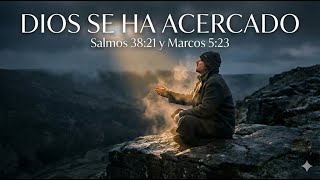
From a Heavy Hand to a Healing Touch: the Journey to Divine Proximity
Do not forsake me, O LORD; be not far from me, O my God. — Psalms 38:21
and pleaded with Him urgently, “My little daughter is near death. Please come and place Your hands on her, so that she will be healed and live.” — Mark 5:23
Summary: The sweeping narrative of scripture reveals a transformative journey regarding God's relationship with suffering humanity, shifting from ancient perceptions of divine discipline to the restorative, personal touch of the incarnate Messiah. While ancient souls cried out for God's nearness amidst perceived displeasure and isolation, Jesus embodies the answer to that profound plea. What was once depicted as a heavy hand of judgment transforms, in Christ, into an intimate, life-giving touch that breaks down all barriers of impurity, social stigma, and even death itself. This assures us that God has drawn near in Christ, offering wholeness and unwavering fidelity to us in our deepest despair, realizing the ancient longing for Immanuel – God with us.
The sweeping narrative of scripture reveals a fundamental truth about God's relationship with suffering humanity. At its heart lies a transformative journey: from experiencing what felt like God’s heavy hand of discipline in ancient times to encountering the restorative, personal touch of the incarnate Messiah. This profound theological arc speaks directly to our core human anxieties of abandonment, ritual impurity, and the desperate yearning for God’s closeness in the face of life's deepest trials.
In the ancient psalms, we hear the intense cries of a soul burdened by its own failings and the resulting distress. The psalmist, enduring physical decay and social isolation, laments under a perceived pressure of divine displeasure. In this season of spiritual depression and outward affliction, the plea "be not far from me" arises not merely from a desire for physical relief, but from a profound longing to restore a fractured relationship with God. When human friends and community turn away, the suffering soul learns to place its entire hope in the Lord, recognizing that God's faithful presence is the ultimate advocate and rescuer, even when physical wholeness seems distant. This journey teaches us that even in our darkest moments of conviction and isolation, our deepest need is for God's unwavering nearness, and His ear is always open to our desperate plea for Him to draw close.
Centuries later, the New Testament introduces us to a new reality in Jesus, the Messiah, who embodies the answer to that ancient prayer for proximity. We see a respected synagogue leader, Jairus, humbled by his daughter's imminent death, falling at Jesus' feet and earnestly begging Him to "come and lay Your hands on her." This request, for a direct, physical touch, marks a profound shift. The child is at her life's very end, mirroring the psalmist's feeling of utter collapse. This story is beautifully interwoven with that of a woman suffering for twelve long years from a ritually defiling hemorrhage, a condition that left her an outcast. Both individuals, one highly esteemed and the other marginalized, represent the breadth of human suffering, symbolizing a "ailing people" in need of divine restoration.
The most striking revelation lies in the transformation of the "Hand of God." What was once depicted in the lament as a heavy, pressing force of judicial discipline, is now, in Jesus, a hand of intimate, life-giving touch. Jesus willingly enters the very space of death and impurity, demonstrating a holy power differential: instead of being defiled by touching the unclean woman or the deceased girl, His touch brings cleansing, healing, and resurrection. This miraculous reversal proclaims that Jesus' presence and touch are stronger than any ritual boundary, social stigma, or even the power of death itself. It teaches believers that Jesus breaks down every barrier—social, ritual, and spiritual—to meet us in our brokenness.
For believers, this unfolding story offers immense edification. It assures us that in our moments of deepest despair, when we feel forsaken or pressed down by the weight of life's circumstances or our own failures, God has drawn near to us in Christ. The longings of the ancient world for a tangible, present God are fully realized in Jesus, Immanuel – God with us. When we, like Jairus, cast aside pride and, in desperate faith, invite Jesus into our seemingly "lost causes," He responds with compassion and transformative power. His holiness is contagious for good, not for defilement. We are invited into a dynamic, "dialogic relationship" of trust, knowing that our Lord is our salvation, ever ready to bring wholeness, life, and an end to the dark seasons of our souls. We are never truly abandoned, for His touch promises unwavering fidelity and a future beyond our brokenness.
What do you think?
What do you think about "From a Heavy Hand to a Healing Touch: The Journey to Divine Proximity"?
Related Content

God Has Drawn Near
The Saviour's Nearness: a Touch for Every Trial
Psalms 38:21 • Mark 5:23
My dear brethren, have you ever felt the crushing weight of life's sorrows, your very soul crying out, "Be not far from me, O Lord!"? In ancient times...
The Theology of Proximity: an Analytical Interplay of Psalm 38:21 and Mark 5:23
Psalms 38:21 • Mark 5:23
The biblical narrative, spanning the ancient Near Eastern world of the Hebrew Psalter to the Greco-Roman environment of the Synoptic Gospels, is funda...
Read in Context
Click to see verses in their full context.
Song (Other Languages)