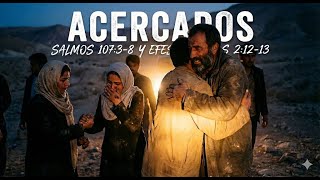
The Gathered and the Near: an Exhaustive Intertextual Analysis of Psalm 107:3, 8 and Ephesians 2:12-13
Psalms 107:3-8 • Ephesians 2:12-13
Summary: The theological architecture of the Judeo-Christian scriptures is fundamentally structured around the twin poles of scattering and gathering, a metanarrative extending from Eden to redemption. Within this grand canonical arc, Psalm 107 and Ephesians 2 stand as monumental pillars, bridging the Old Testament hope of restoration with the New Testament reality of the church. This analysis demonstrates that Ephesians 2 identifies the "gathering of the exiles" in Psalm 107 as the typological framework for the inclusion of the Gentiles, transforming the geographic and ethnic "far off" into the ontologically "near" through the redemptive mechanism of the cross.
Psalm 107 functions as a liturgy for the re-gathered community, answering the prayer for salvation and illustrating God's redemptive initiative. The "redeemed" (geulei) are gathered universally from the four compass points—a merism indicating total and exhaustive retrieval from chaotic states of alienation. This divine action is driven by His steadfast love (Hesed) and wondrous works (Niflaot), providing a historical and prophetic trajectory that anticipates a global assembly of God's people. The Psalm's four vignettes of alienation—the wandering, the imprisoned, the foolish, and the storm-tossed—serve as diagnostics for the human condition, each finding their answer in divine intervention.
Paul’s exposition in Ephesians 2 further develops this "Exile" motif, describing the Gentiles' former state with a five-fold deficit: Christless, stateless, covenantless, hopeless, and godless. This "far off" condition precisely parallels the spiritual homelessness and bondage depicted in Psalm 107. The eschatological turn, marked by "But now," reveals God's initiative to bring those "once far off" near through the "blood of Christ." This mechanism of intervention subverts rabbinic understandings of being "brought near" to the Torah, asserting that true nearness is found only "in Christ Jesus," where the blood serves as the ultimate ransom and magnetic force gathering the scattered.
The interplay between these texts highlights a "New Exodus" theology, where the "gathering" is not merely a physical return from historical exile but a profound spiritual transformation. The historical gathering to a "city to dwell in" in Psalm 107 prefigures the creation of the Church as a "holy temple in the Lord" in Ephesians 2, where believers themselves become the dwelling place of God. This new reality grants universal access in one Spirit to the Father, indicating that the "straight way" of the Psalmist is now Christ himself, the Way to ultimate proximity to God.
Ultimately, the "wondrous works" (niflaot) of God in Psalm 107 find their culmination in the Church, which is God's "workmanship" (poiēma). The miraculous intervention of redemption—the resurrection of dead souls and the creation of a unified body of Jews and Gentiles—becomes the Church's very existence, which serves as a cosmic testimony. The command "Let the redeemed of the LORD say so" is thus fulfilled in the collective doxology of the Church, a living testament to the God who gathers the outcasts and makes them living stones in His temple of gratitude, offering an end to spiritual homelessness and a foundation for incessant thanksgiving.
1. Prolegomena: The Biblical Metanarrative of Scattering and Gathering
The theological architecture of the Judeo-Christian scriptures is fundamentally structured around the twin poles of scattering (diaspora) and gathering (synagōgē). From the primal expulsion in Eden to the confusion of Babel, the narrative of human rebellion is characterized by centrifugal force—sin drives humanity away from the presence of God and away from one another. Conversely, the narrative of redemption is centripetal; it is the divine initiative to retrieve, gather, and unify that which has been dispersed. Within this grand canonical arc, Psalm 107 and Ephesians 2 stand as monumental pillars, bridging the Old Testament hope of restoration with the New Testament reality of the church.
This report provides an exhaustive, expert-level analysis of the interplay between the doxological cry of Psalm 107:3 and 8—"gathered from the lands... for his wondrous works"—and the Pauline soteriology of Ephesians 2:12-13—"brought near by the blood of Christ." We will demonstrate that Ephesians 2 is not merely borrowing language from the Psalter but is identifying the "gathering of the exiles" in Psalm 107 as the typological framework for the inclusion of the Gentiles. The physical gathering of Israel from the compass points of the earth foreshadows the spiritual constitution of the "One New Man," wherein the geographic and ethnic "far off" are made ontologically "near" through the redemptive mechanism of the cross.
1.1 The Hermeneutical Framework
To properly analyze the interplay between these texts, we must employ a robust redemptive-historical hermeneutic. We are not merely looking for verbal parallels, but for the "hermeneutical arc" that connects the post-exilic gratitude of the Psalmist with the apostolic theology of the First Century. This involves:
-
Lexical Analysis: Examining the semantic domains of Hebrew terms like qabats (gather), hesed (steadfast love), and niflaot (wondrous works) alongside Greek terms like sunago, engys (near), and makran (far off).
-
Intertextual Echoes: Identifying how Paul utilizes the "Exile" motif—championed by scholars like N.T. Wright—to describe the Gentile condition.
-
Temple Theology: Exploring G.K. Beale’s insights on how the gathered community transforms from a "city to dwell in" (Psalm 107:7) to a cosmic temple (Ephesians 2:21).
2. Exegesis of Psalm 107: The Liturgy of the Return
Psalm 107 serves as the opening anthem of Book V of the Psalter, a collection deeply concerned with the restoration of Israel and the universal reign of Yahweh. It answers the cliffhanger of Psalm 106:47, which ends with the plea: "Save us, O LORD our God, and gather us from among the nations". Psalm 107 declares that this prayer has been answered, positioning the text as a liturgy for the re-gathered community.
2.1 The Identity of the "Redeemed" (Geulei)
The Psalm opens with a programmatic command: "Let the redeemed of the LORD say so" (v. 2). The Hebrew term for redeemed here is geulim, derived from the root ga'al. This is distinct from padah (ransom); ga'al refers specifically to the Kinsman-Redeemer—a relative who intervenes to rescue a family member from slavery, debt, or dispossession.
The use of geulei establishes the familial nature of this gathering. Yahweh acts not merely as a distant sovereign but as the nearest kin to a people who have sold themselves into the slavery of exile. The "hand of the enemy" (v. 2) from which they are redeemed is historically identified with the Babylonian captivity, yet the text leaves the "enemy" (tzar) sufficiently open to include all forms of oppression—spiritual, physical, and political.
Table 1: The Semantics of Redemption in Psalm 107
| Hebrew Term | Meaning | Usage in Ps 107 | Theological Implication for Eph 2 |
| Ga'al | Kinsman-Redeemer | v. 2 "Redeemed" | Implies restoration of family rights/inheritance (Eph 1:11, 14). |
| Tzar | Adversary/Strait | v. 2 "Hand of the enemy" | Corresponds to the "Prince of the power of the air" (Eph 2:2). |
| Qabats | To Gather/Collect | v. 3 "Gathered" | The reversal of scattering; the formation of the Ekklesia. |
2.2 The Geography of the Gathering (Verse 3)
Verse 3 provides the critical spatial dimension that links this text to the universal scope of Ephesians: "...and gathered in from the lands, from the east and from the west, from the north and from the south".
2.2.1 The Four Compass Points as Merism
The enumeration of the four cardinal directions serves as a rhetorical merism, a figure of speech where contrasting parts represent the whole. This indicates that the gathering is total and exhaustive.
-
From the East (Mimizrach): Historically points to Babylon and Persia, the primary site of the Exile.
-
From the West (Mimaarav): Refers to the Mediterranean isles and coastlands, indicating the dispersion via maritime trade and slavery.
-
From the North (Mitzafon): Often associated with the route of invasion (Assyria/Babylon attacked from the north) and the "land of the north" (Jeremiah 3:18).
-
From the South (Miyam / From the Sea): The Masoretic Text (MT) reads miyam ("from the sea"), which typically denotes the West (Mediterranean). However, since West is already listed, this creates an exegetical difficulty. Many scholars and translations (LXX, Targum) understand this as the "Red Sea" or the southern desert region, representing the direction of Egypt.
Insight: The ambiguity of "the sea" for the south is theologically significant. In ancient Near Eastern cosmology, the "sea" (yam) represented chaos and death. To be gathered "from the sea" is to be retrieved from the realm of chaos—a theme expanded in Ephesians 2 where the Gentiles are retrieved from the chaotic "course of this world".
2.2.2 The Prophetic Trajectory
This four-fold gathering fulfills the prophetic hope of Isaiah 43:5-6 ("I will bring your offspring from the east... and from the west") and anticipates the dominical saying of Jesus in Matthew 8:11: "Many will come from east and west and recline at table with Abraham". It establishes that the "Redeemed" are not a local clan but a global assembly, setting the stage for Paul's mission to the Gentiles.
2.3 The Refrain of Gratitude: Hesed and Niflaot (Verse 8)
The structural backbone of Psalm 107 is the refrain repeated in verses 8, 15, 21, and 31: "Let them thank the LORD for his steadfast love (Hesed), for his wondrous works (Niflaot) to the children of man!".
-
Hesed (Steadfast Love): This is the covenant loyalty of God. It acts as the motive force for redemption. Despite the people's rebellion (v. 11) or foolishness (v. 17), God’s Hesed endures. This directly parallels the "Great Love" (agapēn) and "Rich Mercy" (plousios en eleei) of Ephesians 2:4.
-
Niflaot (Wondrous Works): These are supernatural interventions. In the Exodus narrative, niflaot referred to the plagues and the sea crossing. Here, they refer to the specific acts of delivering the lost, the bound, the sick, and the storm-tossed. Paul will pick up this theme of "works" but transpose it: the believer becomes God's "workmanship" (poiēma) created for good works (Eph 2:10).
3. The Four Vignettes of Alienation: A Diagnostic of the Human Condition
To understand the depth of Paul's description of the Gentiles as "far off" in Ephesians 2, we must analyze the four distinct pictures of alienation presented in Psalm 107. These serve as metaphorical diagnostics for the spiritual condition Paul addresses.
3.1 The Wanderers (vv. 4-9): Spiritual Homelessness
The first group "wandered in desert wastes, finding no way to a city to dwell in" (v. 4). They are characterized by:
-
Disorientation: "Finding no way" (lo matza'u derech).
-
Deprivation: "Hungry and thirsty."
-
Homelessness: Lack of a "city" (ir).
This precisely mirrors the Gentile condition in Ephesians 2:12—"separated from Christ, alienated from the commonwealth (politeias) of Israel." The Gentile is a spiritual nomad, lacking citizenship in the City of God.10
3.2 The Prisoners (vv. 10-16): Bondage to Darkness
The second group sits "in darkness and in the shadow of death, prisoners in affliction and irons" (v. 10). Their condition is explicit:
-
Cause: Rebellion against the words of God (v. 11).
-
State: Bound in iron (barzel).
-
Helplessness: "None to help" (v. 12).
This vignette corresponds to Ephesians 2:1-2, where the unredeemed are "dead in trespasses and sins," walking according to the "prince of the power of the air" (the ultimate jailer), and are "by nature children of wrath".8 The shattering of the "doors of bronze" (Ps 107:16) anticipates the breaking of the "dividing wall" (Eph 2:14).
3.3 The Fools (vv. 17-22): Moral Sickness
The third group are "fools" (evilim) who suffer affliction because of their "sinful ways." They loathe food and draw near to the "gates of death."
-
Parallel: This reflects the "passions of our flesh" described in Ephesians 2:3. The pursuit of sinful desire leads to a sickening of the soul and proximity to spiritual death.
-
Cure: "He sent out his word and healed them" (v. 20). In Ephesians, the Word is Christ himself, who "came and preached peace" (Eph 2:17).
3.4 The Mariners (vv. 23-32): Chaos and Impotence
The fourth group does business on the "great waters" but is overtaken by a storm that melts their courage. They are at their "wits' end" (literally: "all their wisdom was swallowed up").
-
Parallel: This represents humanity's impotence against the cosmic powers and the chaos of a fallen world—being "tossed to and fro by the waves" (Eph 4:14).
-
Cure: God stills the storm (heqim se'arah) to a whisper. This anticipates Christ as "our Peace" (Eph 2:14) who stills the hostility between Jew and Gentile.
4. Exegesis of Ephesians 2:12-13: The Anatomy of the "Far Off"
Having established the Old Testament matrix of scattering and distress, we turn to Paul’s exposition in Ephesians 2. Paul utilizes the "Exile" motif to describe the existential reality of the Gentiles.
4.1 The Five-Fold Deficit (Ephesians 2:12)
Paul commands the Ephesians to "remember" (mnēmoneuete) their former state, echoing the call of Psalm 107:2 to "say so." He delineates their alienation through five privations :
-
Christless (choris Christou): They were without a Messiah. Unlike Israel, who had the promise of a deliverer even in exile, the Gentiles had no such hope.
-
Stateless (apēllotriōmenoi tēs politeias): "Alienated from the commonwealth of Israel." This connects directly to the "Wanderers" of Psalm 107:4 who found "no city to dwell in." They were political outsiders to the Kingdom of God.
-
Covenantless (xenoi tōn diathēkōn): "Strangers to the covenants of promise." They had no legal standing or claim upon God’s Hesed.
-
Hopeless (elpida mē echontes): Living in the "shadow of death" (Ps 107:10) with no anticipation of light.
-
Godless (atheoi): "Without God in the world." This is the ultimate scattering—to be left alone in the cosmos.
4.2 The Mechanism of Intervention: "But Now" (Verse 13)
The phrase "But now" (nyni de) marks the eschatological turn. It corresponds to the "Then they cried to the LORD" in Psalm 107, but with a radical shift: the cry is answered before it is even fully articulated, by the initiative of God.
4.2.1 The Concept of "Far Off" (Makran) and "Near" (Engys)
Paul describes the Gentiles as those who "once were far off" (makran). This terminology is heavily loaded with Isaiah's prophetic theology (Isaiah 57:19: "Peace to him who is far off and to him who is near").
-
Rabbinic Context: In Second Temple Judaism, to be "brought near" was a technical term for a proselyte converting to Judaism. They were brought near to the Torah.
-
Pauline Subversion: Paul asserts they are brought near not to the Law (which created the distance, v. 15), but "in Christ Jesus." The distance bridged is not merely geographical (as in Psalm 107's East/West) but covenantal and ontological.
4.2.2 The Blood as the Instrument of Gathering
"Brought near by the blood of Christ." In Psalm 107, God "gathers" by His power. In Ephesians, the gathering requires a ransom. The "blood" is the price of the Geulah (Redemption). It answers the "hand of the enemy" (Ps 107:2) by breaking the legal claim of the adversary. The blood of Christ acts as the magnetic force that pulls the scattered "from the lands" (Ps 107:3) into the center of God's presence.
5. The Theological Bridge: The "Ongoing Exile" and the New Exodus
A critical insight for understanding the interplay between these texts comes from the "New Exodus" theology championed by scholars like N.T. Wright. This perspective posits that First Century Jews believed the Exile was not truly over, despite the geographic return from Babylon, because the glory of God had not returned to the Temple and the Romans (the new Babylon) still ruled.
5.1 N.T. Wright's "Exile" Thesis
Wright argues that the parable of the Prodigal Son and other Jesuine teachings are retellings of Israel's return from exile. For Paul, the "sin" of humanity is a form of exile from God (Adam's exile).
-
The Gentile Exile: In Ephesians 2, Paul radicalizes this concept. It is not just Israel that is in exile; the Gentiles are in an "ultimate exile"—far off from God, hope, and life.
-
The Return: The "gathering" of Psalm 107 is therefore not just a historical event (return from Babylon) but a foreshadowing of the Messiah's work. Jesus, by taking the curse of the exile upon himself on the cross (Gal 3:13), ends the exile for both Jew and Gentile.
5.2 The "New Exodus" in Psalm 107 and Ephesians
Psalm 107 is structured as a New Exodus: God leads them through the desert (v. 7) just as He did under Moses.
Ephesians 2 presents the ultimate New Exodus:
-
The Tyrant: Not Pharaoh, but the "Prince of the power of the air" (Eph 2:2).
-
The Slavery: Not brick-making, but "lusts of the flesh" (Eph 2:3).
-
The Deliverance: Not crossing the Red Sea, but being "raised up with Him" (Eph 2:6).
-
The Destination: Not Canaan, but "Heavenly Places" (Eph 2:6).
Table 2: The New Exodus Pattern
| Element | Israel (Psalm 107) | The Church (Ephesians 2) |
| State | Scattered in lands | Dead in trespasses |
| Cry/Initiative | Cried to the LORD | God, being rich in mercy |
| Action | Gathered from East/West | Brought Near by Blood |
| Result | City to dwell in | Household of God |
6. The Spatial Dimension: From "City" to "Temple"
G.K. Beale’s temple theology provides a crucial lens for understanding the destination of the gathered people. Psalm 107:7 says God led them to a "city to dwell in" (ir moshav). Ephesians 2:21-22 describes the gathered people growing into a "holy temple in the Lord".
6.1 The Transformation of Space
In the Old Testament, the "gathering" was territorial—returning to the physical land of Israel. In Ephesians, the gathering is architectural and organic. The people themselves become the place of dwelling.
-
Ps 107: They find a city.
-
Eph 2: They are the city (fellow citizens) and the temple.
The "far off" are not brought to a physical Jerusalem; they are brought into the "One New Man," which is the mobile, living Temple of the Holy Spirit. This fulfills the promise that God would dwell with his people, not just among them.29
6.2 Access: The Meaning of Engys (Near)
To be "near" in the Old Testament temple system was restricted. Only priests could go into the Holy Place. Ephesians 2:18 declares that through Christ, we "both have access (prosagōgēn) in one Spirit to the Father."
-
Insight: The "gathering" of Psalm 107 brings the people out of danger. The "bringing near" of Ephesians 2 brings the people into the Holy of Holies. The "straight way" of Psalm 107:7 has become Christ himself, the Way to the Father.
7. The "Wondrous Works" and the "Workmanship"
A philological link exists between the "wondrous works" of Psalm 107 and the "workmanship" of Ephesians 2.
7.1 Niflaot vs. Poiema
-
Psalm 107:8: "Thank the Lord for his wondrous works (niflaot)." These are God's miraculous interventions in history.
-
Ephesians 2:10: "For we are his workmanship (poiēma), created in Christ Jesus for good works."
-
Synthesis: The ultimate "wondrous work" of God is not the parting of a physical sea, but the resurrection of a dead sinner and the creation of the Church. The Church is God's poiema—his poem, his masterpiece of grace. The "works" of God in the Psalm result in the "good works" of the believer in the Epistle.
7.2 The "Say So" of the Church
Psalm 107:2 commands: "Let the redeemed of the LORD say so." What is the content of this speech?
In Ephesians 3:10, Paul reveals the cosmic purpose of the gathering: "so that through the church the manifold wisdom of God might now be made known to the rulers and authorities in the heavenly places."
-
Insight: The Church is the "say so." The very existence of a unified body of Jews and Gentiles—formerly enemies, now brothers—is the vocal testimony to the principalities that the "wondrous work" of redemption is complete. The gathered community is the doxology.
8. Pastoral and Homiletical Implications
The interplay of these texts offers profound resources for preaching and pastoral care, as highlighted by giants of the faith like Spurgeon and Lloyd-Jones.
8.1 Spurgeon: The Theology of Desperation
C.H. Spurgeon, commenting on Psalm 107, emphasized that "Supplications which are forced out of us by stern necessity are none the less acceptable with God". The "cry" in Psalm 107 is the turning point.
-
Application: Pastors can use the interplay to show that the "far off" condition (addiction, despair, alienation) is the very location where the "cry" is heard. The depth of the "exile" magnifies the glory of the "gathering."
8.2 Lloyd-Jones: The Fountain vs. Cisterns
Martyn Lloyd-Jones used the imagery of "broken cisterns" (Jeremiah 2:13) alongside the "hungry and thirsty" soul of Psalm 107:5. He argued that the "far off" try to satisfy themselves with the world (cisterns) but find it empty.
-
Application: The "gathering" to Christ is a gathering to the "Fountain of Living Waters." The satisfaction promised in Psalm 107:9 ("he satisfies the longing soul") is fulfilled in Christ, who is our peace and sustenance.
8.3 Contemporary Resonance: The End of Spiritual Homelessness
Tim Keller often speaks of the modern condition as one of "homelessness"—a lack of identity and belonging. Psalm 107's "wandering" resonates with the postmodern search for community. Ephesians 2 answers this not with a religious club, but with a "Household."
-
Actionable Insight: The church must function as the "City to dwell in" for the gathered wanderers. It must be the place where the "solitary" are set in families (Ps 68:6), fulfilling the gathering mandate of Psalm 107.
8.4 The Ethic of Gratitude
Finally, the refrain "Oh that men would praise the Lord" (Ps 107:8) becomes the ethic of the new community. In Ephesians 5:20, Paul commands "always giving thanks for all things."
-
Connection: The "Redeemed" (Ps 107:2) are characterized by gratitude. A thankless Christian is a contradiction in terms, for they have forgotten the "far off" place from which they were gathered.
9. Conclusion
The interplay between Psalm 107:3, 8 and Ephesians 2:12-13 is a testament to the unified architecture of the biblical canon. Psalm 107 provides the vocabulary of redemption: the distress of the scattered, the intervention of Hesed, and the gathering from the four winds. Ephesians 2 adopts this vocabulary and fills it with the christological reality of the cross.
We find that the "gathering" is not merely a restoration of national sovereignty but the creation of a new humanity. The "wondrous works" are not just historical miracles but the resurrection of the dead soul. The "city to dwell in" is no longer the earthly Jerusalem, but the household of God, built upon the foundation of apostles and prophets, with Christ Jesus himself as the cornerstone.
In the final analysis, the command of the Psalmist—"Let the redeemed of the LORD say so"—is fulfilled in the existence of the Church. Every believer, having been brought near by the blood of Christ, is a living stone in the temple of gratitude, testifying to the cosmos that the God who gathers the outcasts has gathered us.
What do you think?
What do you think about "The Gathered and the Near: An Exhaustive Intertextual Analysis of Psalm 107:3, 8 and Ephesians 2:12-13"?
Related Content
Brought Near
Oh, the Wonder of Being Nigh!
Psalms 107:3-8 • Ephesians 2:12-13
Oh, The Wonder of Being Nigh! Ah, beloved friends, cast your mind back for a moment, and reflect on that desolate state of spiritual dispersion. Was i...
The Divine Homecoming: from Alienation to Adopted Kin
Psalms 107:3-8 • Ephesians 2:12-13
The grand narrative of God's interaction with humanity is a journey from scattering to gathering, a powerful testament to His unwavering love. From th...
Read in Context
Click to see verses in their full context.
Song (Other Languages)