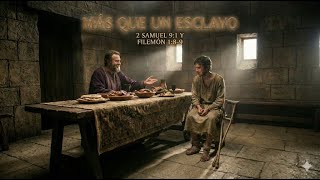
The Scandalous Embrace: from Condemnation to King's Table
And David said, Is there yet any that is left of the house of Saul, that I may show him kindness for Jonathan's sake? — 2 Samuel 9:1
Wherefore, though I might be much bold in Christ to enjoin thee that which is convenient, Yet for love's sake I rather beseech thee, being such an one as Paul the aged, and now also a prisoner of Jesus Christ. — Philemon 1:8-9
Summary: Scripture consistently reveals God's breathtaking pattern of divine mercy, demonstrating how grace suspends justice and lifts the condemned into His family through a mediator. Like the unworthy figures in ancient stories, we had no inherent merit, but through Christ, our spiritual debt is charged to His account, and we are credited with an inheritance we never earned. This radical transformation means we are not merely forgiven but adopted as children, seated at the King's table despite our lameness, our imperfections hidden by His unending grace. Therefore, we are compelled to live out this scandalous grace in our own lives, embodying loyal and self-sacrificial love by welcoming all to the King's table, regardless of past or present flaws.
The ancient tapestries of scripture, woven across millennia, reveal a consistent and breathtaking pattern of divine mercy. Two seemingly disparate narratives—King David's astonishing kindness to Mephibosheth and the Apostle Paul's impassioned plea for Onesimus—converge to illuminate the radical nature of God's redemptive love. These stories, separated by vast stretches of history and culture, unveil a singular truth: grace often suspends the expected rules of justice, lifting the condemned into the embrace of family, all for the sake of another.
Consider first the plight of Mephibosheth, a living relic of the deposed Saulide dynasty. In the brutal world of ancient kingdoms, dynastic change meant annihilation. A surviving heir was a threat, a banner for rebellion, destined for the executioner's sword. Mephibosheth, crippled and living in a desolate place named "No Pasture," saw himself as a "dead dog"—utterly worthless, repulsive, and expecting only death. His physical brokenness mirrored his political impotence. Yet, King David, remembering a solemn promise made to Mephibosheth's father, Jonathan, sought him out not to punish, but to bestow unprecedented favor. This was not a sentimental act but an activation of covenant loyalty, a profound act of steadfast love, or hesed , mirroring the kindness of God himself.
Centuries later, the stage shifts to the Roman Empire, where the escaped slave Onesimus faced a equally dire fate. As property, a runaway slave, a fugitivus , was a criminal deserving of brutal punishment, perhaps even crucifixion. He was considered useless, a liability, and his flight to the sprawling anonymity of Rome was a desperate gamble. However, Onesimus encountered Paul, a prisoner for the Gospel. Through Paul, the "useless" slave became a "useful" brother in Christ. Paul, though holding apostolic authority to command Philemon to release Onesimus, chose instead to appeal to love. He sought a voluntary reception, transforming the vertical relationship of master-slave into the horizontal fellowship of believers, known as koinonia .
These narratives serve as profound illustrations of the Gospel itself. In both cases, the beneficiary—Mephibosheth and Onesimus, much like us—possessed no inherent merit. They were guilty, disabled, or deeply unworthy by societal standards. Their hope rested entirely on a mediator. Mephibosheth received mercy "for Jonathan's sake," and Onesimus was welcomed "for love's sake," as if he were Paul himself. This is the heart of mediated mercy: we receive grace not because of who we are, but because of our identification with a perfect mediator.
Furthermore, these stories illuminate the economics of redemption. Paul directly offered to absorb Onesimus's debt, saying, "Charge it to my account." This is negative imputation, where the mediator takes on the liability of the offender. David, from his position of sovereign power, not only forgave Mephibosheth but restored to him all the lands of Saul, thereby crediting Mephibosheth with an inheritance he never earned. This is positive imputation, bestowing wealth and status. Together, these paint a picture of double imputation: our debt is taken, and Christ's righteousness is credited to us.
The ultimate act of grace in both accounts is the radical transformation of status. Mephibosheth, the "dead dog" from "No Pasture," was not merely spared; he was brought to the King's table to eat continually, "as one of the king's sons." His lameness remained, but it was hidden under the table of grace, his new status as a son overriding his physical reality. Onesimus, the runaway slave, was to be received "no longer as a slave" but as a "beloved brother." The chasms of dynastic enmity and social class were collapsed, replaced by the intimate fellowship of the King's family.
Such acts of mercy were not without risk. David risked political instability by upholding an oath to his enemy's lineage. Paul risked alienating a key patron by advocating for a slave and challenging Roman social norms. These risks highlight the sacrificial nature of true love and grace—a love that values the individual's eternal well-being more than personal comfort or societal expectations.
For believers, this interplay offers profound edification. It reminds us of our own journey from spiritual "Lo-debar" and "uselessness." We too were once enemies of God, crippled by sin, and runaway debtors. But a compassionate King sought us out, and a loving Mediator interceded on our behalf. Our debt has been charged to Christ's account, and we have been credited with an inheritance we did not earn. We are not merely forgiven; we are adopted into the King's family, seated at His table, though still carrying the "lameness" of our earthly frailty. This table does not demand perfection, but presence, covering our imperfections with unending grace until our final glorification.
This understanding compels us to live out this scandalous grace in our own lives and within the Church. We are called to embody hesed and agape, extending loyal love and self-sacrificial kindness to others, especially the marginalized and those considered "unworthy." We are to see beyond social distinctions, valuing every individual as a potential or actual "beloved brother" or "sister" in Christ. Like David, we are to use any influence or power we have to lift others. Like Paul, we are to appeal to love, fostering a community where past wrongs are covered by forgiveness and new identities in Christ are celebrated. The Church is meant to be a foretaste of the Kingdom, where all are welcomed to the King's table, regardless of their past or present imperfections, united by the boundless love of God.
What do you think?
What do you think about "The Scandalous Embrace: From Condemnation to King's Table"?
Related Content
Dead Dog No More
God Might Receive Us as Slaves but Treats Us as Sons
In this meditation I want to finish our long journey through this parable of the Lord Jesus Christ about the useless servant and that we must compare ...
The Architecture of Grace: a Redemptive-Historical Analysis of 2 Samuel 9:1 and Philemon 1:8-9
2 Samuel 9:1 • Philemon 1:8-9
1. Introduction The biblical narrative, though spanned by millennia and bifurcated by distinct linguistic and cultural epochs, exhibits a profound un...
Read in Context
Click to see verses in their full context.
Song (Other Languages)