The Architecture of Grace: a Redemptive-Historical Analysis of 2 Samuel 9:1 and Philemon 1:8-9
2 Samuel 9:1 • Philemon 1:8-9
Summary: We observe a profound unity in the biblical narrative's treatment of redemption, spanning from the Old Testament to the New. Specifically, the accounts of King David's kindness to Mephibosheth in 2 Samuel 9 and Paul's appeal for Onesimus in Philemon 1:8-9, though separated by vast historical and cultural distances, resonate with a singular theological frequency. These texts reveal a consistent mechanism of grace: the suspension of retributive justice in favor of mediated mercy, transforming the socially and legally vulnerable through a third-party intercession.
In both narratives, the beneficiaries—Mephibosheth, a discarded heir, and Onesimus, a fugitive slave—possess no inherent claim to mercy; their default status is condemnation. Yet, grace is extended through a mediator. David acts "for Jonathan's sake," honoring a prior covenant, while Paul appeals "for love's sake," urging Philemon to receive Onesimus as he would receive Paul. This establishes the vital principle of vicarious merit, where kindness is shown not for the recipient's desert but for the merit and relationship of another.
Redemption in these texts also reveals an explicit "economics of grace" through imputation, where the cost and debt are transferred. Paul models negative imputation by offering to bear Onesimus's debt, effectively placing his own credit between the slave and the master's wrath. Correspondingly, David enacts positive imputation, not only sparing Mephibosheth but restoring all of Saul's former land to him, thereby bestowing unearned wealth and status. Together, these illustrate the double imputation at the heart of the Gospel: the mediator absorbing our debt, and the King bestowing an inheritance we did not earn.
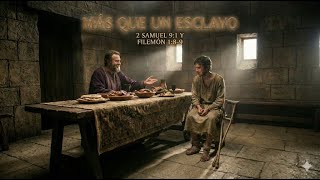
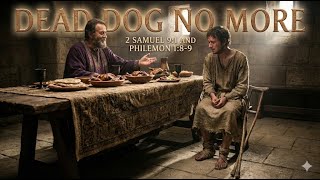
The ultimate goal in both narratives is not merely legal acquittal but a radical transformation of status. Mephibosheth is elevated from a "dead dog" in a barren land to "one of the king's sons," eating continually at the King's table, his physical lameness covered by grace. Similarly, Onesimus transitions from a "useless" runaway slave to a "beloved brother," demanding social equality within the Christian community. These profound shifts illustrate the very heart of the Gospel: that we are all, like Mephibosheth and Onesimus, inherently unworthy and indebted, yet we are sought out by a King and interceded for by a Mediator. God invites us not just to forgiveness, but to intimate fellowship, transforming enemies into family, with our "lameness" covered by grace until our ultimate glorification.
1. Introduction
The biblical narrative, though spanned by millennia and bifurcated by distinct linguistic and cultural epochs, exhibits a profound unity in its treatment of redemption. This report offers an exhaustive analysis of the interplay between two specific texts: the Old Testament narrative of King David’s kindness to Mephibosheth in 2 Samuel 9:1, and the New Testament epistle of Paul to Philemon, specifically verses 8-9. While separated by vast historical distance—one rooted in the tribal monarchies of the Iron Age Levant, the other in the complex social stratification of the Greco-Roman Empire—these texts resonate with a singular theological frequency. They serve as twin pillars supporting a bridge of redemptive logic, spanning from the covenantal fidelity of a Hebrew king to the apostolic intercession for a runaway slave.
The inquiry at the heart of 2 Samuel 9:1—"Is there still anyone left of the house of Saul, that I may show him kindness for Jonathan's sake?"—and the appeal in Philemon 1:9—"yet for love's sake I prefer to appeal to you"—are not merely biographical footnotes in the lives of David and Paul. Rather, they represent the crystallization of a specific mechanisms of grace: the suspension of retributive justice in favor of mediated mercy. In both instances, a figure of authority (David the King, Philemon the Master) is confronted with a socially and legally vulnerable subject (Mephibosheth the rival heir, Onesimus the fugitive slave). In both instances, a third party or a pre-existing bond (Jonathan, Paul) serves as the fulcrum upon which the lever of mercy rests, lifting the marginalized from a position of "deadness" to a position of sonship and brotherhood.
This report will dissect these narratives through historical, linguistic, and theological lenses. We will examine the Ancient Near Eastern (ANE) context of dynastic extermination to understand the radical nature of David’s hesed. We will explore the Roman institution of slavery and the legal peril of the fugitivus to grasp the weight of Paul’s agape. By juxtaposing the Hebrew concept of covenant loyalty with the Greek concept of koinonia (fellowship), we will reveal a sophisticated typology of the Gospel itself—one involving imputation, restitution, and the radical reordering of social status at the King’s table.
2. Part I: The Covenantal Fidelity of the King (2 Samuel 9)
2.1 The Geopolitical Precipice: Dynastic Succession and the Threat of the Remnant
To fully appreciate the gravity of 2 Samuel 9:1, one must first strip away the sentimentalized veneer often applied to biblical stories and confront the brutal Realpolitik of the Ancient Near East. The transition of power from the House of Saul to the House of David was not a democratic handover; it was a protracted, bloody civil war. Saul, the first king, had spent his final years consumed by a paranoia that drove him to hunt David "like big game" across the wilderness of Judea. Upon Saul's death at the Battle of Gilboa, the political vacuum was initially filled by his son Ishbosheth, who waged war against David for two years.
In the cultural milieu of the ANE, the establishment of a new dynasty invariably required the liquidation of the old. A surviving male heir of the previous regime was not merely a loose end; he was a living banner for insurrection. As long as "a spark of life from that family still smoldered," it posed an existential threat to the legitimacy and security of the new king. The "name of the game" in dynastic transition was purge. To leave a rival alive was considered political suicide, a violation of the principle of self-preservation.
The terror inspired by this custom is vividly illustrated in the backstory of Mephibosheth. 2 Samuel 4:4 records that when news of Saul and Jonathan’s death reached the royal nursery, Mephibosheth’s nurse fled in such panic that she dropped the five-year-old prince, shattering his legs and leaving him crippled for life. Her panic was rational; she anticipated the customary massacre that followed a regime change. Thus, when David sits on his consolidated throne in Jerusalem and asks about the "house of Saul," the entire court would have instinctively braced for a purge. The expectation was the sword, not the scepter.
2.2 The Linguistic Pivot: Hesed and the Covenant of Salt
Against this backdrop of expected violence, David’s inquiry introduces a term that upends the political order: Hesed. "Is there still anyone left of the house of Saul, that I may show him kindness (hesed) for Jonathan's sake?" (2 Sam 9:1).
The Hebrew term hesed is notoriously difficult to translate with a single English word. It encompasses a semantic range including "loyal love," "steadfast love," "covenant faithfulness," and "mercy". However, hesed is distinct from the general emotion of kindness; it is fundamentally an act of will rooted in obligation and fidelity. It implies a "personal involvement and commitment in a relationship beyond the rule of law".
In David’s case, this hesed is not an arbitrary act of charity. It is the activation of a specific legal and relational mechanism: the covenant cut with Jonathan years prior. In 1 Samuel 20:14-17, Jonathan, anticipating David’s rise, extracted a sworn oath: "do not cut off your steadfast love (hesed) from my house forever." This was a "covenant of the Lord" (1 Sam 20:8), a binding agreement often sealed with salt, signifying its immutability.
David’s motivation, therefore, is triply layered:
-
Personal Affection: His deep friendship with Jonathan, whose love was "extraordinary".
-
Covenantal Obligation: The sworn oath that bound David’s honor to Jonathan’s progeny.
-
Theological Reflection: David seeks to show "the kindness of God" (2 Sam 9:3). He recognizes that his own kingship is a result of Yahweh’s hesed, and he seeks to mirror that divine attribute toward his enemies.
2.3 The Object of Grace: Mephibosheth in Lo-debar
The search for a beneficiary leads David to Mephibosheth. Every detail regarding Mephibosheth serves to highlight his utter hopelessness and disqualification from royal favor.
2.3.1 The "Dead Dog" Identity
Mephibosheth refers to himself as a "dead dog" (kelev met) in 2 Samuel 9:8. In Hebraic thought, dogs were scavengers, often associated with uncleanness. To be a "dead dog" was to be the lowest form of carrion—utterly worthless, repulsive, and devoid of potential. This self-designation reveals the depth of Mephibosheth’s trauma. He has internalized the shame of his grandfather’s failure and his own physical incapacity. He does not see himself as a prince, but as a piece of refuse to be discarded.
2.3.2 The Geography of Nothingness
Mephibosheth is found living in "Lo-debar." The etymology of this place name is significant. It is a compound of lo (no/not) and dabar (word/thing/pasture). It can be translated as "No Pasture" or "Nothing". It represents a barren wasteland, a place of obscurity far removed from the centers of power and provision. Mephibosheth is hiding in the middle of nowhere, surviving only on the charity of Machir, a wealthy landowner. He is an exile in a land of silence, waiting for the inevitable knock on the door that signals his execution.
2.3.3 The Physical Disqualification
He is "lame in both feet" (2 Sam 9:13). In the ancient world, physical wholeness was often a prerequisite for leadership, particularly military leadership. A king was expected to go out before his people in battle. Mephibosheth’s disability rendered him socially invisible and politically impotent. He could not lead a revolt, nor could he stand in the royal court. His physical state is a mirror of his political state: broken, dependent, and unable to walk into the king’s presence on his own merit.
2.4 The Steward’s Ambiguity: Ziba
The narrative introduces Ziba, a servant of the house of Saul, who serves as the informant. Ziba’s role is complex. While he provides the information David seeks, he does so with a caveat: "There is still a son of Jonathan; he is lame in his feet" (2 Sam 9:3). Scholars suggest Ziba may be highlighting the disability to diminish Mephibosheth's value or threat level, or perhaps to suggest that he is unworthy of the king’s attention. Ziba’s later betrayal of Mephibosheth during Absalom’s rebellion (2 Sam 16) suggests he was a shrewd political operator who viewed Mephibosheth as an obstacle to his own control over Saul’s estate. This adds a layer of vulnerability to Mephibosheth’s situation; he is reliant on servants who may not have his best interests at heart.
3. Part II: The Apostolic Appeal for the Slave (Philemon)
3.1 The Roman Context: Slavery and the Fugitivus
Shifting the lens to the first century A.D., we encounter a different but equally perilous power dynamic in the epistle to Philemon. The subject is Onesimus, a slave who has fled from the household of Philemon in Colossae. To understand Paul’s intervention in Philemon 1:8-9, one must confront the grim reality of Roman slavery.
Slaves in the Roman Empire were not citizens; they were property. Aristotle famously defined a slave as a "living tool." They had no legal standing, no rights to family, and their bodies were subject to the absolute dominion of their masters. A runaway slave, or fugitivus, was considered a criminal—a thief of his own self, stealing his labor from his master.
The legal environment for a runaway was lethal. Professional slave-catchers (fugitivarii) hunted them. If caught, a fugitivus could be branded on the forehead with the letter 'F', tortured, sent to the mines, forced into gladiatorial combat, or crucified. By harboring Onesimus, Paul himself was technically complicit in a crime, engaging in crimen plagii (receiving stolen property).
Onesimus had likely compounded his crime by theft. Paul mentions in verse 18, "If he has wronged you in any way or owes you anything," implying that Onesimus may have pilfered funds to finance his escape. He fled to Rome, the "sprawling capital," hoping to lose himself in the anonymity of the masses. Instead, he found Paul, the prisoner of Christ.
3.2 The Rhetorical Strategy: Parrhesia vs. Agape
Philemon 1:8-9 constitutes the rhetorical pivot of the letter. Paul writes: "Accordingly, though I am bold enough in Christ to command you to do what is required, yet for love's sake I prefer to appeal to you..."
3.2.1 The Waiver of Command (Epitasso)
Paul asserts his possession of parrhesia (boldness/freedom of speech) in Christ. As an Apostle, Paul holds supreme ecclesiastical authority. He founded the churches in Asia Minor (directly or indirectly), and Philemon owes him his spiritual life (v. 19). Paul could legally and spiritually "command" (epitasso) Philemon to release Onesimus. This approach would rely on the "rule of law" and the vertical hierarchy of the Church.
3.2.2 The Preference for Appeal (Parakalo)
However, Paul explicitly rejects the path of command. He chooses to "appeal" (parakalo). This verb carries the semantic weight of "beseech," "exhort," "comfort," and "encourage." It moves the interaction from a vertical axis (Commander-Subordinate) to a horizontal axis (Brother-Brother). Paul seeks a voluntary response, not a coerced obedience, because "love" (agape) loses its moral worth when it is forced (v. 14).
3.2.3 The Basis: Dia ten Agapen
The ground of this appeal is "for love's sake" (dia ten agapen). This is not merely sentimental affection but the defining ethical imperative of the Christian community. By appealing to love rather than law, Paul is forcing Philemon to act from his new nature in Christ rather than his legal rights as a Roman paterfamilias.
3.3 The Patron-Client Dynamic and Koinonia
Paul leverages the Greco-Roman system of patronage to secure Onesimus's safety. In this system, a patron provided protection and resources, and the client owed loyalty and honor. Paul positions himself as a spiritual patron to Philemon ("you owe me your very self"), yet he humbly requests a favor, reversing the typical dynamic.
He grounds this request in koinonia (fellowship/partnership). In verse 6, Paul prays that the "sharing (koinonia) of your faith may become effective." Koinonia implies a deep, mutual participation in a shared reality. Paul argues that if Philemon and Paul are partners (koinonos, v. 17), then Philemon must receive Onesimus as he would receive Paul. The spiritual partnership necessitates a social realignment.
3.4 The Wordplay of Redemption: Achrestos vs. Euchrestos
Onesimus’s name literally means "Useful" or "Profitable." Paul employs a masterful pun in verse 11: "Formerly he was useless (achrestos) to you, but now he is indeed useful (euchrestos) to you and to me".
-
Achrestos (Useless): As a non-believer and a runaway, Onesimus lived in contradiction to his name. He was a liability.
-
Euchrestos (Useful): Through the gospel, the "useless" tool has become a "useful" brother.
Some scholars also detect a play on Christos (Christ). To be "without Christ" is to be achrestos; to be "in Christ" is to be euchrestos.26 Paul is signaling that Onesimus has undergone an ontological change that demands a sociological change.
4. Part III: The Redemptive Interplay (Comparative Analysis)
When 2 Samuel 9 and Philemon are viewed in tandem, a sophisticated theological architecture emerges. The interplay between the two texts reveals a unified biblical theology of redemption, constructed upon the pillars of mediation, imputation, and status reversal.
4.1 Mediated Mercy: "For the Sake of Another"
The most striking parallel between the two narratives is the mechanism of mercy. In both cases, the beneficiary has no standing to demand favor on their own merit.
-
Mephibosheth: As the grandson of the deposed king and a "dead dog," his only claim is to the sword of judgment.
-
Onesimus: As a criminal slave, his only claim is to the brand or the cross.
Mercy is extended solely based on the merit and relationship of a third party—a mediator.
Table 1: The Structure of Mediated Mercy
| Feature | 2 Samuel 9 (David & Mephibosheth) | Philemon (Paul & Onesimus) | Theological Implication |
| The Beneficiary | Mephibosheth (The Enemy/Cripple) | Onesimus (The Fugitive/Thief) | The Sinner (Helpless/Guilty) |
| The Benefactor | King David (Sovereign Power) | Philemon (Aggrieved Master) | The Father (Just Judge) |
| The Mediator | Jonathan (The Covenant Friend) | Paul (The Spiritual Father) | Christ (The Son) |
| The Motive Clause | "For Jonathan's sake" (2 Sam 9:1) | "For love's sake" / "Receive him as me" (Philemon 9, 17) | Vicarious Merit |
| The Basis | Ancient Covenant (1 Sam 20) | Spiritual Union (Koinonia) | The New Covenant |
Insight: This establishes the doctrine of Vicarious Merit. The kindness Mephibosheth receives is actually the kindness David owes Jonathan. The welcome Onesimus receives is the welcome Philemon owes Paul. In 2 Samuel 9, the covenant is the legal instrument that protects the helpless. In Philemon, the spiritual identification ("receive him as you would receive me") is the leverage used to protect the guilty. This mirrors the Pauline soteriology of Ephesians 4:32: "forgiving one another, as God in Christ forgave you." God shows kindness to the sinner not for the sinner's sake, but for Christ's sake.
4.2 The Economics of Redemption: Imputation and Restitution
Redemption is never costless; the cost is simply transferred. Both texts explicitly deal with the economics of grace—the handling of debt and loss.
In Philemon 1:18, Paul uses the technical accounting term elloga ("charge it to my account"). "If he has wronged you in any way or owes you anything, charge it to me". This is a commercial guarantee. Paul essentially signs a promissory note, placing his own credit standing between Onesimus and Philemon’s financial wrath. He offers Negative Imputation: taking the debt of the offender upon himself.
In 2 Samuel 9, David engages in a similar economic transfer, though from a position of sovereignty. He commands the restoration of "all the land of Saul" to Mephibosheth (2 Sam 9:7). Following the fall of Ishbosheth, these lands would likely have reverted to the crown as the spoils of war. By returning them, David is voluntarily reducing his own royal revenue to enrich the grandson of his enemy. This is Positive Imputation: crediting the offender with wealth and status they did not earn.
Insight: The interplay of these two texts provides a complete picture of Double Imputation:
-
Paul/Philemon: The Mediator absorbs the debt (The Cross).
-
David/Mephibosheth: The King bestows the inheritance (The Resurrection/Glorification).
4.3 The Transformation of Status: From "Lo-debar" to the "Brotherhood"
The ultimate goal of the intervention in both texts is not merely legal acquittal (escaping execution or punishment) but radical social elevation.
4.3.1 The Table Fellowship (2 Samuel 9)
In 2 Samuel 9, the recurring refrain is "eat at my table." It appears four times (vv. 7, 10, 11, 13). In the ANE, eating at the king’s table was the highest sign of royal favor. It signified intimate fellowship, total provision, and public protection. Mephibosheth is moved from "Lo-debar" (The Wasteland) to the King's Table. He is transformed from a "dead dog" to "one of the king's sons" (v. 11).
Crucially, the narrative notes: "So Mephibosheth dwelt in Jerusalem, for he ate continually at the king's table. And he was lame in both his feet" (v. 13). The grace of the table did not cure his physical lameness, but it covered it. His disability was hidden under the table; his status as a son superseded his reality as a cripple.
4.3.2 The Brotherhood of Believers (Philemon)
In Philemon, the destination is not a physical table but a spiritual fraternity. Paul asks Philemon to receive Onesimus "no longer as a slave" (ouketi hos doulon) but as a "beloved brother" (adelphon agapeton). In the Roman household, the gap between Master and Slave was an ontological chasm. Paul collapses this chasm. While he may or may not be demanding legal manumission (scholars debate this), he is certainly demanding social equality within the Ecclesia. In the sphere of the Kingdom, the property becomes a partner.
Synthesis: Both texts destroy the barriers of "us vs. them."
-
David destroys the Dynastic Barrier (Saul vs. David).
-
Paul destroys the Class Barrier (Slave vs. Free).
They replace the politics of exclusion with the politics of the Table and the Family.
4.4 Risk and Reputation in Acts of Mercy
We must also recognize the political and social risk involved in these acts of grace.
-
David’s Risk: By preserving Mephibosheth, David kept a rival heir alive. In the volatile world of tribal politics, this was dangerous. Mephibosheth could—and later was accused of trying to—rally the Benjaminites to retake the throne. David valued his covenant with Jonathan more than his own political security.
-
Paul’s Risk: By advocating for a slave and hinting at his release, Paul risked alienating Philemon, a key patron of the church. He risked the stability of the Colossian household codes. He valued the soul of the slave more than the social order of the empire.
5. Part IV: Theological & Practical Implications
5.1 Soteriological Typology: The Gospel in Miniature
The interplay of these texts serves as a robust typology for the Christian doctrine of salvation.
-
Total Inability: Like Mephibosheth, humanity is "crippled" by the Fall, unable to walk to God, dwelling in the wasteland of separation (Lo-debar). Like Onesimus, humanity is legally guilty, a "runaway" from the Creator, owing a debt we cannot pay.
-
Unconditional Election: "The King sought us out before we sought Him". David takes the initiative to find Mephibosheth. Paul takes the initiative to intercede for Onesimus. Grace is prevenient.
-
Substitution: Christ, like Paul, says, "Charge it to my account." Christ, like Jonathan, provides the covenant grounds for our acceptance.
-
Glorification: We are seated at the table. We are adopted as sons. Our "lameness" (sin nature/frailty) remains in this life, but it is covered by the table of Grace.
5.2 Ecclesiological Ethics: The Church as the New Household
Practically, these texts define the ethics of the Christian community. The Church is a community where Hesed (loyalty) and Agape (love) override social stratification.
-
The Ethics of Power: Like David, those with power are called to use it to bless the marginalized "for the sake of" the King.
-
The Ethics of Conflict: Like Paul, we are called to resolve conflict not by appealing to rights and commands, but by appealing to love and identification. The Church is the place where the Master and the Slave wash each other's feet.
5.3 Eschatological Tension: The Lame at the Table
The image of Mephibosheth eating at the table while lame captures the "Already/Not Yet" tension of the Christian life. We are already seated in heavenly places (Eph 2:6), fully accepted, and treated as sons. Yet we are not yet fully whole; we carry the scars and limps of our fallenness. The table does not demand perfection; it demands presence. The grace of God is sufficient to cover the lameness until the day of final resurrection.
6. Conclusion
The interplay between 2 Samuel 9:1 and Philemon 1:8-9 offers a breathtaking vista of biblical redemption. In the Old Testament, we witness the Shadow: a King who, bound by a covenant of salt, spares the crippled son of his enemy and seats him at his banqueting table. It is a story of Hesed—loyalty that triumphs over the political instinct to purge. In the New Testament, we witness the Substance: an Apostle who, bound by the love of Christ, intercedes for a guilty slave, offering his own righteousness to cover the debt and demanding his reception as a brother. It is a story of Agape—love that triumphs over the legal instinct to punish.
Together, these narratives articulate the heart of the Gospel: that we are all Mephibosheth, hiding in Lo-debar, fearing the King’s judgment; we are all Onesimus, unprofitable runaways, unable to pay our debts. And we have been sought out by a King and interceded for by a Mediator. The "interplay" is not merely literary; it is existential. It reminds us that in the Kingdom of God, the "dead dog" becomes a son, the "useless" slave becomes a brother, and the debt is paid in full by Another.
Through David’s decree and Paul’s appeal, the Bible presents a unified vision of a God who does not merely forgive from a distance but invites the forgiven to the Table, transforming enemies into family. This is the scandal of Grace: that the King would pay the debt of the slave, and the Judge would adopt the criminal.
What do you think?
What do you think about "The Architecture of Grace: A Redemptive-Historical Analysis of 2 Samuel 9:1 and Philemon 1:8-9"?
Related Content
Dead Dog No More
God Might Receive Us as Slaves but Treats Us as Sons
In this meditation I want to finish our long journey through this parable of the Lord Jesus Christ about the useless servant and that we must compare ...
The Scandalous Embrace: from Condemnation to King's Table
2 Samuel 9:1 • Philemon 1:8-9
The ancient tapestries of scripture, woven across millennia, reveal a consistent and breathtaking pattern of divine mercy. Two seemingly disparate nar...
Read in Context
Click to see verses in their full context.
Song (Other Languages)