The Unbound Word: God's Deliverance for Daring Proclamation
The angel of the LORD encampeth round about them that fear him, and delivereth them. — Psalms 34:7
But the angel of the Lord by night opened the prison doors, and brought them forth, and said, Go, stand and speak in the temple to the people all the words of this life. — Acts 5:19-20
Summary: God consistently intervenes to protect us, but this divine safeguarding has a profound purpose beyond our personal comfort or survival. We see a clear progression from being preserved for safety to being liberated for a dynamic, world-changing mission. Our reverence for God is the prerequisite for experiencing this miraculous deliverance, as He subverts all earthly authority to ensure His unbound Word is boldly proclaimed through us. We are preserved not to hide, but to courageously advance His Kingdom, overcoming the world with the life-giving message of Jesus.
God's intervention in human affairs is a cornerstone of the biblical narrative, showcasing His transcendent power intersecting with the immanent realities of human struggle. Across millennia, from the ancient struggles of King David to the early days of the Christian church, two powerful accounts illuminate the unwavering truth of divine protection and its ultimate purpose. These stories reveal a progression from God preserving His people for their survival to liberating them specifically for a dynamic, world-changing mission.
In times of profound vulnerability, like David fleeing King Saul and feigning madness in enemy territory, God’s steadfast protection is a profound promise. Surrounded by danger, David found himself in the humble refuge of the Cave of Adullam, a gathering place for the distressed and outcast. It was here that he grasped and proclaimed a fundamental truth: God's divine presence, often manifested through a powerful divine emissary, "encamps around" those who revere Him, delivering them from peril. This "encamping" is not passive; it’s a military-grade perimeter, a spiritual fortress around the faithful, assuring comprehensive, unyielding protection. This initial layer of divine intervention emphasizes God's commitment to defending and preserving His beloved, snatching them from tight situations and alleviating their deepest fears. The foundation of this deliverance is a reverent "fear of the Lord" – a covenantal submission to His authority that precedes and qualifies one for His mighty hand.
Fast forward to the dawn of the New Covenant, where this promise of protection finds its profound fulfillment and transformation. The early apostles, boldly proclaiming the resurrection of Jesus in Jerusalem, faced fierce opposition from the religious establishment, particularly the Sadducees who denied the very existence of angels and the resurrection itself. Imprisoned and shamed, the apostles were meant to be silenced. Yet, in the dead of night, a divine messenger appeared, not to quietly protect them within their cell, but to dramatically "open the doors" of the jail and lead them out. This was no mere escape; it was a deliberate act of God, echoing the ancient Exodus, pulling His people out of bondage.
The stunning irony of this event is deeply instructive: God used the very beings the Sadducees denied – angels – to dismantle their authority and mockery. The emptied prison cell was not just a testament to angelic power, but a theological statement against a faith that restricted God’s reality. Crucially, the deliverance was not for retreat or hiding. The divine messenger explicitly commissioned the apostles to "Go, stand in the temple and speak to the people all the words of this Life." They were sent back to the very heart of their opposition, to the public square, to boldly declare the eternal, resurrection life found in Christ.
This interplay between David’s experience and the apostles’ liberation reveals a critical spiritual escalation. David’s angel "encamped around" him for preservation, a defense mechanism for survival. The apostles’ angel "opened doors" and "led them out" for proclamation, an offensive maneuver for mission. The journey shifts from David’s cave of refuge to the apostles’ public temple courts—from a focus on safety in hiding to boldness in facing public danger.
For believers today, this theological journey carries an edifying message:
- God's Protection Has a Purpose Beyond Comfort: We are assured of divine protection not merely for our personal comfort or to be removed from all earthly trouble, but to be empowered for God’s greater mission. Our "safety" is redefined not as the absence of danger, but as the enduring presence of God’s power and purpose within the danger.
- Fear the Lord, Not Man: The prerequisite for experiencing God’s miraculous deliverance remains a holy reverence for Him, prioritizing His will over any human authority or fear. When we obey God rather than man, we align ourselves with His redemptive work and qualify for His unique intervention.
- God Subverts Earthly Authority for His Kingdom: No earthly institution, prison, or power can ultimately bind God's Word or His people. God possesses the true keys, overruling human verdicts and demonstrating His sovereign stealth over all opposition.
- The Unbound Word: Even when circumstances threaten to silence us, God ensures that His message, "the Words of this Life," remains unbound. Our call is to boldly speak this life-giving truth, even when it means stepping into uncomfortable or hostile spaces.
- Corporate Resilience: Just as God ensured "not one bone was broken" in the body of Christ, He protects the structural integrity of His church. He preserves its leadership and foundational truth, enabling it to continue its mission despite afflictions and persecution.
The divine guardian, whether as the potent "Angel of the Lord" in the Old Covenant or a ministering spirit dispatched in the New, consistently serves as the bridge between God's promise and its fulfillment. He protects so that His people may proclaim, breaking down barriers not for retreat, but for a daring advance of the Kingdom. We are preserved not to hide, but to overcome the world with the life-giving message of Jesus, ensuring the Word of God remains eternally unbound.
What do you think?
What do you think about "The Unbound Word: God's Deliverance for Daring Proclamation"?
Related Content
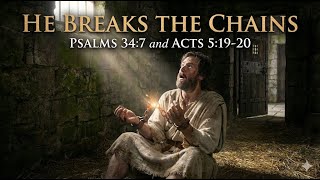
He Breaks the Chains
Guarded for God's Glory
Psalms 34:7 • Acts 5:19-20
My beloved brethren, cast your minds to the wondrous care of our God, whose eye never slumbers, and whose mighty hand is never shortened! We find ours...
Angelic Agency and Missional Deliverance: a Comprehensive Analysis of the Interplay Between Psalm 34:7 and Acts 5:19–20
Psalms 34:7 • Acts 5:19-20
I. Introduction: The Theological Architecture of Divine Intervention The biblical narrative, spanning from the Patriarchal wanderings to the Apostoli...
Read in Context
Click to see verses in their full context.
Song (Other Languages)