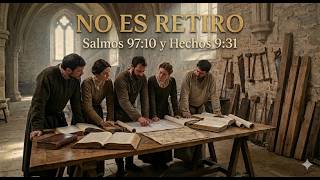
The Divine Economy of Preservation and Peace: an Exegetical and Historical Analysis of the Interplay Between Psalm 97:10 and Acts 9:31
Psalms 97:10 • Acts 9:31
Summary: The canon of Scripture consistently reveals a profound coherence, particularly in the interplay between the imperative mandate of Psalm 97:10 and the ecclesiological report of Acts 9:31. Though distinct in genre and epoch, these texts demonstrate a deep, symbiotic relationship. Psalm 97:10 establishes the theological conditions—an exclusive love for Yahweh manifesting as a militant hatred of evil—necessary for activating divine preservation. Acts 9:31 then provides the historical fulfillment of this dynamic, illustrating what transpires within a covenant community when it embodies the "fear of the Lord" and consequently experiences the "comfort of the Holy Spirit" and multiplication.
To grasp this profound connection, one must first understand Psalm 97 as a political manifesto of God’s absolute sovereignty, rooted in righteousness and justice. It directly commands, "Ye that love the Lord, hate evil" (Hebrew: *sinu ra*), a forceful imperative denoting a comprehensive, active hostility toward all moral depravity, social injustice, and idolatry. This command is not merely an ethical suggestion but an ontological necessity: true devotion to Yahweh inherently demands repulsion toward all that opposes His nature. The psalm promises that in response to this militant holiness, God "preserves the souls of his saints" and "delivers them out of the hand of the wicked."
Acts 9:31 serves as the historical validation of this divine principle. Following a period of intense persecution, the early church experienced unexpected "rest throughout all Judea and Galilee and Samaria." This deliverance from the "hand of the wicked" was divinely orchestrated through a twofold intervention: the conversion of Saul, the primary persecutor, and the providential distraction of the Caligula crisis, which consumed the Jewish authorities' attention. Crucially, the church did not squander this peace but utilized it for spiritual consolidation, "walking in the fear of the Lord"—the New Testament embodiment of "hating evil."
This alignment—their active moral stance against evil—paved the way for the "comfort of the Holy Spirit" and subsequent "multiplication." The presence of the Spirit as an advocate and comforter reinforces that holiness precedes growth; the Spirit can only comfort those who are walking in truth, aligning themselves with God’s holiness. Thus, the security and growth of the people of God are inextricably linked to their moral alignment with the nature of God. When the church loves what God loves and hates what God hates, it enters a sanctuary of preservation where even the machinations of empires and persecutors are transformed into seasons of peace and proliferation by the Hand of the Almighty.
Introduction
The canon of Scripture, though composed over millennia by diverse authors, exhibits a profound internal coherence that binds the hymnic theology of the Old Testament with the historical realization of the New Testament church. Within this vast tapestry of redemptive history, a particularly striking interplay exists between the imperative mandate of Psalm 97:10 and the ecclesiological report of Acts 9:31. On the surface, these texts appear to occupy distinct literary genres and historical epochs: the former is a liturgical enthronement psalm commanding moral allegiance to Yahweh amidst a cosmic celebration of His reign, while the latter is a historiographical summary of the early church's condition following the pivotal conversion of Saul of Tarsus. However, upon rigorous exegetical, historical, and theological scrutiny, a deep, symbiotic relationship emerges that transcends mere thematic coincidence.
Psalm 97:10 establishes the theological conditions—an exclusive love for Yahweh manifesting as a militant hatred of evil—required for the activation of divine preservation. Acts 9:31 serves as the historical fulfillment of that dynamic, illustrating what occurs within a covenant community when it walks in the "fear of the Lord"—the practical application of hating evil—and experiences the consequent "comfort of the Holy Spirit." The narrative of the early church, particularly in the wake of intense persecution, offers a tangible demonstration of the Psalmist’s promise: that the Sovereign Lord preserves the souls of His saints and delivers them from the hand of the wicked.
This report provides an exhaustive analysis of the interplay between these two scriptures. It explores how the command to "hate evil" in the Psalm serves as the prerequisite for the "peace" (eirene) and "multiplication" (plethuno) experienced in the Acts narrative. Furthermore, it examines the mechanisms of divine deliverance, specifically how the "hand of the wicked" (Psalm 97:10) was stayed through the conversion of Saul and the providential distractions of Roman imperial politics—specifically the crisis under Emperor Caligula—thereby granting the church its season of rest. By synthesizing linguistic analysis, historical context, and systematic theology, this report demonstrates that the flourishing of the Acts church was not an accident of history but the covenantal result of adhering to the moral ontology set forth in the Psalter.
Part I: The Theocratic Foundation — Exegesis of Psalm 97
To understand the interplay between the Psalmist's command and the Apostle's history, one must first deconstruct the theological architecture of Psalm 97. This text is not merely a song of praise; it is a political manifesto of the Kingdom of Heaven, asserting the absolute sovereignty of Yahweh over all rival powers, both celestial and terrestrial.
1.1 The Enthronement of Yahweh: "The LORD Reigns"
Psalm 97 is classified within the collection of "Enthronement Psalms" (Psalms 93–100), characterized by the acclamation Yahweh Malak—"The LORD reigns." The Psalm begins with this decisive proclamation, inviting the earth to rejoice and the "multitude of isles" to be glad. The theological context is one of active, irresistible sovereignty. Yahweh is not depicted as a passive deity, a "watchmaker" who set the universe in motion and then withdrew, nor is He a local tribal god limited by geography. He is the active Ruler whose presence generates joy for the earth and terror for His adversaries.
The imagery employed in the opening verses—clouds, thick darkness, fire, and lightning—serves to establish the transcendence and holiness of this King. "Clouds and thick darkness are all around him; righteousness and justice are the foundation of his throne" (Psalm 97:2). This duality is crucial for understanding the ethical demands that follow. The King is unapproachable in His majesty, yet His rule is not arbitrary; it is founded upon ethical immutables: righteousness (tsedeq) and justice (mishpat). Consequently, the subjects of this King are required to align their moral dispositions with the nature of the King Himself. If the King’s throne is built on righteousness, His people cannot build their lives on wickedness. The joy of the earth is predicated on the fact that this Power is moral; a reign of omnipotent evil would be a cause for universal terror, but the reign of Yahweh is a cause for gladness because He is good.
1.2 The Conflict of Allegiances: Idolatry vs. True Worship
The Psalm establishes a sharp dichotomy between the "lovers of the Lord" and the "worshipers of images." Verse 7 declares, "Confounded be all they that serve graven images, that boast themselves of idols: worship him, all ye gods." This imprecation against idolatry is essential for understanding the specific definition of "evil" in verse 10. In the ancient Near Eastern context, and indeed in the Greco-Roman context of Acts, idolatry was the primal sin—the replacement of the Creator with the creature.
The Psalmist mocks the futility of these rival gods, asserting that they must bow before Yahweh. This polemic against idolatry sets the stage for the specific injunction to the faithful. The "lovers of Yahweh" are defined in opposition to the "boasters in idols." This distinction becomes historically vital when analyzing the context of Acts 9, where the early church stood in stark contrast to both the rigid, Christ-rejecting legalism of the Sanhedrin and the polytheistic paganism of the Roman Empire. The call to "hate evil" is, at its root, a call to reject the "evil" of false worship and compromised allegiance.
1.3 The Imperative: "Hate Evil" (Sinu Ra)
The pivot of the Psalm is found in verse 10, where the descriptive praise shifts to prescriptive command: "Ye that love the Lord, hate evil" (KJV). The Hebrew phrasing ohavei Yahweh sinu ra contains a profound theological logic that binds affection for God with repulsion toward sin.
The Linguistic Force of the Command
The Hebrew verb for "hate" (sane) appears here in the imperative mood (sinu). This is not a suggestion or a passive observation; it is a forceful command. It denotes a violent aversion, a complete rejection, and an active hostility. It is not merely a matter of avoiding the consequences of sin, but of detesting the nature of sin itself. As noted by commentators, this "practical test of true religion can never be obsolete".
The object of this hatred is ra (evil/wickedness). This term is comprehensive, encompassing moral depravity, social injustice, idolatry, and personal transgression. It includes "all that he hates, or that is evil in his sight". Therefore, the command creates a totalizing ethical demand upon the believer. There is no realm of life—private or public, political or religious—where "evil" can be tolerated by one who claims to love Yahweh.
The Inseparability of Love and Hate
The text posits an ontological necessity: it is impossible to love Yahweh without hating evil. There is a reciprocal relationship at play; true devotion involves turning away from all that opposes God's nature. As the commentator Horne notes, "Love of God implies the hatred of all He hates". This concept was understood even by heathen philosophers; Lucian records a dialogue where Philosophy states, "To love and to hate, they say, spring from the same source".
If God is the essence of Good, then anything contrary to Him is Evil. To embrace God is necessarily to reject His opposite. Thus, the "lovers of Yahweh" (ohavei Yahweh) are defined not merely by their ritual observance or their emotional experiences, but by their ethical repulsion of sin. This defines the "saint" (hasid) as one who possesses a militant holiness. As Spurgeon notes, the believer must be "in arms against it". This suggests that the "peace" promised to the saints is not a peace of compromise or capitulation, but a peace secured through a steadfast refusal to countenance wickedness.
1.4 The Promise: Preservation and Deliverance
The second half of Psalm 97:10 provides the divine response to the human obedience of hating evil: "He preserveth the souls of his saints; he delivereth them out of the hand of the wicked." This establishes the causal link that will be explored in the Acts narrative.
The Doctrine of Preservation (Shamar)
The Hebrew verb shamar means to hedge about, guard, protect, or attend to with scrutiny. Crucially, the text specifies that He preserves the souls (nephshot) of His saints. This indicates a holistic preservation that transcends mere physical survival. While it certainly includes protection from physical harm, as seen in the deliverance of the early church, it points to a deeper reality: the preservation of the essential self, the life, and the spiritual integrity of the believer.
Matthew Henry expands this to mean preservation from "sin, from apostacy, and despair, under their greatest trials," keeping them safe for His heavenly kingdom. The greatest danger to the saint is not physical death—which is merely a transition to glory—but spiritual corruption. By commanding them to "hate evil," God is commanding them to participate in the means of their own preservation, for to love evil is to court spiritual death. God "guards the lives of his faithful" , ensuring that the "wicked one" cannot touch the core of their being.
The Mechanism of Deliverance (Natsal)
The verb natsal implies snatching away, rescuing, or delivering from danger. The specific threat identified is "the hand of the wicked" (yad reshaim). In Hebrew idiom, the "hand" represents power, influence, agency, and dominion. The "wicked" have a "hand"—a capacity to oppress, persecute, and enforce their will upon the righteous.
The promise of Psalm 97:10 is that while the wicked may exert power for a season, Yahweh possesses a superior hand that can snatch His people from their grip. This deliverance is not always the prevention of trouble, but the rescue out of it. The saints may fall into the hand of the wicked, but they will not remain there. This dynamic creates a theological equation that governs the history of God's people: Love for God + Hatred of Evil = Divine Preservation + Deliverance. This equation is the hermeneutical key for unlocking the narrative arc of Acts 9.
Part II: The Historical Fulfillment — Exegesis of Acts 9:31
If Psalm 97 provides the theological theory, Acts 9 provides the historical data. Acts 9:31 stands as a monumental "progress report" in Luke’s ecclesiastical history, summarizing the condition of the church at a crucial juncture. It reads: "Then had the churches rest throughout all Judea and Galilee and Samaria, and were edified; and walking in the fear of the Lord, and in the comfort of the Holy Ghost, were multiplied" (KJV).
2.1 The Context of Persecution and "The Hand of the Wicked"
To appreciate the "rest" or "peace" (eirene) mentioned in verse 31, one must contextualize it against the backdrop of the preceding chapters. For a significant period, the infant church had been crushed under the "hand of the wicked," primarily personified by Saul of Tarsus.
Saul was the active agent of the "wicked" mentioned in Psalm 97:10. He was "breathing out threatenings and slaughter against the disciples of the Lord" (Acts 9:1). Armed with letters from the high priest—legal authority, or "a hand"—he sought to bind men and women and drag them to Jerusalem. His goal was the eradication of the "Way." The church was in a state of existential peril, scattered and hunted. This period of terror corresponds to the situation presupposed by the Psalmist: the saints were in the "hand of the wicked."
2.2 The Cessation of Hostilities: A Twofold Deliverance
Acts 9:31 reports a sudden and pervasive peace "throughout all Judea and Galilee and Samaria." This peace was not a natural lull; it was a divinely orchestrated deliverance resulting from two distinct historical interventions: the conversion of the primary persecutor and the distraction of the persecuting institutions.
The Conversion of Saul as Deliverance
The most immediate cause of the peace was the neutralization of Saul. God’s method of "delivering" the church from Saul’s hand was not to wither the hand, but to join it to the Body of Christ. On the road to Damascus, the "fire that goes before Him" (Psalm 97:3) manifested as a light from heaven, blinding the persecutor and bringing him to his knees.
By converting Saul, God transformed the "wicked" into a "saint" (one of the hasid mentioned in Ps 97:10). The removal of the ringleader resulted in a systemic collapse of the persecution apparatus. Without Saul's zeal and organizational energy, the Sanhedrin's campaign lost its momentum. As noted by commentators, "The principal persecutor had just been converted, and that would somewhat damp the zeal of his followers". The church was delivered out of the hand of the wicked by the sovereign power of the Risen Lord.
The Historical Dimension: The Caligula Crisis
However, the "peace" of Acts 9:31 cannot be attributed solely to Saul's conversion. Historical analysis reveals a second, geopolitical layer of "deliverance" involving the Roman Emperor Gaius Caligula (reigned A.D. 37–41). This period coincides perfectly with the timeline of Acts 9.
Historical sources, including Josephus (Antiquities 18.8), record that Caligula, in a fit of megalomania, ordered a massive statue of himself—depicted as Zeus—to be erected in the Holy of Holies in the Jerusalem Temple. This order sent shockwaves through the Jewish world. It was the ultimate "evil" of idolatry, an "abomination of desolation" that threatened the very existence of the Jewish faith.
The reaction was immediate and all-consuming. The Jewish population, from the peasantry to the priesthood, mobilized in mass non-violent protests. They abandoned their fields and gathered in the tens of thousands before Petronius, the Roman governor of Syria, declaring their readiness to die rather than see the Temple desecrated.
This existential crisis for Judaism provided a providential "breathing-space" for the church. The "hand of the wicked" (the Jewish authorities who were persecuting the church) was suddenly forced to defend itself against a greater "hand of the wicked" (the Roman imperial cult). Consumed by the threat of Caligula, the Sanhedrin had neither the time nor the resources to hunt down the scattered Christians.
Here, the interplay with Psalm 97 is profound. Psalm 97:7 mocks those who "serve graven images." In a twist of divine irony, the pagan emperor's desire to set up a graven image became the means by which God delivered His saints. The Jewish hatred of the "evil" of idolatry inadvertently protected the church. God used the geopolitical machinations of a wicked empire to secure peace for His people, fulfilling the promise that He "delivers them out of the hand of the wicked."
2.3 The Ecclesiological State: Edification and Fear
The "peace" secured by God was not squandered on complacency. Acts 9:31 describes a church that utilized this respite for spiritual consolidation. The church was "edified" (oikodomeo), a construction metaphor implying the strengthening of the structural integrity of the community—doctrinally, relationally, and spiritually.
Crucially, the text notes that they were "walking in the fear of the Lord." This phrase is the direct linguistic and theological link back to Psalm 97:10. In the wisdom literature of the Hebrew Bible, which informed the worldview of the early church, the "fear of the Lord" is consistently defined by the hatred of evil. "The fear of the LORD is to hate evil: pride, and arrogancy, and the evil way" (Proverbs 8:13).
Therefore, when Luke reports that the church walked in the "fear of the Lord," he is reporting that they were fulfilling the command of Psalm 97:10. They were a community that "hated evil." This was not a "slavish dread" or a terror of punishment, but an "affectionate reverence" —a holy anxiety to please the One who had just delivered them. They feared to offend the God who had blinded Saul; they feared to return to the "evil" of their former lives. This "fear" was the preservative agent that kept the church pure during the time of peace.
2.4 The Comfort of the Holy Spirit (Paraklesis)
The divine response to the church’s "fear of the Lord" was the "comfort of the Holy Spirit." The Greek term paraklesis is rich in meaning, implying "calling to one's side" for help, exhortation, advocacy, and consolation. It is the fulfillment of Jesus' promise of the Paraclete (Parakletos).
This pairing—Fear of the Lord and Comfort of the Spirit—is vital. The Spirit is the Holy Spirit. He comforts those who align themselves with God’s holiness. As noted in the commentaries, an "unholy gospel is no gospel". If the church had used the time of peace to indulge in the flesh or compromise with the world (loving evil), they would have grieved the Spirit. But because they "hated evil" (walked in fear), they experienced the nearness and advocacy of the Spirit. The Spirit comforted them in their trials, empowered their witness, and validated their status as the true people of God.
2.5 Multiplication (Plethuno)
The cumulative result of peace, edification, fear, and comfort was multiplication. The church "increased in numbers" (plethuno). This growth was not merely an expansion of membership but a multiplication of disciples. It was the organic result of a healthy organism.
The "blood of the martyrs" had been sown during the persecution, but it was the "peace" that allowed the harvest to be reaped. Psalm 97:11 promises that "Light is sown for the righteous." In Acts 9, this "light" manifested as the revelation of Christ spreading throughout the region. The preservation of the saints led directly to the proliferation of the saints.
Part III: The Theological Interplay — Synthesis and Analysis
Having engaged in the exegesis of both texts and their contexts, we can now synthesize the theological interplay between Psalm 97:10 and Acts 9:31. The relationship is not merely one of similarity, but of cause and effect within the divine economy.
3.1 The Theological Equation of Preservation
The central thesis of this report is that Acts 9:31 is the historical validation of the theological principle set forth in Psalm 97:10.
| Psalm 97:10 (The Mandate & Promise) | Acts 9:31 (The Historical Realization) |
| Command: "Hate Evil" | Action: "Walking in the Fear of the Lord" |
| Condition: "Ye that love the Lord" | Condition: "The Church... edified" (Love in action) |
| Promise: "He delivers them out of the hand of the wicked" | Event: Deliverance from Saul & Caligula Crisis |
| Promise: "He preserves the souls of his saints" | State: "Had rest/peace" (Eirene) |
| Result: "Light is sown... Gladness" (v. 11) | Result: "Comfort of the Spirit... Multiplied" |
Hating Evil as the Substance of Fearing God
The primary connector is the equivalence of "Hating Evil" and the "Fear of the Lord." By connecting Psalm 97:10 with Proverbs 8:13, we establish that the early church's "fear" was not a passive emotion but an active moral stance. To "fear the Lord" in the context of Acts 9 meant to reject the "evil" of Christ-rejection (Judaism) and the "evil" of idolatry (Roman paganism). It meant standing firm in the truth of the Gospel.
This active hatred of evil is the prerequisite for divine preservation. God "preserves the souls" of those who hate evil because they have aligned themselves with His nature. If the church had compromised—if they had said, "We love the Lord, but we will tolerate a little idolatry to stay safe"—they would have forfeited the divine protection. But because they maintained their distinctiveness ("hating evil"), God maintained their safety.
3.2 The Mechanism of Divine Distraction
The interplay reveals a fascinating aspect of how God "delivers out of the hand of the wicked." In the case of Acts 9, God utilized a "wicked" force (Caligula’s idolatry) to neutralize another "wicked" force (the Sanhedrin’s persecution).
This validates the sovereignty proclaimed in Psalm 97:1 ("The LORD Reigns"). God is not limited to using "holy" means to protect His people. He can use the arrogance of a pagan emperor to create a shield for His church. The "hand of the wicked" is ultimately under the control of the "Hand of the Lord." The Jewish zealots, in their hatred of Caligula's evil statue, became the unwitting protectors of the very sect they sought to destroy. God orchestrated history such that the enemies of the Gospel were too busy fighting each other to fight the Church.
3.3 The Paradox of Fear and Comfort
The juxtaposition of "Fear of the Lord" and "Comfort of the Holy Spirit" in Acts 9:31 resolves the apparent tension in Psalm 97 between the "fire" of God’s holiness and the "joy" of His reign.
-
The Fire and the Joy: Psalm 97 presents God as a consuming fire (v. 3) who melts mountains, yet also as the source of gladness for the righteous (v. 12).
-
The Resolution: For the wicked (who love evil), God is Fire. For the righteous (who hate evil), God is Light and Joy.
-
The Acts Realization: The church experienced the "Comfort" of the Spirit precisely because they walked in "Fear." The Fear of the Lord cleanses the vessel of the "evil" that would otherwise repel the Holy Spirit. When the believer hates what God hates, they are compatible with God’s presence. The Spirit can only comfort those who are walking in the truth. There is no comfort in a lie, and there is no comfort in sin. Therefore, the "Fear of the Lord" is the gateway to the "Comfort of the Spirit."
3.4 Preservation Leading to Proliferation
The interplay highlights that divine preservation is teleological—it has a purpose. God does not preserve the saints merely so they can survive; He preserves them so they can multiply.
Psalm 97:10 focuses on the defensive aspect ("preserves," "delivers"). Acts 9:31 pivots to the offensive aspect ("multiplied"). The peace was given for the purpose of propagation. The "Light" that was sown (Ps 97:11) germinated into a harvest of new believers. This suggests that the ultimate way to "hate evil" is to spread the Gospel, which displaces evil with the Kingdom of God. The "hand of the wicked" destroys, but the "hand of the Lord" builds and multiplies.
Part IV: Socio-Political and Geographical Dimensions
To fully appreciate the "interplay," one must look beyond the theological abstract to the concrete political and geographical realities of the first century, which serve as the stage for these scriptures.
4.1 The Geography of Peace: Judea, Galilee, and Samaria
Acts 9:31 explicitly names "Judea, Galilee, and Samaria" as the beneficiaries of this peace. This geographical triad is significant.
-
Judea: The heart of Jewish orthodoxy and the center of the persecution. For peace to reign here meant the Sanhedrin had been effectively muzzled.
-
Galilee: The region of Jesus' ministry, often a hotbed of revolutionary zeal.
-
Samaria: The region of traditional enmity with Jews.
The "Comfort of the Holy Spirit" unified these disparate and historically fractured regions. Psalm 97:1 calls for the "multitude of isles" (Gentile/distant regions) to be glad. Acts 9 shows the beginning of this expansion. The Gospel had crossed the boundary from Judea to Samaria (Acts 8), and now the "peace" allowed for the cross-pollination of these communities.
The singular use of "The Church" (Ekklesia) in the Greek text of Acts 9:31 (as opposed to "churches") underscores this unity. Despite being spread across three distinct provinces with deep cultural animosities, they were one Body. This unity was made possible because they shared a common "Fear of the Lord" and a common "Comfort."
4.2 The Irony of the "Abomination of Desolation"
The Caligula crisis serves as a historical echo of the "images" mocked in Psalm 97:7. Caligula wanted to be worshipped as a god. He was a "boaster in idols." Psalm 97 says, "Confounded be all they that serve graven images."
Historically, Caligula was confounded. His plan failed due to the courageous resistance of the Jews and the procrastination of Petronius , and ultimately, his assassination in A.D. 41 ended the threat. But in the interim, his hubris served God's purpose. The "evil" of his idolatry was hated by the Jews, and that hatred created a shield for the Christians. This is a profound example of how God's providence rules over the "gods" of the nations. He utilizes the folly of idolaters to preserve the souls of His saints.
Part V: Pneumatological Implications — The Role of the Spirit
The presence of the Holy Spirit in Acts 9:31 is the distinctive mark of the New Covenant fulfillment of Psalm 97. While the Psalm speaks of Yahweh's preservation, Acts reveals that this preservation is mediated through the Spirit.
5.1 The Spirit as the Agent of Preservation
In the Old Testament economy of Psalm 97, preservation is attributed to Yahweh generally. In the New Testament economy of Acts, the experience of that preservation is mediated through the "Comfort of the Holy Spirit."
The term Paraklesis implies that the Spirit was the church's Advocate. When the accuser (Saul) stood against them, the Advocate stood with them. When the "hand of the wicked" reached out to crush them, the Spirit strengthened them from within. This internal strengthening was just as vital as the external cessation of persecution. Peace without the Spirit leads to spiritual lethargy; Peace with the Spirit leads to multiplication.
5.2 The "Light Sown" and the Spirit's Illumination
Psalm 97:11 promises, "Light is sown for the righteous, and gladness for the upright in heart." In the Acts narrative, this "light" has a double fulfillment:
-
The Light of Conversion: Saul saw a "light from heaven" (Acts 9:3). This light blinded his physical eyes but sowed the seed of righteousness in his soul. The persecutor became the "righteous" one.
-
The Light of Revelation: The church, walking in the comfort of the Spirit, experienced the "gladness" promised in the Psalm. The Spirit illuminated the Scriptures, revealing that the Christ they followed was indeed the "LORD who reigns" of Psalm 97. The joy of the Lord became their strength, fueling their multiplication.
Part VI: Ecclesiological Implications for the Church
The interplay between these texts offers a timeless blueprint for church flourishing. It challenges the modern pragmatism that often seeks growth through compromise or cultural accommodation.
6.1 Holiness as the Prerequisite for Growth
The model of Acts 9:31 is clear: Holiness precedes Multiplication. The church did not grow because it softened its message to be more palatable to the "wicked." It grew because it "hated evil" (feared the Lord). It maintained its distinctiveness.
This aligns with the mandate of Psalm 97:10. The preservation of the church is contingent on its loyalty to Yahweh. If the church ceases to "hate evil"—if it tolerates sin, idolatry, or injustice within its ranks—it forfeits the "Comfort of the Holy Spirit." Without the Spirit, there is no true multiplication, only swelling.
6.2 The Organic Nature of the Church
The use of the term oikodomeo ("being built up") in Acts 9:31 suggests that the church is a building or a temple. Psalm 97 declares that righteousness and justice are the "foundation" of God’s throne. Similarly, the church must be built on a foundation of righteousness.
God preserves the stones (the saints) so that the building can rise. If the "souls" are not preserved from evil (apostasy), the building collapses. Therefore, the "fear of the Lord" is the mortar that holds the church together. It ensures that the building is not made of "wood, hay, and stubble" (compromise), but of "gold, silver, and precious stones" (holiness).
Conclusion
The interplay between Psalm 97:10 and Acts 9:31 offers a comprehensive theology of divine preservation and ecclesiastical flourishing. Psalm 97:10 provides the covenantal condition: a love for God that manifests as a militant, uncompromising hatred of evil. This condition activates the divine promise: the preservation of the soul and deliverance from the power of the wicked.
Acts 9:31 serves as the historical validation of this theology. Following the conversion of the ultimate antagonist (Saul)—a deliverance in itself—and amidst the providential distractions of imperial idolatry (the Caligula crisis), the early church found itself delivered from the "hand of the wicked." True to the Psalmist’s paradigm, they did not squander this peace on complacency or license. Instead, they walked in the "fear of the Lord"—the New Testament expression of "hating evil"—and consequently experienced the "comfort of the Holy Spirit."
The synthesis of these texts reveals a timeless principle: The security and growth of the people of God are inextricably linked to their moral alignment with the nature of God. When the church loves what God loves and hates what God hates, it enters into a sanctuary of preservation where even the machinations of empires and persecutors are turned, by the hand of the Almighty, into seasons of peace and multiplication. The "hand of the wicked" may be strong, but the "Hand of the Lord" is stronger, preserving the souls of His saints and building His church upon the unshakable foundation of righteousness and joy.
Table 1: The Theological Interplay Between Psalm 97 and Acts 9
| Theme | Psalm 97 (The Theological Mandate) | Acts 9 (The Historical Fulfillment) |
| Sovereignty | "The LORD Reigns" (v. 1) | The Church is "built up" despite empire/Sanhedrin |
| The Enemy | "Hand of the wicked" / "Serve graven images" | Saul (Persecutor) / Caligula (Idolater) |
| The Mandate | "Hate Evil" (Sinu Ra) | "Walking in the Fear of the Lord" |
| Deliverance | "He delivers them out of the hand..." | Saul converted; Jewish focus diverted to Rome |
| Preservation | "He preserves the souls of his saints" | The Church had "Rest/Peace" (Eirene) |
| Divine Aid | "Light is sown" / "Gladness" | "Comfort of the Holy Spirit" |
| Outcome | "Rejoice in the Lord" (v. 12) | "Were Multiplied" (Plethuno) |
This analysis confirms that the "peace" of the early church was not an accident of history, but the inevitable result of a community living out the theology of the Enthronement Psalms in the power of the Pentecostal Spirit.
What do you think?
What do you think about "The Divine Economy of Preservation and Peace: An Exegetical and Historical Analysis of the Interplay Between Psalm 97:10 and Acts 9:31"?
Related Content
Sacred Staging Ground
When the Storm Quiets: Preparing for Kingdom Growth
Psalms 97:10 • Acts 9:31
We all know the heavy, bone-deep exhaustion that follows a season of spiritual warfare. When the fierce intercession finally gives way to silence, the...
The Unshakeable Foundation: How Holiness Secures Divine Protection and Flourishing
Psalms 97:10 • Acts 9:31
From the earliest songs of God's people to the unfolding narrative of the New Covenant community, a profound truth echoes through the ages: the flouri...
Read in Context
Click to see verses in their full context.
Song (Other Languages)