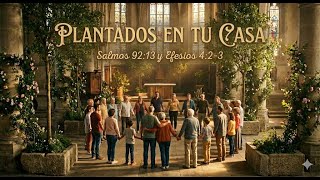
The Arboretum of Grace: an Exegetical and Theological Analysis of Divine Stability and Ecclesial Unity in Psalm 92 and Ephesians 4
Psalms 92:13 • Ephesians 4:1-3
Summary: The biblical narrative frequently employs agrarian and architectural metaphors to articulate the soul's condition in relation to the Divine. Within this metaphorical landscape, Psalm 92:13 and Ephesians 4:2-3 stand as pillars of a unified theological vision for spiritual stability and communal harmony. This vision posits that a profound vertical rootedness in God is the absolute prerequisite for horizontal cohesion among His people, establishing the "planted" state of Psalm 92 as the ontological foundation for the ethical "walk" commanded in Ephesians 4.
Psalm 92 portrays the righteous as palms and cedars, deliberately "planted" by divine initiative into the sacred enclosure of Yahweh’s house. This imagery of "transplanting" signifies an act of sovereign grace, a purposeful placement within the covenant community, and a deep, hydro-stable rooting in God’s enduring life source. Unlike the ephemeral flourishing of the wicked, the righteous derive their vitality and stability from divine presence, embodying both the fruitfulness and sweetness of the palm, and the strength and durability of the cedar, which are essential for spiritual maturity.
Conversely, Ephesians 4 exhorts believers to "walk in a manner worthy of the calling" by diligently preserving the "unity of the Spirit in the bond of peace." This requires a specific cluster of virtues: humility, gentleness, patience, and bearing with one another in love. These qualities function as the spiritual "sap" and connective "ligaments" that maintain the integrity and flexibility of the body of Christ. We are not commanded to create unity, but to actively guard and sustain the unity already granted by the Spirit, recognizing peace as the essential connective tissue.
The interplay between these two passages reveals that ecclesial unity is the direct fruit of liturgical stability. We cannot effectively "walk together" in harmony (Ephesians 4) if we are not deeply "planted" and standing firm in God (Psalm 92). The vertical intake of divine grace provides the spiritual resilience needed to extend humility, gentleness, and patience horizontally within the community, preventing spiritual burnout and division. This theological ecology shows that the flourishing of the individual in God's presence now manifests as actively maintaining the "bond of peace" within the corporate body, transforming the sacred space from a physical temple to the enduring, fruitful community of believers itself.
Introduction: The Theological Ecology of Stability
The biblical narrative frequently employs agrarian and architectural metaphors to articulate the condition of the human soul in relation to the Divine. Within this metaphorical landscape, two distinct passages—Psalm 92:13 and Ephesians 4:2-3—stand as pillars of a unified theological vision regarding spiritual stability and communal harmony. While separated by centuries, genre, and covenantal administration, these texts converse with one another to present a comprehensive ecology of the spiritual life: that vertical rootedness in God is the absolute prerequisite for horizontal cohesion among His people.
Psalm 92:13, embedded within a Sabbath song of thanksgiving, portrays the righteous as trees—specifically palms and cedars—transplanted into the sacred enclosure of Yahweh’s house. Here, "flourishing" is defined not by independent expansion but by proximity to the divine center and stability within the sanctuary. Conversely, Ephesians 4:2-3, situated at the pivotal transition from doctrine to duty in the Pauline corpus, employs the somatic metaphor of a body held together by a "bond of peace" (sundesmos). Paul delineates specific character traits—humility, gentleness, patience—required to sustain this unity.
This report posits that the state of being "planted" described in Psalm 92 serves as the ontological foundation for the ethical "walk" commanded in Ephesians 4. The structural integrity of the "cedar in Lebanon" provides the spiritual resilience necessary to maintain the "ligaments" of the body of Christ. The interplay suggests that the "unity of the Spirit" is the New Testament realization of "flourishing in the courts of our God," effectively relocating the sacred space from the Jerusalem Temple to the corporate assembly of believers.
Part I: The Liturgical Soil – Contextualizing Psalm 92
1.1 The Sabbath Superscription and Theodicy
Psalm 92 is unique in the Psalter, bearing the superscription Mizmor Shir l’yom HaShabbat—"A Psalm, a Song for the Sabbath day". This liturgical marker is hermeneutically decisive. The Sabbath represents the cessation of secular labor to acknowledge the sovereign work of the Creator and Redeemer. Therefore, the "flourishing" described in this psalm is not the result of human striving (the labor of the six days) but of divine placement and rest.
The psalm functions as a theodicy, addressing the apparent prosperity of the wicked. The psalmist observes that the wicked "spring up like grass" (eseb) and "flourish" (tzutz). However, this flourishing is ephemeral; grass lacks a substantial root system and is destined for rapid desiccation and destruction. This botanical contrast sets the stage for verse 13: the righteous are not grass, but trees. They do not merely "spring up" wildly; they are deliberately "planted."
1.2 The Theology of Shathal (The Transplanted Life)
The imagery of verse 13 hinges on the Hebrew participle shathal (שָׁתַל), translated as "planted." This verb is distinct from mere sowing (zara). Lexical analysis indicates that shathal carries the nuance of "transplanting"—taking a shoot from one location and deliberately placing it in another, more favorable environment.
The theological implications of shathal are threefold:
-
Sovereign Initiative: A tree does not transplant itself. The passive participle indicates that the believer’s position in the "house of the Lord" is an act of external grace. Just as the cedar of Lebanon does not spontaneously appear in the arid courts of the temple, the righteous are placed there by the Divine Gardener.
-
Deliberate Location: The transplantation is purposeful. The tree is moved from the "wild" (the world) into the "courts" (the covenant community). This mirrors the trajectory of Israel and the Church—called out (ecclesia) and placed within a covenantal framework.
-
Hydro-Stability: In contrast to the surface-level roots of the grass, the transplanted tree strikes deep roots into the "streams of water" (referencing Psalm 1:3, which also uses shathal). This signifies a connection to an enduring, subterranean life source that remains unaffected by surface drought.
1.3 Sacred Space: The House and The Courts
The text specifies the location of this planting: "in the house of the Lord" (beveit Yahweh) and "in the courts of our God" (bechatzrot eloheinu). Historically, while decorative motifs of palm trees adorned Solomon’s Temple (1 Kings 6:29), actual trees were likely located in the outer precincts or courts.
Theologically, "the house of the Lord" represents the sphere of God's manifest presence (panim) and the center of communal worship. To be planted "in the house" implies that the believer derives their vitality from the act of worship and communion with Yahweh. The "courts" (chatser) refer to the enclosures where the community gathered. Thus, the flourishing of the individual is inseparable from their presence in the congregation. The isolated cedar is a vulnerable cedar; the flourishing tree stands among the "trees of the Lord."
Part II: Botanical Typology – The Palm and The Cedar
Verse 12 provides the specific botanical identities for the "planted" ones: the Palm Tree (Tamar) and the Cedar of Lebanon (Erez). These are not chosen randomly; they represent complementary aspects of spiritual maturity that directly correlate to the virtues requested in Ephesians 4.
Table 1: Comparative Botanical Metaphors in Psalm 92
| Attribute | The Wicked (Grass/ Eseb) | The Righteous (Palm/ Tamar) | The Righteous (Cedar/ Erez) | Theological Implication |
| Growth Rate |
Rapid, overnight sprouting. |
Moderate, steady vertical growth. |
Slow, enduring growth over centuries. | Spiritual maturity requires patience (makrothymia); rapid "success" is often deceptive. |
| Root System | Shallow, surface-level. |
Deep taproot accessing water table. |
Massive, spreading roots anchoring in rock. | Stability comes from depth (rootedness) in doctrine and grace, not surface circumstances. |
| Primary Characteristic | Abundance in number, fragility. |
Fruitfulness (Dates), Sweetness, Uprightness. |
Strength, Durability, Incorruptibility, Fragrance. | The believer must balance "sweetness" (Gentleness) with "strength" (Patience/Endurance). |
| Lifespan |
Ephemeral; withers seasonally. | Long-lived; bears fruit for decades. |
Millennial; resistant to rot and insect decay. | The "Unity of the Spirit" is a long-term endeavor, surviving generational shifts. |
| Utility | Fuel for fire; fodder. | Food (Dates), Shade, Beauty. |
Structural timber for Temples and Palaces. | Believers are "built together" into a dwelling place for God (Eph 2:22). |
The righteous combine the fruitfulness of the palm (feeding others, sweetness, grace) with the fortitude of the cedar (sheltering others, stability, structural integrity). This dual nature—sweetness and strength—prefigures the combination of "gentleness" and "patience" found in Ephesians 4.
Part III: The Architecture of Unity – Exegesis of Ephesians 4:2-3
Shifting from the poetic imagery of the Psalms to the didactic prose of the New Testament, Ephesians 4 marks the transition in Paul's epistle from the indicative (who we are in Christ, chapters 1-3) to the imperative (how we must live, chapters 4-6).
3.1 The Worthy Walk (Axios Peripatesai)
Ephesians 4:1 opens with the exhortation to "walk in a manner worthy of the calling." The word "worthy" (axios) implies a balancing of scales. The conduct of the believer must carry a spiritual weight equivalent to the glorious calling described in the previous chapters. If the calling is to be the "body of Christ" and the "temple of the Holy Spirit" (Eph 2:21), the walk must exhibit characteristics that preserve the integrity of that temple.
3.2 The Virtue Cluster: The Sap of Community
Paul lists four specific virtues in verse 2 that are essential for maintaining unity. These are not merely individual character traits but relational dynamics necessary for community survival. They function as the "sap" that keeps the body flexible and alive.
-
All Humility (Tapeinophrosynē): In the Greco-Roman world, humility was often viewed as a vice, associated with servility and weakness. Paul elevates it to a primary Christian virtue. Tapeinophrosynē literally means "lowliness of mind". It is the refusal to assert one's status or rights over others. It is the direct antidote to the pride that causes division. In the context of Psalm 92, the cedar does not boast of its height because it knows it was transplanted by God. Humility is the recognition of one's creatureliness and dependence on grace.
-
Gentleness (Prautēs): Often translated as "meekness," this word does not imply weakness. It was used of a wild horse that had been broken and trained—strength under control. It represents a soothing quality, a refusal to be harsh or abrasive. It is the "sweetness" of the palm tree applied to human relationships. Gentleness prevents the friction that inevitably arises in close community from igniting into conflict.
-
Patience (Makrothymia): Literally "long-tempered" or "long-suffering." It is the capacity to endure provocation without retaliation. It implies a long fuse. This virtue is crucial because, as the source material notes, "people are going to irritate us". Patience is the temporal aspect of love—the willingness to wait for others to grow, just as the cedar grows slowly over centuries.
-
Bearing with One Another in Love (Anechomenoi): This participle explains how patience is exercised. It means "to put up with" or "to hold up." It acknowledges the burden of community. Other people are heavy; their faults, idiosyncrasies, and sins weigh on us. To "bear with" is to sustain that weight without collapsing or casting it off. This recalls the architectural function of pillars or beams (cedars) in a temple, bearing the load of the structure.
3.3 The Bond of Peace (Sundesmos)
Verse 3 contains the teleological goal of these virtues: "being diligent to keep the unity of the Spirit in the bond of peace."
-
Diligence (Spoudazontes): The participle implies haste, zeal, and intense effort. Unity is not the default state of fallen humanity; entropy applies to relationships. Unity must be actively maintained.
-
Unity of the Spirit (Enoteta): Importantly, Paul does not command the church to create unity, but to keep (preserve/guard) it. The unity is a given reality created by the Spirit through baptism into one body (v. 4). The church's task is to not break what God has joined.
-
The Bond (Sundesmos): The word sundesmos refers to a ligament, a fetter, or a band that holds things together. In ancient medical texts, it referred to the ligaments that bind bones together. In Colossians 2:19, Paul uses the same word to describe how the body is "knit together".
-
Peace (Eirene): Peace is identified as this ligament. It is not merely the absence of conflict but the active presence of wholeness and reconciliation. Peace acts as the connective tissue that allows the disparate members of the body to function as a singular organism without tearing apart under stress.
Part IV: The Interplay – Synthesizing Vertical Roots and Horizontal Bonds
The integration of Psalm 92 and Ephesians 4 reveals a profound theological mechanic: Ecclesial unity is the fruit of liturgical stability. The "interplay" is not merely thematic but causal. A believer cannot fulfill the horizontal demands of Ephesians 4 (bearing with others) without the vertical resources of Psalm 92 (being planted in the house of the Lord).
4.1 From "Planted" to "Rooted and Grounded"
The language of "planting" (shathal) in Psalm 92 finds its direct New Testament corollary in Ephesians 3:17, where Paul prays that believers be "rooted and grounded in love". This "rooting" is the prerequisite for the "walking" in Chapter 4.
-
The Mechanism of Grace: The "courts of God" (Ps 92) provide the nutrient of divine grace. The cedar draws sap from the soil of God’s presence. This sap manifests as the makrothymia (patience) needed to endure people. Without the vertical intake of grace, the horizontal output of patience depletes the individual.
-
The Problem of Burnout: When a Christian attempts to maintain the "bond of peace" solely through human effort, they wither. True "bearing with" is the overflow of being "fat and flourishing" with the Spirit’s oil (Ps 92:10, 14). The "sap" of the Spirit becomes the "bond" of peace.
4.2 Anatomical and Botanical Structural Integrity
Both texts utilize structural metaphors to describe the community of faith. Psalm 92 uses the Cedar of Lebanon, a structural timber used to build the Temple. Ephesians 4 uses the sundesmos (ligament) of the body.
Table 2: The Structural Interplay
| Structural Element | Psalm 92 Metaphor | Ephesians 4 Metaphor | Function in Community |
| Rigidity/Strength | The Cedar (Erez) | The Mature Man (v. 13) | Provides doctrinal stability; prevents being "tossed to and fro" (Eph 4:14). Stands firm against the "wicked." |
| Flexibility/Connection | The Palm (Tamar) | The Ligament (Sundesmos) | Allows for movement and growth; "bears with" the weight of others; maintains connection during stress. |
| Vitality | "Fresh and Green" | "Growth of the Body" | The result of being connected to the Head/Source. |
The Interplay: A community needs both the Vertical Integrity of the cedar (individual righteousness/plantedness in truth) and the Horizontal Elasticity of the ligament (humility, gentleness).
-
If everyone is only a "cedar" (rigid, uncompromising), the building is brittle. It lacks the "joint" function.
-
If everyone is only "ligament" (flexible, soft), there is no structure.
-
The righteous man of Psalm 92 becomes the structural pillar in the Temple of Ephesians 2:21, bound to others by the ligament of peace.
4.3 The Transformation of Sacred Space
Psalm 92 locates flourishing in the "courts of our God"—a physical, geographical location (the Jerusalem Temple). It implies that to flourish, one must travel to the place where God dwells.
Ephesians 4 transforms this geography. The "unity of the Spirit" signifies that the believers themselves constitute the Temple. The "courts" of Psalm 92 have become the "one body" of Ephesians 4.
-
Implication: "Flourishing in the courts" (Ps 92) is now achieved by "keeping the unity of the Spirit" (Eph 4). You cannot claim to be "planted in the house of the Lord" if you are severing the "bond of peace" with the brother or sister who constitutes a living stone in that house.
-
Worship as the Engine of Unity: One cannot worship the "Most High" (Ps 92:1) while despising the "lowliness" (Eph 4:2) required to love His people. The vertical praise of Psalm 92 must translate into the horizontal peace of Ephesians 4. The "fresh oil" of worship (Ps 92:10) lubricates the "joints and ligaments" of the body (Eph 4:16), preventing the friction of conflict.
4.4 Time and Maturity: The Cedar's Growth vs. The Infant's Instability
Psalm 92 contrasts the righteous with the wicked who "spring up like grass" (v. 7). Grass grows overnight but lacks structure. The cedar grows slowly over centuries. Ephesians 4:14 contrasts the mature body with "children, tossed to and fro and carried about with every wind of doctrine."
-
Patience as Long-term Growth: The virtue of makrothymia (patience) in Ephesians 4:2 is the behavioral manifestation of the cedar's growth cycle. Just as a cedar requires decades to reach maturity, spiritual unity requires "long-suffering." We must allow others time to grow. We do not demand that an acorn be a cedar overnight.
-
Stability: The "planted" nature of the cedar prevents it from being "tossed to and fro" by winds (Eph 4:14). A community rooted in the deep theology of God's sovereignty (Ps 92:5 "Thy thoughts are very deep") creates a stabilizing "bond of peace" that protects the immature from doctrinal instability.
Part V: Eschatological Fruitfulness
Psalm 92:14 makes a startling promise: "They shall still bear fruit in old age; they shall be fresh and flourishing." This counters the natural law of entropy. Ephesians 4:13 speaks of "attaining to the whole measure of the fullness of Christ"—spiritual maturity.
The "fruit" of old age is often the stability and peace that holds the younger generation together. The older "cedars" in the community, who have weathered storms and remained planted, provide the "bond of peace" for the younger, more volatile "saplings." Their flourishing is not necessarily active labor (works) but being (standing firm, declaring the Lord is upright).
This connects to the "perfect man" of Ephesians 4:13. The goal of the unity of the faith is a corporate maturity that mirrors the endurance of the cedar. The "fruit" of the Spirit (love, patience, gentleness) typically ripens with time. The "old age" flourishing of Ps 92 is the perfection of the Eph 4 virtues.
Conclusion
The analysis of Psalm 92:13 and Ephesians 4:2-3 reveals a cohesive biblical theology of stability and community. The interplay is clear: We cannot walk together (Eph 4) if we do not stand together (Ps 92).
The "Bond of Peace" that holds the body together is spun from fibers of humility and patience that only grow in the soil of worship. The "Unity of the Spirit" is the forest of Cedars standing in the courts of God—distinct, yet rooted in the same soil, drinking the same water, and swaying to the same wind of the Spirit. To neglect the "planting" (worship, abiding in Christ, the Sabbath rest of Ps 92) while attempting the "walking" (community ethics of Eph 4) leads to burnout and division. We become dry ligaments that snap under pressure.
Therefore, the path to the "bond of peace" is through the "courts of our God." The righteous man, the cedar of Lebanon, is the one whose deep roots in God allow him to be a pillar of peace in the church, bearing the fruit of love even in old age, to the glory of the Upright Rock. The interplay of these texts calls the believer to a life that is vertically rooted in grace and horizontally expanded in peace, proving that the house of the Lord is built of living stones, held together by the love of the Architect.
What do you think?
What do you think about "The Arboretum of Grace: An Exegetical and Theological Analysis of Divine Stability and Ecclesial Unity in Psalm 92 and Ephesians 4"?
Related Content
Planted in Your House
What Kind of Church Are You Looking For?
Many people prefer to join churches whose members resemble themselves in the way they speak, look, and act. They need to be identified in these sociol...
Flourishing in God's Courts: the Foundation for Peaceful Fellowship
Psalms 92:13 • Ephesians 4:1-3
Our journey as believers is fundamentally shaped by how deeply we are rooted in God and how harmoniously we relate to one another within His family. I...
Read in Context
Click to see verses in their full context.
Song (Other Languages)