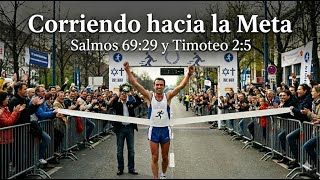
The Crown and the Fortress: a Theological and Exegetical Analysis of the Interplay Between Psalm 69:29 and 2 Timothy 2:5
Psalms 69:29 • 2 Timothy 2:5
Summary: The canon of Scripture presents a dynamic tension between the monergistic sovereignty of God in salvation and the synergistic responsibility of the human agent in sanctification. This tension is vividly illustrated in the juxtaposition of Psalm 69:29, which expresses a desperate cry for total dependence on divine rescue — "But I am afflicted and in pain; let Your salvation, O God, set me on high" — and 2 Timothy 2:5, a pastoral charge for disciplined exertion: "Also if anyone competes as an athlete, he does not win the prize unless he competes according to the rules." While these texts initially appear to inhabit distinct theological realms, our rigorous analysis reveals them not as contradictory poles, but as complementary pillars of a unified soteriology.
Our examination demonstrates that the "setting on high" ( *sagab* ) requested in the Psalm provides the necessary ontological and eschatological platform for the "lawful striving" ( *athleo nomimos* ) commanded in the Epistle. God’s salvation extracts the believer from the "mire" of sin and suffering, placing us on the solid ground where we can then engage in the disciplined "contest" of faith. This is not a choice between passive waiting and active exertion, but rather a grace-empowered discipline, where our very lament and dependence, as expressed in Psalm 69, become a "lawful" act of faith in the Christian journey. The "rules" for this contest are fundamentally cruciform, requiring conformity to Christ's pattern of suffering before glory.
Ultimately, the hermeneutical key that unlocks this interplay is the person of Jesus Christ. He is the ultimate referent for both texts, embodying the complete synthesis. Jesus stands as the Petitioner of Psalm 69, whose profound humiliation and suffering found its answer in His resurrection and exaltation to the highest place. Concurrently, He is the quintessential Lawful Athlete of 2 Timothy, who competed perfectly according to the Father's rules, enduring the cross and despising its shame, thereby earning His imperishable crown of glory.
For us, as believers, this synthesis is realized through our union with Christ. We are positionally raised with Him from the mire, and experientially empowered by His Spirit to run the race. This understanding offers profound pastoral and practical implications: it validates lament as a "lawful" component of our spiritual contest, redefines success as integrity in adhering to Christ's way rather than worldly outcomes, and fuels our endurance with eschatological hope. We are cautioned against spiritual shortcuts, understanding that the only path to being "set on high" and receiving the "Crown" is through embracing both the mire of suffering and the disciplined contest of faith, all in union with our victorious Lord.
Introduction
The canon of Scripture presents a dynamic tension between the monergistic sovereignty of God in salvation and the synergistic responsibility of the human agent in sanctification. This tension is nowhere more vividly illustrated than in the juxtaposition of Psalm 69:29 and 2 Timothy 2:5. The former, a desperate cry from the Davidic Psalmist, articulates a theology of total dependence: "But I am afflicted and in pain; let Your salvation, O God, set me on high." The latter, a pastoral charge from the Apostle Paul to his spiritual son, articulates a theology of disciplined exertion: "Also if anyone competes as an athlete, he does not win the prize unless he competes according to the rules."
At a cursory glance, these texts appear to inhabit distinct theological ecosystems. Psalm 69 operates within the genre of the individual lament, characterizing the believer as a victim of overwhelming external forces—waters, mire, and enemies—requiring rescue from an external agent. 2 Timothy 2 operates within the genre of parenesis (moral exhortation), characterizing the believer as an active combatant—a soldier, an athlete, a farmer—requiring internal discipline and adherence to a code of conduct to secure a reward.
However, a rigorous analysis reveals that these two texts are not contradictory poles but complementary pillars of a unified soteriology. The "setting on high" (sagab) requested in the Psalm provides the necessary ontological and eschatological platform for the "lawful striving" (athleo nomimos) commanded in the Epistle. Furthermore, both texts converge in the person of Jesus Christ, who is both the Ultimate Sufferer of Psalm 69, whose zeal for God’s house consumed Him, and the Pioneer and Perfecter of the faith who competed according to the redemptive rules of the cross to win the imperishable crown.
This report offers an exhaustive examination of these verses, exploring their lexical depths, historical contexts, and theological interplay. It argues that the "rules" of the contest in 2 Timothy are fundamentally cruciform, requiring the athlete to enter the "mire" of Psalm 69 with the assurance of divine elevation. Thus, the passive reception of deliverance and the active pursuit of the prize are shown to be inextricably linked in the economy of grace.
Part I: The Anatomy of Despair and Deliverance – Psalm 69:29
1.1 The Genre and Setting of the Lament
Psalm 69 is classified as an individual lament, a genre that gives voice to the disorientation of human suffering. It is traditionally attributed to David, though the specific historical setting remains ambiguous—fitting contexts include the persecution by Saul or the betrayal by Absalom. Regardless of the specific historical moment, the psalm serves as a paradigmatic expression of the righteous sufferer. It is the most quoted psalm in the New Testament after Psalm 22, indicating its profound messianic significance.
The psalm opens with imagery of chaotic waters: "Save me, O God, for the waters have come up to my neck" (v. 1). In the ancient Near Eastern cosmology, deep waters (mayim amaqim) and mire (yaven) symbolized the realm of chaos and death, a place furthest removed from the order and life of the Temple. The sufferer is not merely uncomfortable; he is de-created, sinking into a non-structure where there is "no foothold" (v. 2). This lack of purchase is critical: the psalmist cannot save himself because he has no leverage. He is physically exhausted, his throat is parched from crying, and his eyes fail while waiting for God (v. 3).
The lament moves through cycles of complaint, confession, and imprecation. The psalmist acknowledges his own "folly" (v. 5), yet insists that his suffering is primarily due to his zeal for God (v. 7-9). He has become a stranger to his own brothers, a byword among the drunkards at the gate. This social isolation compounds the physical threat. The transition to verse 29 comes after a fierce section of imprecation (vv. 22-28), where the psalmist calls for the "table" of his enemies to become a snare and for their names to be blotted out of the book of life.
Verse 29 functions as the pivot of the entire poem. It shifts the gaze from the horizontal threat of the enemies to the vertical hope of Yahweh. The particle Wa'ani ("But as for me") marks a strong adversative turn. While the wicked may be temporarily secure in their tents, and while the psalmist is currently in the mire, he invokes a future reality defined by God’s intervention.
1.2 Lexical Exegesis of the Petitioner’s State
The psalmist uses two descriptors for his condition in verse 29: ani and ko'eb.
The Meaning of Ani (Afflicted/Poor):
The Hebrew word ani (Strong's H6041) is derived from anah, meaning to be bowed down or depressed.6 It covers a semantic range that includes material poverty, physical pain, and social oppression. In the Psalms, the anawim (the plural form) became a technical term for the "pious poor"—those who have no helper but Yahweh. This is not a description of economic class alone but of theological posture. To be ani is to be emptied of self-reliance. It is the necessary prerequisite for divine intervention, for God is repeatedly described as the "helper of the helpless".6 By identifying himself as ani, David is presenting his credentials for grace. He is not claiming merit; he is claiming emptiness.
The Meaning of Ko'eb (In Pain/Sorrowful):
Coupled with ani is ko'eb (or koveh), from the root ka'ab.6 This term denotes physical and mental agony. It is the pain of a wound or a grief that mars the soul. The KJV translates this as "sorrowful," while the NASB and ESV prefer "in pain." The combination suggests a holistic suffering—body and spirit are besieged. This aligns with the earlier descriptions of the "parched throat" and "broken heart" (v. 20). The petitioner is not a stoic philosopher rising above his circumstances; he is a human being vividly feeling the crushing weight of his reality.
1.3 The Theology of Sagab (Setting on High)
The petition "Let Your salvation, O God, set me on high" centers on the Hebrew verb tesaggeveni, from the root sagab (Strong's H7682). This word is rich in military and spatial nuances.
The Fortress Metaphor:
Sagab literally means to be "inaccessibly high" or "lofty".7 It is frequently used in parallel with migdal oz (strong tower) or tsur (rock). In Proverbs 18:10, "The name of the LORD is a strong tower; the righteous run to it and are safe (sagab)." The safety provided by sagab is not the safety of a shield that deflects blows while remaining on the battlefield; it is the safety of elevation. It implies being lifted out of the range of the enemy's weapons.
-
Spatial Salvation: In the context of Psalm 69, where the threat is "deep waters" and "mire" (low places), sagab represents a reversal of altitude. The psalmist asks to be transported from the depths to the heights. This is a spatial soteriology: salvation is movement from the realm of death (Sheol/Mire) to the realm of life (High Tower/Zion).
Exaltation and Vindication:
Beyond mere safety, sagab carries the nuance of exaltation. To be "set on high" is to be vindicated before one’s accusers. In Psalm 20:1, the "name of the God of Jacob" is said to sagab the king—to set him on high in victory. Thus, David is asking for a public reversal of his status. He, who is currently the song of drunkards (v. 12) and covered in shame (v. 7), asks to be elevated to a position where his righteousness is manifest and his enemies are silenced.11 This anticipates the Resurrection, where the humiliated Christ is exalted to the right hand of the Father.
The Agent of Elevation:
Crucially, the subject of the verb is Yeshuatkha—"Your salvation." The psalmist does not say, "Let me climb to the high place." The mire prevents climbing. The action is entirely monergistic. God’s salvation acts upon the passive agent. The structure of the prayer acknowledges that only an external power can effect this change in altitude. This establishes the theological foundation of Divine Deliverance: it is a sovereign act of rescue extended to those who have no capacity to rescue themselves.
Part II: The Arena of Discipline and Rules – 2 Timothy 2:5
2.1 The Context of the Pastoral Charge
We turn now from the mire of the Psalms to the prison cell of the Apostle Paul. 2 Timothy is Paul’s "swan song," written shortly before his execution under Nero (c. 64-67 AD). The letter is intensely personal, addressed to Timothy, his "beloved son." The context is one of impending death and the urgent need to preserve the "good deposit" of the Gospel.
Chapter 2 is a treasury of metaphors describing the Christian minister:
-
The Son (v. 1): Dependent on grace.
-
The Teacher (v. 2): Entrusting truth to others.
-
The Soldier (v. 3-4): Single-minded and entangled.
-
The Athlete (v. 5): Disciplined and lawful.
-
The Farmer (v. 6): Hardworking and patient.
Verse 5 sits at the heart of this cluster, emphasizing that zeal and effort are insufficient if detached from divine order.
2.2 Lexical Exegesis of the Athletic Metaphor
The Greek text of 2 Timothy 2:5 is precise: ean de kai athlē tis, ou stephanoutai ean mē nomimōs athlēsē ("And also if anyone competes as an athlete, he is not crowned unless he competes lawfully").
The Verb Athleo (Compete):
The verb athleo (from which we derive "athletics") signifies engaging in a contest, struggling, or contending for a prize.12 It implies intense exertion. Unlike the ani of Psalm 69, who is waiting for God, the subject here is expending massive energy. The Christian life is not a spectator sport; it is an agon (struggle). Paul frequently uses this imagery (1 Cor 9:24-27; Phil 3:14) to denote the rigorous demand of the faith.
The Adverb Nomimos (Lawfully/According to Rules):
The crux of the verse lies in the adverb nomimos.13 It stems from nomos (law) and means "legitimately" or "in accordance with the established regulations." In the context of the ancient Greco-Roman games (such as the Olympics or the Isthmian games near Corinth), nomimos referred to two distinct phases of compliance:
-
The Rule of Preparation: Professional athletes were required to swear an oath before the statue of Zeus Horkios that they had strictly trained for ten months prior to the games. Failure to fulfill this training period, or cheating during it, resulted in disqualification, regardless of one's performance on the day of the contest. This implies that the "rules" involve a lifestyle of discipline long before the public performance.
-
The Rule of Competition: During the event, the athlete had to observe the specific boundaries—staying in the lane, not tripping opponents in a race, or obeying the conventions of wrestling. To "cut corners" was to forfeit the prize.
Theologically, nomimos serves as a guardrail against two errors: antinomianism (living without moral restraint) and pragmatism (using ungodly methods to achieve "spiritual" results). Paul warns Timothy that ministry cannot be improvised. There is a "pattern of sound words" (1:13) and a standard of conduct that must be adhered to. A minister might fill a stadium, but if they have compromised the truth or their character, they will not be crowned.
The Prize: Stephanos (The Crown):
The goal of the athleo is the stephanos. In the Greek games, this was a wreath of laurel, pine, or celery—a perishable symbol of imperishable glory. Paul contrasts this with the "imperishable crown" (1 Cor 9:25). This is distinct from the diadema, which is the crown of royalty.18 The stephanos is the victor's crown, the badge of public honor granted by the judge.
In the Pastoral Epistles, this is identified as the "crown of righteousness" (2 Tim 4:8) and the "crown of life" (James 1:12, Rev 2:10). It represents the eschatological affirmation of the believer's faithfulness. Crucially, the text says the athlete is not crowned (ou stephanoutai) unless the rules are followed. This introduces a conditional element to the reward: while entrance into the race is by grace, the reward at the finish line is contingent upon faithful perseverance.19
2.3 The Meaning of the "Rules" in a Christian Context
What exactly are the "rules" (nomimos) for the Christian athlete? They are not the Mosaic ceremonial laws, nor are they arbitrary bureaucratic hoops. In the context of 2 Timothy, the "rules" are defined by the nature of the Gospel and the character of Christ.
-
The Rule of Suffering: The immediate context (2:3) is "suffer hardship with me." The primary rule of the Christian contest is that glory follows suffering. To attempt to bypass suffering is to compete "unlawfully."
-
The Rule of Truth: Timothy is to "rightly divide the word of truth" (2:15). Doctrinal fidelity is a rule of the contest.
-
The Rule of Holiness: "Let everyone who names the name of the Lord depart from iniquity" (2:19). Moral purity is a prerequisite for being a "vessel for honor" (2:21).
Part III: The Interplay – Divine Deliverance as the Foundation for Human Discipline
Having analyzed the texts individually, we now explore their profound interplay. The tension between the cry for rescue in Psalm 69 and the call to discipline in 2 Timothy is resolved when we understand them as sequential and mutually reinforcing movements in the life of faith.
3.1 Spatial Synthesis: From the Mire to the Arena
A spatial analysis connects the two texts. In Psalm 69, the believer is in the Mire. The need is Rescue. The mire represents the impossibility of self-salvation; there is "no foothold." In 2 Timothy 2, the believer is in the Arena. The need is Victory. The arena presumes a foothold; one cannot wrestle or run while sinking in quicksand.
The Insight: The "setting on high" (sagab) of Psalm 69 is the prerequisite for the "competition" (athleo) of 2 Timothy. God’s salvation extracts the believer from the mire of sin and death (justification) and places them on the solid ground of the arena (sanctification). We compete because we have been set on high. The fortress of Psalm 69 becomes the training ground for the athlete of Timothy. The "salvation" provides the footing necessary for the "striving." Without the initial, monergistic rescue of the Psalm, the synergistic striving of the Epistle is impossible.
3.2 The Paradox of Agency: Grace-Empowered Discipline
Psalm 69 emphasizes passivity ("Let your salvation... set me"), while 2 Timothy emphasizes activity ("competes"). This reflects the biblical paradox of Grace-Empowered Discipline.
-
Active Dependence: The "discipline" required in 2 Timothy is not an autonomous exercise of will. It is the discipline of remaining dependent on grace. Paul exhorts Timothy in 2:1, "Be strong in the grace that is in Christ Jesus." The strength to compete comes from the grace.
-
Prayer as Athleticism: The cry of Psalm 69 ("Save me, O God") is, paradoxically, the primary "athletic move" of the Christian life. To strive "lawfully" is to strive by faith, and faith expresses itself in prayer. The athlete competes by crying out. As Martin Luther argued in his Theology of the Cross, the one who strives lawfully is the one who despairs of their own strength and relies entirely on God’s power. Therefore, the lament of Psalm 69 is not a sign of failure in the contest but the correct execution of the "rules"—namely, the rule of faith.
3.3 The "Rules" (Nomimos) as the Way of the Cross
The deepest link between the texts lies in the definition of nomimos. If the "rule" of the Christian faith is conformity to Christ, then the rule is Cruciformity—the pattern of suffering leading to glory.
-
Psalm 69 depicts the "suffering" side of the equation (reproach, zeal, agony).
-
2 Timothy 2 depicts the "glory" side (crowning, reigning), but makes it contingent on enduring the suffering.
-
"If we died with Him, we will also live with Him; If we endure, we will also reign with Him" (2 Tim 2:11-12).
-
Thus, the "lawful" athlete is the one who accepts the "mire" of Psalm 69 as part of the race. To reject the mire—to seek a prosperity gospel without pain, or a crown without a cross—is to compete unlawfully. The "affliction" (ani) of the Psalmist is not an obstacle to the crown; it is the track upon which the race is run.
Table 1: Comparative Analysis of Keywords and Concepts
| Feature | Psalm 69:29 | 2 Timothy 2:5 | Synthesis |
| Key Term | Sagab (Hebrew) | Nomimos (Greek) | Elevation requires Regulation |
| Literal Meaning | To be set on high, inaccessible | Lawfully, according to rules | Divine safety empowers lawful striving |
| Context | Lament, drowning, persecution | Exhortation, athletics, endurance | Suffering is the context for both rescue and reward |
| Human State | "Poor and sorrowful" (Ani/Ko'eb) | "Athlete" (Athleo) | The athlete is often sorrowful; the sorrowful must strive |
| Divine Role | Savior/Protector (Yeshuah) | Judge/Rewarder (Stephanos) | God saves from the mire to crown on the podium |
| Action | Passive (Waiting/Crying) | Active (Competing/Training) | We work because He works; Prayer is the energy of action |
| Theological Core | Monergistic Deliverance | Synergistic Sanctification | Justification (Ps 69) grounds Sanctification (2 Tim) |
Part IV: Christological Synthesis – The Suffering Servant and the Victorious Athlete
The hermeneutical key that fully unlocks the interplay of these texts is the person of Jesus Christ. He is the ultimate referent of both the Psalm’s lament and the Epistle’s exhortation.
4.1 Jesus as the Petitioner of Psalm 69
The New Testament unequivocally identifies Jesus as the speaker of Psalm 69.
-
Zeal: "Zeal for Your house has consumed me" (Ps 69:9) is cited in John 2:17 regarding Jesus' cleansing of the Temple.
-
Reproach: "The reproaches of those who reproached You fell on me" (Ps 69:9) is cited by Paul in Romans 15:3 to describe Christ’s selflessness.
-
The Passion: "They gave me gall for my food and vinegar to drink" (Ps 69:21) is historically enacted at the crucifixion (Matt 27:34).
If Jesus is the speaker, then verse 29 takes on profound significance. "I am poor and sorrowful" refers to His state of humiliation—the kenosis (emptying) where He took the form of a servant (Phil 2:7). The prayer "Let Your salvation set me on high" is nothing less than the Son’s prayer for Resurrection. The Hebrew sagab here corresponds to the hyper-ypsoō (super-exaltation) of Philippians 2:9. God the Father answers the prayer of the Son by raising Him from the "mire" of the grave and seating Him at the right hand on high.
4.2 Jesus as the Lawful Athlete of 2 Timothy
In 2 Timothy 2:8, immediately following the athlete metaphor, Paul commands Timothy: "Remember Jesus Christ, risen from the dead, descendant of David, according to my gospel." Why this specific remembrance? Because Jesus is the archetype of the Athlete who "competed according to the rules."
-
The Rules: The "rule" for the Messiah was that He must suffer and then enter His glory (Luke 24:26). He could not take the shortcut offered by Satan in the wilderness (Matt 4:8-10)—that would have been an unlawful competition.
-
The Contest: He endured the cross, despising the shame (Heb 12:2). He ran the race with perfect discipline, obeying the Father even unto death.
-
The Crown: Because He competed lawfully, He was "crowned with glory and honor" (Heb 2:9).
4.3 The Synthesis: Co-Athletes in Union with Christ
For the believer, the interplay is realized through Union with Christ.
-
Positional Union (Ps 69): We were in the mire of sin. Christ entered the mire for us and as us. His cry for deliverance became our cry. When He was "set on high" (sagab) in the Resurrection, we were raised up with Him (Eph 2:6). Our fundamental status is now "set on high."
-
Experiential Union (2 Tim 2): Because we share in His victory, we are called to share in His "contest." We run the race in His power (2 Tim 1:7). The Spirit of the Resurrected Athlete dwells within us, empowering us to keep the "rules" of the cross—dying to self and living for God.
-
Eschatological Union: The "crown of righteousness" (2 Tim 4:8) is ultimately the sharing of His glory. The deliverance of Psalm 69 is consummated when the believer finally receives the stephanos in the Kingdom.
Part V: Historical and Patristic Perspectives
Understanding how the church has historically read these texts enriches our modern analysis.
5.1 Patristic Exegesis: The Totus Christus
St. Augustine, in his exposition of the Psalms, employs the hermeneutic of the Totus Christus (the Whole Christ—Head and Body). For Augustine, Psalm 69 is the voice of the Head (Christ) speaking for the Body (the Church). When the Psalmist says, "I am poor and sorrowful," it is Christ suffering in His members. When he asks to be "set on high," it is the Head asking for the resurrection of the Body.
-
Insight: This connects the two texts powerfully. The "Athlete" of 2 Timothy is a member of the Body whose Head has already been "set on high" in Psalm 69. The struggle of the Church in history (2 Tim) is sustained by the victory of Christ in eternity (Ps 69).
5.2 The Reformation: The Theology of the Cross
Martin Luther’s reading of these texts is framed by his distinction between the Theology of Glory and the Theology of the Cross. A Theologian of Glory seeks God in power and triumph, bypassing suffering. A Theologian of the Cross finds God in the "mire"—in suffering and weakness.
-
Luther on 2 Timothy: For Luther, striving "lawfully" means striving with the understanding that our works do not justify us. The "rule" is faith. To strive thinking that one’s own discipline merits the crown is to strive "unlawfully."
-
Luther on Psalm 69: He viewed the imprecatory sections not as personal vendettas but as the Divine Judge’s verdict against sin, spoken by the Messiah. The cry for help is the model of true prayer: naked dependence on God’s promise.
5.3 Modern Application: Spurgeon’s Treasury
Charles Spurgeon, in The Treasury of David, captures the interplay beautifully: "No man was ever poorer or more sorrowful than Jesus of Nazareth, yet his cry out of the depths was heard, and he was uplifted to the highest glory. 'Let thy salvation, O God, set me up on high.' How fully has this been answered in our great Master's case... O ye poor and sorrowful ones, lift up your heads, for as with your Lord so shall it be with you". Spurgeon links the "mire" of the believer directly to the "high place" of Christ, using the Psalm to fuel the perseverance required in Timothy.
Part VI: Pastoral and Practical Implications
The synthesis of Psalm 69:29 and 2 Timothy 2:5 offers robust guidance for the contemporary church, correcting imbalances in how we view suffering, success, and salvation.
6.1 Validating Lament as "Lawful" Competition
The "Athlete" metaphor of 2 Timothy is often co-opted by a "muscular Christianity" or a "prosperity gospel" that views weakness as a lack of faith. Psalm 69:29 corrects this error. It validates the reality that a believer can be "poor and sorrowful" (ani ve'kho'eb) and yet be right with God.
-
Pastoral Insight: Lament is not a disqualification from the race; it is a "lawful" part of the contest. Admitting "I am sinking" (Ps 69:2) is not a failure of the athlete; it is the honesty required to receive the strength to continue. Pastors must teach that crying out to God from the mire is a form of spiritual fighting.
6.2 Redefining Success: Integrity over Outcome
In a pragmatic culture, the church is tempted to measure success by numbers, influence, or political power. 2 Timothy 2:5 warns that one can "compete" (be busy in ministry, build large platforms) and yet not be crowned if the rules are violated.
-
The "Rules" of Ministry: The nomimos requirement demands integrity of character and purity of doctrine. God does not reward the size of the crowd; He rewards the lawfulness of the striving. A pastor who builds a church on marketing rather than the Word, or on personality rather than character, is competing "unlawfully" and risks forfeiting the stephanos.
6.3 Endurance through Eschatological Hope
The phrase "set me on high" (sagab) provides the endurance needed to "compete" (athleo). Athletes endure the rigorous training (the "ten months") only because they visualize the podium.
-
The Logic of Hope: The assurance of Psalm 69—that God hears the needy (v. 33) and will save Zion (v. 35)—fuels the discipline of 2 Timothy. We can say "no" to ungodliness and "yes" to suffering today because we know that the "Crown of Righteousness" is laid up for tomorrow.
6.4 Avoiding Shortcuts
The temptation for the athlete is always to find a shortcut—a performance-enhancing drug or a path across the infield. In the spiritual life, these shortcuts are:
-
Legalism: Trying to earn the crown by works, bypassing the "salvation" of Psalm 69.
-
Cheap Grace: Claiming the "setting on high" without engaging in the "contest" of 2 Timothy.
The interplay teaches that there are no shortcuts. The only way to the High Place is through the Mire (in union with Christ), and the only way to the Crown is through the Contest (in the power of the Spirit).
Conclusion
The interplay of Psalm 69:29 and 2 Timothy 2:5 offers a stereoscopic view of the Christian life, combining the depth of human need with the height of divine calling. Through the lens of Psalm 69, we see the believer as the Dependent Supplicant, drowning in the mire of a fallen world, crying out for a monergistic rescue that only the "God of Salvation" can provide. Through the lens of 2 Timothy 2, we see the believer as the Disciplined Athlete, entering the arena of faith, striving with synergistic energy to lay hold of the prize.
These are not contradictory images but sequential realities. The "High Place" (Sagab) of the Psalm is the solid ground upon which the "Lawful Contest" (Nomimos Athlesis) of the Epistle takes place. We are lifted from the pit so that we may run the race. And ultimately, both texts point us to Jesus Christ—the One who sank into the ultimate mire of the Cross to be set on the ultimate height of the Resurrection, thereby guaranteeing the Crown of Life to all who follow Him in the fellowship of His sufferings.
Table 2: The "Rules" of the Christian Contest (Nomimos)
| Rule Category | Description in 2 Timothy | Connection to Psalm 69 |
| Preparation | "Be strong in grace" (2:1) | Relying on "Your Salvation" (Ps 69:29) |
| Focus | "No entanglement" (2:4) | "Zeal for Your house" (Ps 69:9) |
| Conduct | "Depart from iniquity" (2:19) | "I restored what I did not steal" (Ps 69:4 - innocence) |
| Endurance | "Suffer hardship" (2:3) | "I am weary with crying" (Ps 69:3) yet waiting |
| Method | "Rightly dividing the Word" (2:15) | "I will praise the name of God" (Ps 69:30) |
| Goal | "The Crown of Righteousness" (4:8) | "Set me on high" (Ps 69:29) |
What do you think?
What do you think about "The Crown and the Fortress: A Theological and Exegetical Analysis of the Interplay Between Psalm 69:29 and 2 Timothy 2:5"?
Related Content
A Crown Awaits
Accolades from God
A few decades ago, an award-winning Cuban athlete in the sport of weightlifting, weights, was stripped of the most precious accolade to which a high-p...
From Mire to Crown: the Divine Rescue That Fuels Our Faithful Race
Psalms 69:29 • 2 Timothy 2:5
The Christian journey unfolds as a profound interplay between God's sovereign rescue and our disciplined response. At first glance, our path seems to ...
Read in Context
Click to see verses in their full context.
Song (Other Languages)