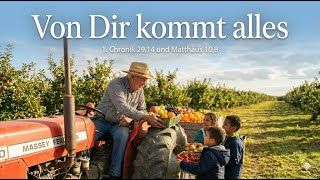
The Divine Economy of Grace: a Theological and Exegetical Analysis of the Interplay Between 1 Chronicles 29:14 and Matthew 10:8
1 Chronicles 29:14 • Matthew 10:8
Summary: The concept of stewardship, often reduced to pragmatic financial management, is more profoundly revealed through an intertextual analysis of 1 Chronicles 29:14 and Matthew 10:8. This examination posits a unified "Divine Economy of Grace" where God is the sole Originator of all capital—material or spiritual—and humanity functions exclusively as a conduit. This framework critically challenges the commodification of the Gospel, asserting that authentic biblical stewardship stems from recognizing the divine source of all assets and ensuring their dynamic distribution, rather than focusing on their mere possession.
In the Davidic context of 1 Chronicles 29:14, the theology of material relinquishment takes center stage. King David, offering vast wealth for the Temple, humbly declares, "For all things come from you, and of your own have we given you." This declaration, made in the presence of immense material contributions, fundamentally negates human ownership. It asserts God's comprehensive sovereignty over all resources and even the innate capacity for generosity. This centripetal model emphasizes giving as a sacred cycle of return and an act of worship, explicitly rejecting any transactional view aimed at coercing divine favor, and grounding human existence in the transient nature of a sojourner on God's earth.
Conversely, Matthew 10:8 presents an apostolic mandate for centrifugal dispersion. Jesus commissions His disciples with spiritual authority to heal, raise the dead, cleanse, and cast out demons, while explicitly forbidding the accumulation of material wealth. The command "Freely you have received; freely give" establishes a radical "Gift Economy," where spiritual power, having been received gratuitously, must be dispensed without any charge. This principle serves as a foundational defense against simony—the attempt to commercialize spiritual gifts—and clearly delineates between legitimate sustenance for those engaged in ministry and the illegitimate practice of selling God's unmerited grace. Disciples are to remain "empty" of self-provision, thereby facilitating their role as pure conduits of divine abundance.
The synthesis of these two scriptural texts underscores that both material wealth and spiritual power originate entirely from God. While 1 Chronicles describes a centripetal flow of resources directed *to* God in worship and for sacred infrastructure, Matthew mandates a centrifugal flow of spiritual power *from* God, through His agents, to a suffering world in mission. True stewardship demands an integration of both: acknowledging God's absolute ownership and returning His gifts (as exemplified in Chronicles) *so that* His grace can be freely extended to others (as commanded in Matthew). Failure to integrate these principles can lead to a religion of hoarding or to spiritual burnout and commodification. Ultimately, a "Davidic Apostleship" is advocated, wherein the church, recognizing the boundless resources of the Kingdom, deploys them without cost or prejudice. This unified theory of stewardship positions the Christian life as the joyful and continuous circulation of God's grace, affirming that true possession of the gift is paradoxically achieved through its selfless distribution.
Abstract
The concept of stewardship within the Judeo-Christian tradition is frequently reduced to the pragmatic management of financial resources. However, a rigorous intertextual analysis of 1 Chronicles 29:14 ("For all things come from you, and of your own have we given you") and Matthew 10:8 ("Freely you have received; freely give") reveals a far more complex theological architecture. This report posits that these two texts, though separated by a millennium and distinct socio-political contexts, articulate a unified "Divine Economy of Grace." This economy operates on a closed-loop system where God is the sole Originator of all capital—whether material (Davidic context) or spiritual (Apostolic context)—and the human agent functions solely as a conduit. The report explores the tension between the centripetal accumulation of wealth for the Temple and the centrifugal dispersion of power for the Mission, arguing that the integration of these models provides the only robust defense against the commodification of the Gospel (Simony). Through an exhaustive examination of linguistic data, historical backgrounds, and contemporary applications, this study demonstrates that true biblical stewardship is defined not by the possession of assets but by the recognition of their source and the fluidity of their distribution.
Part I: The Davidic Acknowledgement – The Theology of Material Relinquishment
1.1 The Historical Precipice: The End of the Warrior King’s Reign
The narrative of 1 Chronicles 29 is situated at a pivotal historical threshold: the transition from the chaotic, war-torn consolidation of the Kingdom of Israel under David to the centralized, administrative peace of Solomon. The text captures the final public act of King David, a moment heavy with political and theological significance. David, the "man after God's own heart," had harbored a lifelong ambition to build a permanent house for YHWH, moving the Ark of the Covenant from the transient setting of a tent to the permanence of a Temple.
However, divine prohibition had barred David from this task because he was a "man of war" who had shed blood. This context is crucial for understanding the nature of the giving in chapter 29. The offering is not a conquest; it is a sublimation of the conqueror's energy into preparation. Unable to be the architect, David becomes the benefactor. The chronicler details this preparation with meticulous care to demonstrate that the Temple was not merely Solomon’s achievement but the result of a corporate, consecrated act of stewardship initiated by David.
The assembly described in 1 Chronicles 29 includes the "commanders of thousands and commanders of hundreds," the "officials in charge of the king's property," and the "mighty men". This gathering of the military and bureaucratic elite sets the stage for a radical subversion of ancient Near Eastern kingship. Typically, the king was seen as the ultimate patron, the provider of prosperity to the people. In this assembly, David publicly dismantles this royal prerogative, declaring himself not as the owner of Israel's wealth, but as a mere transient handler of God's property.
1.2 The Materiality of the Gift: Tonnage and Significance
To grasp the weight of David’s statement in verse 14, one must first appreciate the weight of the offering that preceded it. The text is unapologetically material, dealing in specific quantities of precious metals that represent the accumulated surplus of David’s conquests and the nation's prosperity.
Table 1: The Inventory of David’s Preparatory Offering
| Material | Quantity Recorded | Approximate Modern Equivalent | Symbolic Significance |
| Gold | 3,000 Talents (David's Personal) | ~110 Tons (Metric) | Represents divine glory and the purity of the King's devotion. "Gold of Ophir" indicates highest quality. |
| Silver | 7,000 Talents (David's Personal) | ~260 Tons (Metric) | Used for currency and structural bases; represents redemption and moral purity. |
| Bronze | "Beyond Weighing" | Indeterminate / Massive | Represents judgment and strength; used for the altar and laver. |
| Iron | "Beyond Weighing" | Indeterminate / Massive | Represents military might repurposed for worship; structural integrity. |
| Precious Stones | Onyx, Turquoise, etc. | Various | Represents the beauty and variety of creation; associated with the High Priest's breastplate. |
Data derived from analysis of 1 Chronicles 29:3-7 and historical weight estimations.
The sheer magnitude of this contribution—3,000 talents of gold from David’s personal treasury alone—is staggering. Some scholars estimate the value of the gold and silver in modern terms to be in the billions of dollars. This was not a token gesture; it was a liquidation of the royal treasury.
Yet, immediately following this enumeration of vast wealth, David effectively negates the value of the human contribution in verse 14. He does not say, "Look at this great wealth we have generated." He says, "Who am I... that we should be able to offer so willingly?". The juxtaposition of massive material value with a declaration of total insolvency ("we have given you only what comes from your hand") creates the central theological tension of the passage. The gold is real, but the human claim to it is illusory.
1.3 Exegetical Analysis of 1 Chronicles 29:14
The verse functions as the theological fulcrum of David’s prayer. It moves the assembly from the realm of accounting (counting the talents) to the realm of ontology (defining the nature of being).
"But who am I, and who are my people, that we should be able to give as generously as this? Everything comes from you, and we have given you only what comes from your hand." (1 Chronicles 29:14, NIV)
1.3.1 The Interrogative of Humility (Ki mi ani)
David begins with a double rhetorical question: Ki mi ani ("For who am I?") and "who are my people?" This interrogative posture is rare for a monarch at the height of his power. In the ancient world, royal inscriptions typically boasted of the king's might, his conquests, and his independent ability to build temples for the gods. David’s question serves as a confession of creaturely finiteness.
This self-negation acknowledges that the "ability to give" (koach - strength/power) is itself a derived power. David recognizes that the will to be generous is not an inherent human virtue but a spark of divine grace. As noted in the research, "David knew that both the ability and the heart to give were themselves gifts from God". This anticipates the New Testament doctrine that God works in the believer "to will and to act" (Philippians 2:13). The miracle is not the gold; the miracle is the willingness to part with the gold.
1.3.2 The Doctrine of Divine Origin (Ki-mimmecha hakkol)
The phrase "Everything comes from you" (literally: "For from you is the whole") establishes the comprehensive doctrine of Divine Ownership.
-
The Scope of Hakkol: The Hebrew hakkol ("the all") leaves no residue for human autonomy. It encompasses the raw materials formed in the earth (geological provenance), the political victories that secured the tribute (historical provenance), and the very life breath of the givers (biological provenance).
-
The Rejection of Dualism: This statement refutes any sacred-secular divide where "spiritual" things belong to God and "material" things belong to man. In David’s theology, the gold of Ophir is as much God's property as the spirit of prophecy. Deuteronomy 8:18 is echoed here: "It is He who gives you the power to get wealth".
1.3.3 The Liturgy of the Hand (Miyadcha)
The specific phrasing "and from your hand we have given to you" (u-miyadcha natannu lach) utilizes anthropomorphic imagery to describe the mechanism of stewardship. The "hand" of God represents active power and provision.
Table 2: Linguistic Breakdown of the "Hand" Motif
| Hebrew Phrase | Translation | Theological Implication |
| Miyadcha | From Your Hand | Identifies God as the active Provider. The resource originates in His grasp. |
| Natannu | We have given | The human action is real but secondary; it is a response, not an initiation. |
| Lach | To You | The destination of the resource is the same as its source. |
This structure defines the offering as a cycle of return. In pagan sacrificial systems, the offering was often viewed as a transaction—a gift from man to the deity to secure favor (the do ut des principle). David destroys this transactional view. Since the gold already belongs to God ("from your hand"), giving it back cannot indebt God to David. It cannot buy favor. It can only serve as an acknowledgment of reality.
The research snippets highlight that this is "the truest form of praise," arising spontaneously from a recognition of God's goodness rather than a desire to manipulate God. It transforms the act of giving from a commercial exchange into a liturgical drama of relinquishment.
1.4 The Theology of the Sojourner (Gerim)
In verse 15, David provides the anthropological grounding for this stewardship: "For we are aliens and pilgrims before You, as were all our fathers".
This is a profound political statement. The King of Israel, standing on the soil of the Promised Land, declares himself a "stranger" (ger) and a "sojourner" (toshav).
-
Land Theology: In Leviticus 25:23, God declares, "The land must not be sold permanently, because the land is mine and you reside in my land as foreigners and strangers." David applies this Levitical property law to the monarchy itself.
-
Implications for Ownership: If the King is a tenant, he cannot possess fee simple ownership of the national treasury. He is a steward holding the Master's assets for a temporary period.
-
The Shadow of Time: David adds, "Our days on earth are as a shadow, and without hope" (v. 15). This reference to temporality underscores the urgency of the gift. Since humans are transient ("shadows"), they cannot retain wealth. The only way to give permanent meaning to material wealth is to transfer it into the eternal realm by giving it to God. Hoarding is futile because the hoarder is evaporating.
Part II: The Apostolic Mandate – Matthew 10:8
2.1 The New Context: From Temple Building to Kingdom Building
Moving from the Old Testament to the New, the context shifts from the centripetal gathering of resources for a static Temple to the centrifugal scattering of resources for a dynamic Mission. In Matthew 10, Jesus commissions the Twelve Apostles. This "Limited Commission" restricts their movement to the "lost sheep of the house of Israel," mirroring the particularity of the Davidic covenant but preparing for the universal scope of the Great Commission.
The contrast in "capital" is stark. David managed gold and silver. The Apostles are explicitly forbidden from accumulating these: "Do not get any gold or silver or copper to take with you in your belts" (Matt 10:9). Instead, their capital is Authority (Exousia). Jesus gives them authority over unclean spirits and every disease (Matt 10:1). This is the "wealth" of the New Kingdom—restoration power.
2.2 Exegetical Analysis of Matthew 10:8
The command in Matthew 10:8 is the constitutional clause of the apostolic economy:
"Heal the sick, raise the dead, cleanse those who have leprosy, drive out demons. Freely you have received; freely give." (Matt 10:8, NIV)
2.2.1 The Catalog of Restoration
The four imperatives—Heal, Raise, Cleanse, Cast Out—represent a total reversal of the curse of the Fall.
-
Heal (Therapeuete): Addresses physical suffering and frailty (asthenes).
-
Raise (Egeirete): Addresses the ultimate enemy, death.
-
Cleanse (Katharizete): Addresses social and ritual exclusion (leprosy).
-
Cast Out (Ekballete): Addresses spiritual oppression and demonic dominion.
In the first-century religious marketplace, these were highly valued services. Physicians, magicians, and pagan priests charged exorbitant fees for healing and exorcism. By empowering the disciples to perform these acts, Jesus placed an immense "market value" in their hands.
2.2.2 The Adverb of Grace (Dorean)
The Greek term dorean is the linguistic key to the passage. It functions as an adverb meaning "gratuitously," "without payment," or "as a free gift".
Table 3: Linguistic Analysis of Dorean in Matthew 10:8
| Greek Phrase | Transliteration | Literal Meaning | Economic Implication |
| δωρεὰν ἐλάβετε | dorean elabete | Gratis you received | The acquisition of power cost the disciples $0. It was unmerited grace. |
| δωρεὰν δότε | dorean dote | Gratis give | The distribution of power must be priced at $0. No transaction fee. |
-
The Reception: The aorist elabete points to the specific moment of their commissioning. They did not pay tuition to a rabbinical school; they did not undergo expensive initiation rites common in the mystery religions. They received the power simply because Jesus called them. It was pure grace.
-
The Distribution: The present imperative dote commands continuous action. Jesus establishes a firewall between spiritual power and economic exchange. Because the power is not intrinsic to the disciples (it is "received"), they have no right to sell it. They are stewards, not owners. To sell the healing would be to claim ownership of the Spirit.
2.2.3 The Rejection of the Commercial Spirit
This command creates a radical "Gift Economy." In a commercial economy, value is determined by scarcity. In the Kingdom economy, value is determined by the generosity of the Source.
-
Anti-Simony: This command is the preemptive strike against Simony (the buying and selling of spiritual office/power). It asserts that the things of God are incommensurate with money. They operate in different spheres of value.
-
The "Empty" Healer: Lewis Hyde, in his work The Gift, describes the "bearer of the empty place" as one who acts as a vehicle for abundance without retaining it. The Apostles are to be empty of gold (v. 9) so they can be full of power. If they fill their belts with gold, they block the flow of the gift.
2.3 The Laborer and His Sustenance (v. 10)
A critical tension exists between verse 8 ("freely give") and verse 10 ("the worker is worthy of his keep").
-
Sustenance vs. Profit: Jesus distinguishes between support and transaction. The disciple is permitted to receive hospitality (food, shelter) which sustains their life. This is the community’s participation in the mission. However, they are forbidden from commodifying the miracle itself.
-
Mechanism of Reliance: By carrying no moneybag, the disciple is forced to rely on God’s daily provision through the "worthy person" (v. 11). This dependence ensures humility. If they were wealthy independent contractors, they would not need the community, and the relational bond of the Gospel would be severed.
Part III: Comparative Synthesis – The Unified Theory of Stewardship
3.1 The Interplay of Divine Source
The theological bridge connecting 1 Chronicles 29:14 and Matthew 10:8 is the recognition of Source.
-
David: "All things come from You" (Material Source).
-
Jesus: "Freely you have received" (Spiritual Source).
Both texts serve to dismantle the illusion of human autonomy. Whether it is the King accumulating tons of gold or the Apostle wielding the power to raise the dead, neither possesses any intrinsic resource. The interplay reveals a consistent biblical anthropology: humanity is a dependent creature, a vessel. The "hand" of God in Chronicles becomes the "power" of Christ in Matthew.
3.2 Centripetal vs. Centrifugal Stewardship
While the source is identical (God), the directionality of the stewardship differs, reflecting the shift in redemptive history.
Table 4: Directional Analysis of Stewardship Flows
| Feature | 1 Chronicles 29 (Monarchy) | Matthew 10 (Apostolic) | Theological Synthesis |
| Vector | Centripetal (Inward) | Centrifugal (Outward) | The Church gathers to worship (Chronicles) and scatters to serve (Matthew). |
| Destination | The Temple (Jerusalem) | The "Lost Sheep" (The World) | Stewardship serves both the vertical relationship (Worship) and horizontal (Mission). |
| Capital | Material (Gold/Silver) | Spiritual (Healing/Authority) | Both types of capital are "From His Hand" and must be managed by His rules. |
| Action | Accumulation / Return | Dispersion / Transmission | Gifts must be returned to the Source, either directly (Temple) or via the Neighbor (Mission). |
-
The Vertical Loop (Chronicles): Resources flow from God -> King -> Temple -> God. This establishes the Holiness of God.
-
The Horizontal Vector (Matthew): Power flows from God -> Apostle -> Suffering World. This establishes the Compassion of God.
-
Synthesis: True biblical stewardship requires both. We acknowledge God's ownership (Chronicles) so that we can serve God's world freely (Matthew). If we only have Chronicles, we become a hoarding cult. If we only have Matthew (without the acknowledgment of Source), we become secular social workers, burning out on our own limited resources.
3.3 The Transformation of Agency
In 1 Chronicles, David gives from his hand, which he acknowledges is filled by God's hand. In Matthew 10, the Apostles effectively become God's hands. When they touch the leper, it is the divine power flowing through them. This represents an escalation of intimacy. The steward has graduated from managing the Master's goods to managing the Master's nature. This higher level of stewardship requires a stricter standard of purity—hence the absolute prohibition on profit in Matthew 10, whereas David was permitted to possess the wealth before giving it.
Part IV: The Pathology of Exchange – Simony and Commodification
4.1 The Sin of Simon Magus (Acts 8)
The theological principles of these two texts find their negative proof in the narrative of Simon Magus in Acts 8. This account serves as the historical collision between the "Gift Economy" of the Apostles and the "Market Economy" of the world.
Simon, a magician accustomed to trading tricks for money, observes the Apostles imparting the Holy Spirit through the laying on of hands. He recognizes this as a superior "product" and offers cash to acquire the franchise rights: "Give me also this ability so that everyone on whom I lay my hands may receive the Holy Spirit" (Acts 8:19).
Peter’s rebuke is devastating and deeply rooted in the theology of Matthew 10:8 and 1 Chronicles 29:
"May your money perish with you, because you thought you could buy the gift of God with money!" (Acts 8:20, NIV)
-
The Violation: Simon attempted to commodify the Dorean (Gift). He treated the Holy Spirit as a tradeable asset rather than a sovereign Person.
-
The Theological Error: He failed to recognize the "From Your Hand" principle (1 Chron 29). He thought the Apostles were the source (owners) who could sell the rights, rather than stewards who could only dispense by grace.
This sin, Simony, became the technical term for the buying and selling of spiritual office. It represents the ultimate corruption of stewardship—the attempt to monetize the mystery of God.
4.2 The Modern Commodification of the Gospel
The research snippets point to a resurgence of this "Simony" in modern contexts, particularly within certain strands of the Prosperity Gospel and Neo-Pentecostal movements in regions like Nigeria and South Africa. This is described as the transition from "Opium of Religion" to "Religion as Opioids".
-
Mechanism: The sale of "anointed" products (oil, water, wristbands) promised to cure diseases, reverse bad luck, or guarantee wealth.
-
Inversion of Matthew 10:8: Instead of "Freely you have received, freely give," the implicit message becomes "You have received a problem; pay to receive the solution."
-
Inversion of 1 Chronicles 29: David gave because he was blessed by God. Modern commodification often teaches people to give in order to coerce a blessing from God ("seed faith"). This reverses the causal arrow of grace. It turns the offering into a lever of manipulation rather than an act of gratitude.
The research indicates that this commercialization leads to the exploitation of the poor, who are desperate for the relief that the Apostles offered freely. It turns the church into a marketplace, repeating the very error Jesus cleansed from the Temple.
Part V: Theoretical Integration – Lewis Hyde and the Gift Economy
5.1 The Gift Must Move
Anthropologist Lewis Hyde’s seminal work The Gift provides a secular vocabulary that illuminates the biblical dynamics at play. Hyde argues that the essential nature of a gift is that it must remain in motion. "The gift moves toward the empty place," he writes. If a gift is hoarded, it loses its "gift-property" and becomes mere capital.
-
Application to 1 Chronicles 29: David understood that he could not "keep" the gold. If he kept it in his treasury, it would stagnate. By pouring it out into the Temple project, he kept the wealth in motion, returning it to its Source. The "void" left by his giving created the space for national joy and worship.
-
Application to Matthew 10: The Apostles were "bearers of the empty place." They carried no gold (emptiness), which allowed them to be filled with power. If they had charged for healing, they would have stopped the flow of the gift. A commercial transaction ends the relationship (I pay you, we are even). A gift establishes a bond (I give to you, you are grateful, the bond remains). By freely giving, the Apostles created a web of gratitude that formed the social substrate of the early church.
5.2 Usury vs. Gift
Hyde distinguishes between "Usury" (charging interest, maximizing profit) and "Gift" (increasing connections).
-
Usury: Treats the brother as a stranger (Deut 23:19-20 allowed usury only with foreigners).
-
Gift: Treats the stranger as a brother.
-
The Apostolic Ethic: By giving freely to the "lost sheep," the Apostles were treating them as kin, welcoming them back into the family of God. To charge them would be to treat them as customers/strangers.
Part VI: Contemporary Ecclesial Implications
6.1 Ecclesial Finance: Balancing Support and Simony
How does the modern church navigate the tension between "Freely Give" and "The Worker is Worthy"?
-
The Distinction: The church must distinguish between Fundraising for Sustenance and Selling the Gospel.
-
Legitimate: Asking for tithes/offerings (1 Chron 29 style) to support the infrastructure and the "food" of the ministers. This is the community participating in the mission.
-
Illegitimate: Charging "admission" for prayer, prophesying for money, or suggesting that financial giving buys spiritual merit (Simony).
-
-
The Stewardship of Mystery: The church is a steward not just of money, but of "the mysteries of God" (1 Cor 4:1). The Gospel must be dispensed dorean (freely). The lights, the building, and the staff salaries are supported by the willing offerings of those who have been touched by the Gospel, not by fees charged to access it.
6.2 The Eucharist as the Ultimate Synthesis
The interplay of these texts finds its liturgical climax in the Eucharist (Communion).
-
The Offertory (1 Chron 29): The congregation brings the fruit of the earth (bread, wine) and their resources (money) to the altar. The celebrant prays, "Thine own of Thine own we offer unto Thee." This is David's prayer. We give back what came from God’s hand.
-
The Communion (Matt 10): God takes these elements, consecrates them, and gives them back to the people as the Body and Blood of Christ (sacramentally). The people receive "freely." There is no charge for the table.
-
The Cycle: We give our finite material gifts to God; God gives His infinite spiritual life to us. This is the heartbeat of the Christian experience.
6.3 Vertical vs. Horizontal Growth
The research touches on the concept of "Vertical vs. Horizontal Growth" in church strategy.
-
Vertical Growth: Increasing numbers in one location (Centripetal/Temple model).
-
Horizontal Growth: Planting new sites/campuses (Centrifugal/Apostolic model).
-
Stewardship Application: A healthy church uses the resources gathered vertically (tithes) to fund the horizontal expansion (missions/planting). If the resources stop moving outward, the church becomes a reservoir rather than a river, risking stagnation (Hyde’s warning).
Conclusion
The interplay between 1 Chronicles 29:14 and Matthew 10:8 provides a comprehensive theology of the "Divine Economy."
-
1 Chronicles 29 establishes the Posture of the Steward: Humility. We stand before God with open hands, acknowledging that every asset—from the gold in the vault to the breath in our lungs—is a loan from the Creator. "All things come from You."
-
Matthew 10 establishes the Practice of the Steward: Generosity. We walk into the world with open hands, acknowledging that the grace we have received is not for hoarding but for healing. "Freely give."
To separate these texts is to court theological disaster.
-
David without Matthew leads to a hoarding religion that builds magnificent monuments while ignoring the suffering of the world.
-
Matthew without David leads to spiritual burnout, as stewards try to give what they have not acknowledged receiving, or to Simony, as they try to sell what is not theirs to own.
The synthesis calls for a "Davidic Apostleship"—a church that recognizes the immense majesty of the King and the vast resources of the Kingdom (Chronicles), but uses those resources to serve the world without price and without prejudice (Matthew). In this economy, the only way to truly possess the gift is to give it away.
"For we are aliens and pilgrims... Freely we have received."
The Christian life is the faithful stewardship of this sojourn, marked by the joyful circulation of God's grace until the Shadow gives way to the Substance.
What do you think?
What do you think about "The Divine Economy of Grace: A Theological and Exegetical Analysis of the Interplay Between 1 Chronicles 29:14 and Matthew 10:8"?
Related Content
Freely Given
Embracing the Gift of Giving: a Path to Fulfillment and Abundance
In a world often consumed by the pursuit of personal success and material wealth, it's easy to overlook the profound joy and fulfillment found in givi...
The Divine Economy of Grace: Living as Stewards of All God Provides
1 Chronicles 29:14 • Matthew 10:8
True stewardship, far from being a mere financial exercise, is a profound theological posture and a radical way of life, rooted in the understanding t...
Read in Context
Click to see verses in their full context.
Song (Other Languages)
De Gracia Dado