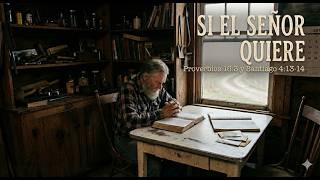
If the Lord Wills, We Will Live
Commit your works to the LORD and your plans will be achieved. — Proverbs 16:3
Come now, you who say, “Today or tomorrow we will go to this or that city, spend a year there, carry on business, and make a profit.” You do not even know what will happen tomorrow! What is your life? You are a mist that appears for a little while and then vanishes. — James 4:13-14

Author
Dr. Roberto Miranda
Summary: Surrendering to the Will of God means adopting an attitude of total subjection and always seeking His guidance. In James 4:13 onwards, James warns against Christians who live as if they are independent and rebel against God's Will. He urges them to adopt the correct attitude of total surrender, saying "if the Lord wills, we will live and do this or that." This level of surrender means acknowledging God's right to do whatever He wants in our lives, even if it means taking us prematurely. The believer's attitude should be one of total subjection and surrender to God's Will, always looking towards Him for guidance and protection.
The position of being totally surrendered to the Will of God, of being as slaves before the Father's designs has very practical implications that help us to frame in a more precise way the way in which we relate to God and the way in which we all interpret the events of our life in the light of the Lordship of God.
Here we have now, in James, another of those texts that invite us to see the practical implications of this position that the Lord tries to instill in us through His parable of the servant who, at the end of everything, after having done everything what his master asks of him must be considered as a useless servant, and we have said that what the Lord wants to establish in us is the attitude of always seeking the Will of God, always looking towards Him instead of looking towards us.
In James chapter 4, beginning with verse 13, we are going to see how by understanding this truth of the ultimate Lordship of God and the absolute subjection of the children of God, we can better understand passages like this one from James chapter 4:13 onwards. Santiago says: "Let's go now those who decide today and tomorrow we will go to that city, and we will be there for a year, and we will traffic, and we will win, when you do not know what will be tomorrow. Because what is your life? It is certainly a mist that appears for a little while and then it fades away; instead of which you should say: if the Lord wills we will live, and we will do this, and that. "
You see how in a very interesting way the apostle James is saying something very similar to what the parable of Jesus Christ implies. James implies those Christians, or so-called Christians, who even when they say that they have surrendered to God and His Will, in reality they live as if they were independent and think that they can do whatever they want.
Santiago asks: hey, you who are out there saying: tomorrow I'm going to get up and go to that city, and I'm going to buy this, and I'm going to sell the other thing, and I'm going to do what I determine, even when not. you are doing it from an open and obvious rebellious posture in reality ultimately that is what you are doing. They are asserting their independence from God and they are rebelling against the Will of God instead of adopting the correct attitude, which is one of total subjection and which is the attitude that a servant, a slave must adopt with respect to his master, which is the to say: if the Lord wants, that is, if Jesus Christ wants, we will live and do this or that.
Notice that first, the Lord Jesus Christ calls us in the parable doulos, servants, slaves, and that other parable that is assigned to Jesus Christ: kirios or kurios which is the word that is translated into Spanish: sir, the kurios is precisely The owner of the slaves is the boss, he is the one who totally commands the slave, and that is the title assigned to Jesus Christ. When we say: Lord to Jesus Christ we are saying: You are totally sovereign over my life.
When we say to Him: Lord Jesus Christ, we are saying to Him: We acknowledge You Lord the right to do whatever You want in our life. Then James says: "instead of saying: if the Lord wants to", and notice to the point that this attitude of surrender must reach, "if the Lord wants we will live"; In other words, it is God's business if today I am going to be alive or I am going to die, my level of surrender to God must reach that point, God has the right. If today He wants to take my life and bring me into His Presence, that is His business.
It is interesting that many times when we lose a loved one or something terrible happens, a child becomes ill or prematurely dies, or something that we love very much is taken away from us, we rebel against God, because how dare God take this away from me prematurely or how dares to send me a disease and take my life according to us prematurely? when the attitude should be: no, if God wants to do this in my life, I am subject to His Will.
Santiago invites us, instead of an attitude of implicit independence, one of absolute dependence on the Lord to the point of saying: Lord, what do you want me to do today, where do you want me to go, what decisions do you want me to make? my work, in my life? because after all, you are the one who has the total right to do whatever you want in my life.
And the Bible is full of invitations like this from the Apostle James to see ourselves as totally surrendered to the Will of God. We must always be looking towards the Father as that weaned child looks towards his mother to receive his food and to receive his protection, that is the attitude of greatness of the believer, that of total subjection and surrender to the Will of God.
In our next meditation we are going to go into another part that, as I said before, will actually invite us to see ourselves in a way that is almost contrary to that of being slaves, but that is totally complementary, and that these two attitudes should be the framework. within which our life moves, and we are going to see how interesting this topic is from a theological point of view. God bless you and until our next meditation.
What do you think?
What do you think about "If the Lord wills, we will live"?
Related Content
If the Good Lord Wills
Navigating Tomorrow: the Believer's Call to Dependent Planning
Proverbs 16:3 • James 4:13-14
The human experience is marked by a deep tension: we possess the capacity to envision and plan for the future, yet our existence is fragile and utterl...
The Architecture of Providence: a Theological and Exegetical Analysis of the Interplay Between Proverbs 16:3 and James 4:13–17
Proverbs 16:3 • James 4:13-14
1. Introduction: The Tension of Temporal Agency The human condition is defined by a paradoxical relationship with time. Consciousness allows humanity...
Read in Context
Click to see verses in their full context.
Song (Other Languages)